THE NIBBLE BLOG: Products, Recipes & Trends In Specialty Foods


Also visit our main website, TheNibble.com.

Give Dad A Pickle-Making Kit + Pickling Vs. Slicing Cucumbers

Is there a better gift for a pickle lover than an easy-to-make pickle kit?

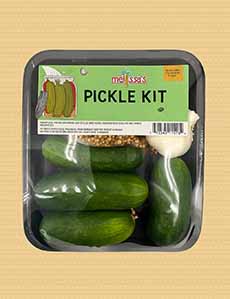
Whether for a first-time pickler or a seasoned pro, Melissa’s Pickle Kit (photos #1 and #2)makes it a snap (pun intended) to create crisp, tangy homemade pickles.

> The different types of pickles: a photo glossary.

> The history of pickles.

> How pickles are made.

Check below for:

> The difference between pickling cucumbers and slicing cucumbers (for eating fresh).

> International pickling spices you can use to customize your pickles.
 
 
QUICK HOMEMADE PICKLES

Ingredients

Each Melissa’s Pickle Kit includes:

  • Crunchy pickling cucumbers
  • A head of garlic
  • Melissa’s signature pickling spice blend
  •  
    You’ll also need:

  • Vinegar*
  • Water
  • Sugar
  • Optional ingredients to taste (e.g. fresh dill, crushed dried or chopped chiles)
  • A quart jar with tight lid
  •  
    Then follow the easy recipe using the QR code on the label, which will direct you to this:
     
    Preparation

    1. SLICE the cucumbers and place them in a 32 ounce glass Mason jar or other jar†.

    2. COMBINE 1 cup white vinegar and 1 cup water in a medium saucepan. Add 1 tablespoon Melissa’s Pickling Spices, 1 tablespoon salt and 2 tablespoons granulated sugar. Bring the mixture to a boil, stir, and reduce to a simmer for 5 minutes.

    3. REMOVE the pan from the heat and let the pickling liquid cool to room temperature. Then pour it into the jar with the cucumbers. Seal the jar and refrigerate for two hours.

    The pickles will be ready to eat, but you can keep them marinating for 2-3 weeks in the refrigerator (although some recipes mention that unopened jars will keep for 2 months.

    Once opened, it’s best to consume the pickles within a week or two and ensure they remain submerged in the brine.
     
     
    REUSE THE BRINE!

    Whether homemade or store-bought, pickle brine can be reused:

  • To pickle new vegetables—just add them to the jar.
  • In recipes, from marinades to sauces and dressings to dirty pickle Martinis.
  •  
     
    GET YOUR PICKLING KITS

    > Head to Melissas.com.
     
     
    THE DIFFERENCE BETWEEN PICKLING CUCUMBERS & SLICING CUCUMBERS

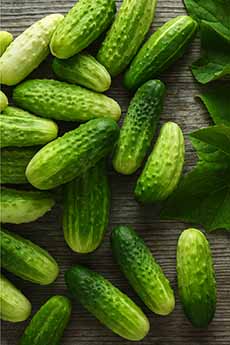
    Pickling cucumbers differ from slicing (or fresh-eating) cucumbers in several key ways that make them ideal for preserving through brining, fermentation, or vinegar pickling.

    They’re bred for durability, texture, and size consistency as preserved cucumbers. Slicing cucumbers, on the other hand, prioritize fresh flavor and appearance.

  • Pickling cucumbers are shorter (typically 3–6 inches), more uniform in size, and often slightly curved or blocky.
  • Slicing cucumbers are usually longer (6–10+ inches) and more tapered at the ends.
  •  
    Skin Texture

  • Pickling cucumbers have thinner, bumpy, often spiny or rough skin that absorbs brine better and retains crunch during pickling.
  • Slicing cucumbers usually have smoother, thicker skin that is sometimes waxed to extend shelf life.
  •  
    Interior Texture

  • Pickling cucumbers have fewer and smaller seeds, with denser, firmer flesh that stays crisp after processing.
  • Slicing cucumbers have more watery flesh and larger seeds, which can become soft or mushy when pickled.
  •  
    Flavor Profile

  • Pickling cucumbers tend to be less sweet and have a slightly bitter or astringent edge that pairs well with pickling spices.
  • Slicing cucumbers are milder and sweeter, better suited for fresh eating.
  •  
     
    HOW TO PICK A PICKLING PICKLE

    Even within the popular pickling varieties, there are reasons to choose one over another.

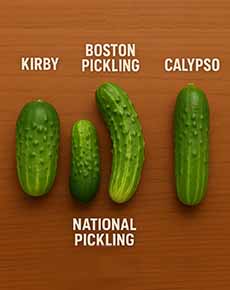
    Kirby Cucumber

    This variety is found at grocery stores and farmers markets. It’s an all-purpose cucumber, for fresh eating as well as for pickling.

  • Shape & Size: Short, blocky (3–4 inches), good for whole pickles.
  • Texture: Bumpy, crisp skin; very firm flesh.
  •  
     
    Boston Pickling Cucumber

    This heirloom variety has been popular since the 19th century, for making whole or sliced pickles.

  • Shape & Size: Uniformly short (3–6 inches), cylindrical.
  • Texture: Warty skin, tender but crisp.
  •  
     
    National Pickling Cucumber For Slicing Or Spears

    This variety was developed by the USDA for commercial production. It has prolific yields.

  • Shape & Size: Tapered ends, 4–5 inches long.
  • Texture: Slightly bumpy, thin skin.
  •  
     
    Calypso Cucumber>

    These are great for whole pickles or chips.

  • Shape & Size: Uniform, slightly longer (4–6 inches).
  • Texture: Bumpy, medium-thick skin.
     
     
    Bush Pickle Cucumber

    This variety is ideal for small gardens and containers. It is very productive on a small footprint.

  • Shape & Size: Small fruits (3–5 inches) on a compact plant.
  • Texture: Slightly bumpy.
  •  
    Are you ready to pickle? And if not, why not?
     
     
    INTERNATIONAL PICKLING SPICES

    The typical American pickling spice blend includes ingredients like allspice, bay leaf, coriander, cinnamon, cloves, dill seeds, mustard seeds, peppercorns, and red pepper flakes.

    Once you get into pickling vegetables of any kind, try some of these spices:

  • China: Szechuan peppercorns add citrusy heat and a tongue-tingling sensation.
  • Eastern Europe: horseradish root or leaves, pungent and spicy, are popular in Eastern European Jewish pickling but not typical in American blends.
  • India: fennel seeds add a licorice-like aroma and a slight anise flavor; fenugreek seeds add a bitter-sweet flavor with a maple aroma; ajwain seeds are intensely aromatic, thyme-flavored, and used in spice blends for pickled mango and lemon; asafoetida adds an intense umami and sulfur note; green mango powder (amchur) adds tangy depth.
  • Japan and Korea: shiso (perilla leaf) adds a grassy, minty, almost basil-like flavor. It’s often used in tsukemono (Japanese pickles).
  • Middle East: nigella seeds (kalonji), earthy, oniony, used in Middle Eastern pickled turnips and Indian achaar; sumac, tart, bright, and lemony, great in quick-pickled onions or turnips.
  • Southeast Asia: makrut lime leaves, highly aromatic and citrusy and common in Thai-style pickles; tamarind, sour and fruity.
  •  
     
    ________________
     
    *While distilled white vinegar is used to pickle because it is the cheapest, if you have flavored vinegars you’d like to use up, feel free to do so.

    †Since these are refrigerator pickles a.k.a. quick pickles, they will be pickled and can be consumed within hours. They will not need to be stored in shelf-stable jars.


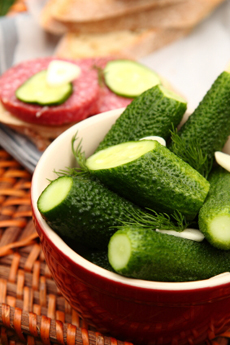
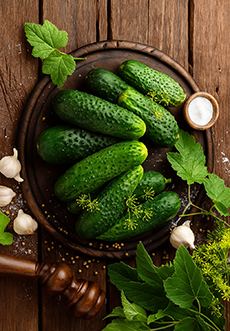
    A Bowl Of Homemade Pickles
    [1] How about making some pickles (photo © Iryna Melnyk | iStock).

    Pickle Making Kit
    [2] Inspire someone to make these refrigerator pickles. They’ll be ready in an hour or two (photos #1 and #2 © Melissa’s Produce).

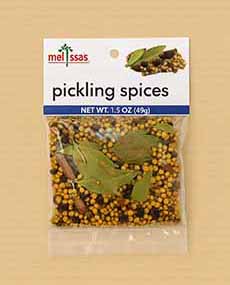
    Package Of Pickling Spices
    [3] Classic pickling spices include allspice, bay leaf, black pepper, cinnamon, coriander, and mustard seed, plus garlic (which is neither spice nor herb but a root vegetable). But there are many other options; see them below.

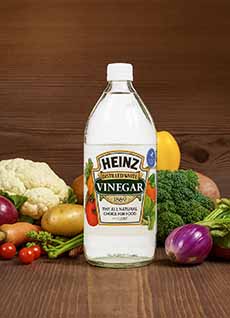
    A Bottle Of Heinz Distilled White Vinegar
    [4] White vinegar is used for pickling as it’s the least expensive. But if you want to use flavored vinegar, go for it (photo © Heinz).

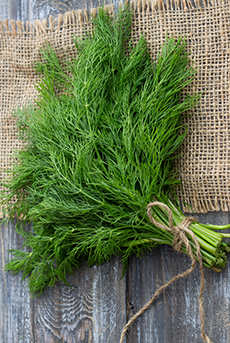
    A Bunch Of Fresh Dill
    [5] We personally find fresh dill a “must” in pickled cucumbers (photo © RE Farm Cafe | Windswept Farm).

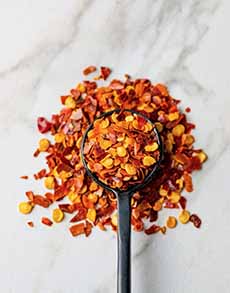
    A Spoon Of Crushed Red Pepper Flakes
    [6] If you like spicy pickles, add crushed red pepper flakes to the pickling spices (photo © Savory Spice Shop).

    Pickling Cucumbers
    [7] A comparison of top pickling cucumbers (photo by Chat GPT 2025-05-30).

    Boston Pickling Cucumbers
    [8] Grow your own Boston pickling cucumbers. Get the seeds here (photo © Annie’s Heirloom Seeds).

    Bush Pickle Cucumbers
    [9] You can easily plant these bush pickle cucumbers. Buy the seeds here (photo © My Seeds).


    CHECK OUT WHAT’S HAPPENING ON OUR HOME PAGE, THENIBBLE.COM.


    Comments off

    Exotic Burgers To Consider For National Hamburger Day

     
    Black Scorpion Burger
    [1] Black Scorpion Burger: a grass-fed beef burger topped with a black scorpion, giant waterbug tamarind sauce, and fresh leaf lettuce (photo © WRAL-TV; all other photos © Bull City Burger & Brewery).

    Kangaroo Burger
    [2] Kangaroo Burger topped with chimichurri sauce and fresh leaf lettuce, served on a house-baked salted bun.

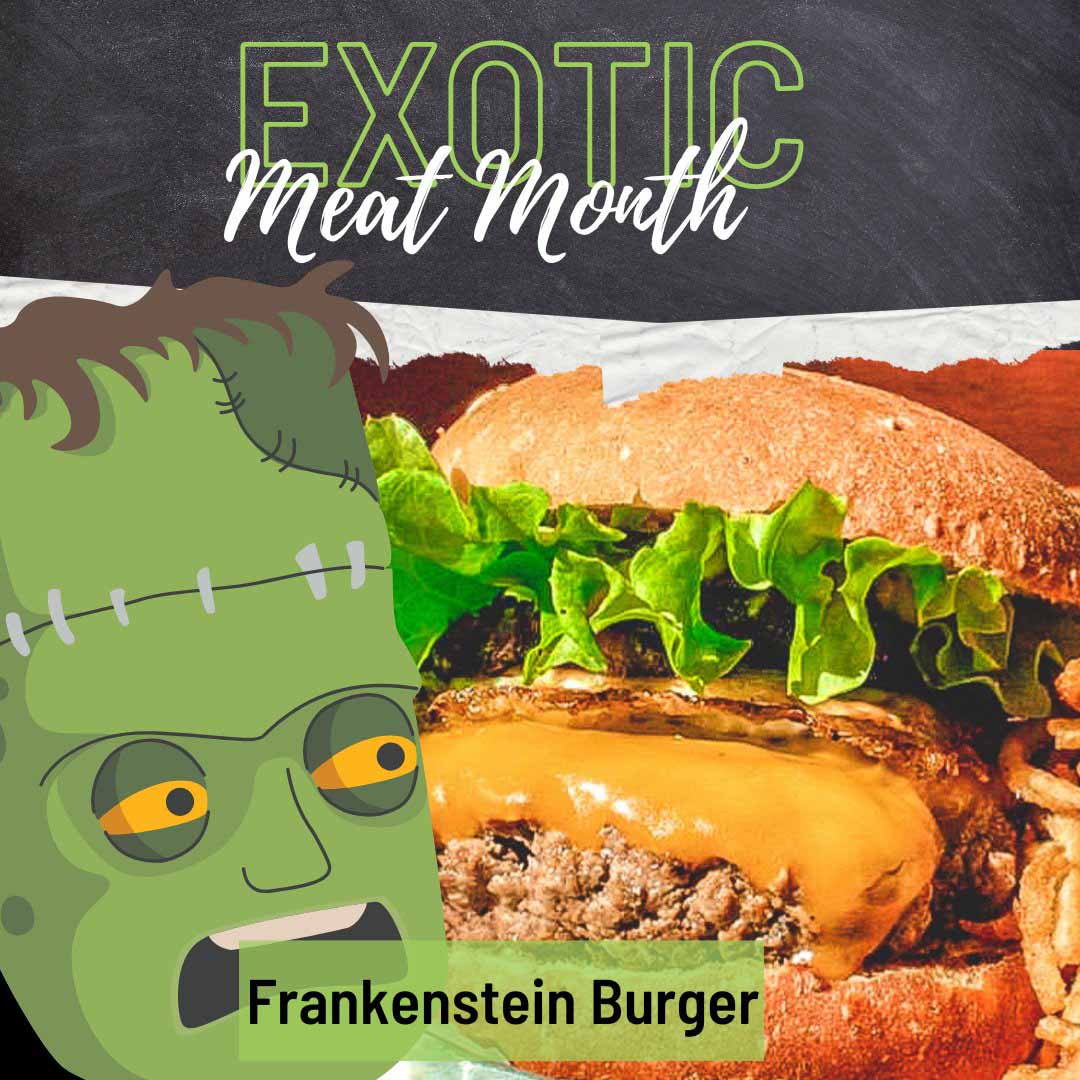
    Frankenstein Burger
    [3] Frankenstein Burger 6 oz. Patty made with ostrich, emu, turkey, and yak, topped with honey bourbon pickled jalapeños and fresh leaf lettuce, served on house-baked spinach and sesame seed bun.

    Ostrich Burger
    [4] Ostrich Sausage Scotch Egg Burger: grass-fed beef burger topped with an ostrich sausage Scotch Egg, lettuce, shaved red onions, and spicy beer mustard.


    Bull City Burger and Brewery in Durham, North Carolina celebrates their Exotic Meat Month each April, with exotic meat burgers all month long.

    If this sounds good to you, Durham is a lovely place to visit in April. Start planning your trip!

    Throughout the month different types of exotic burger meat are featured, rotating daily depending on the scarcity of each particular meat.

    Given how burger-crazy Americans are, maybe that’s why there aren’t exotic burger festivals everywhere.

    Bull City Burger embodies the farm-to-fork philosophy. So which farms do those alligator, caribou, iguana and python burgers come from?

    The restaurant works for months to source exotic meats for the month-long celebration. Some of the meats are so difficult to get, there are as few as twelve burgers available.
     
     
    WHAT’S ON THE MENU

    From A to Z, in the four years of the festival they’ve served alligator, antelope, bear, bison, bugs, camel, duck, elk, emu, escargot, frog Legs, hare, kangaroo, moose, ostrich, python, rabbit, reindeer, scorpion, squirrel, tarantula, turkey, turtle, wild boar, and yak.

    Not all are available each year.

    Some, like bison burgers, have become pretty mainstream and won’t intimidate anyone. Others are only the most adventurous and daring of eaters.

    (We’re still creeped out over watching Al Roker eat tarantula-on-a-stick, a common Chinese street food, at the Beijing Olympics.)

    There are shirts with the event motto, “I never met a meat I wouldn’t eat.” Eat six exotic burgers and its free.

    And there’s dessert: Dark Chocolate Bug Bark, house-made chocolate loaded with a mix of crispy, crunchy bugs (including, but not limited to, ants, crickets, and mealworms).

    It’s available as a candy bar-size serving or as a topping option for their homemade ice cream.

    Bull City Burger’s year-round menu is either made from scratch or bought locally.

    They grind North Carolina pasture-raised beef daily, make their own buns, make the mustard, the mayo, the bacon, and the pickles, and stuff their all-beef hotdogs.

    Everything is all-natural: no corn syrup, no added hormones, no antibiotics.

    > Here’s more about Exotic Meat Month. 
     
     
    HAVE YOUR OWN EXOTIC BURGER FESTIVAL!

    Wild Fork Foods sells ground bison, boar, elk, kangaroo, ostrich, venison, and yak.

    They’re all heart healthy: very lean and high in protein.
     
     
    Why is Durham, North Carolina called “Bull City?”

    It was the home of the Blackwell Tobacco Company, that produced tobacco from the 1850s through 1988. They named their tobacco brand “Bull Durham.”

    The name and the image of a bull became synonymous with the city, and the nickname “Bull City” stuck.
     
     
    > The history of the hamburger.

    > 35+ hamburger recipes.

     
    Exotic Burgers
    [5] A trio of exotic sliders: camel with cactus salad, elk with chimichurri, and yak with garlic aïoli.


    CHECK OUT WHAT’S HAPPENING ON OUR HOME PAGE, THENIBBLE.COM.


    Comments off

    Peanut Butter & Jelly Ice Pops Recipe For Grape Popsicle Day

    We’d like to add some excitement to National Grape Popsicle Day, May 27th. How about this recipe for Peanut Butter & Jelly Ice Pops?

    (Note: Popsicle® is a trademarked term of Unilelever. Everything else is an ice pop. Creamsicle®, Fudgsicle® and any other -sicle® suffix are covered by the Trademark.)

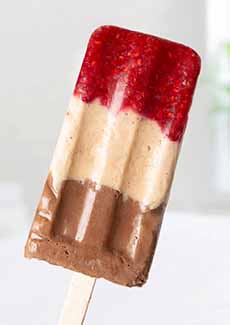
    In this three-layer pop, the peanut butter and jelly layers are joined by a layer of peanut butter chocolate—although if you want, you can do two layers of regular PB and one of jelly instead.

    And while the original recipe creates the yogurt-jelly layer with raspberries, you can use grapes (or any other mashable fruit, from other berries to bananas).

    > The history of ice cream.

    > The invention of ice pops.

    > The different types of frozen desserts: a photo glossary.

    > The year’s ice cream holidays.

    > The history of peanut butter.

    > The history of jelly.
     
     
    RECIPE: 3-LAYER PEANUT BUTTER & JELLY ICE POPS

    Thanks to Peanut Butter & Co. for this delicious recipe.

    Prep time is 15 minutes plus freeze time.

    You’ll need:

  • An ice pop mold that can be filled from the top
  • Or, paper cups plus ice pop sticks
  •  
    Ingredients For 6 Ice Pops

  • 1/2 cup Peanut Butter & Co. Smooth Operator (or substitute)
  • 1/2 cup Peanut Butter & Co. Dark Chocolatey Dreams (or substitute)
  • 1 tablespoon cocoa powder
  • 1/2 cup plain or vanilla Greek yogurt, divided
  • 1 pint fresh raspberries, washed and patted dry
  •  
    Preparation

    1. PLACE the raspberries in a small bowl and smash with a fork until they resemble jam. Set aside.

    2. COMBINE 1/4 cup of Greek yogurt and the smooth peanut butter in a small bowl. Set aside. In another bowl…

    3. COMBINE combine the remaining 1/4 cup of Greek yogurt, the chocolate peanut butter, and the cocoa powder. Set aside.

    4. POUR the smashed raspberries into the ice pop mold, filling each cavity 1/3 of the way. Freeze for one hour.

    5. REMOVE the mold from the freezer and pour in equal amounts of the smooth peanut butter/yogurt mixture on top of the raspberry layer, filling each cavity so that 1/3 of the space still remains. Freeze for one hour. 

    6. REPEAT with the chocolate peanut butter mixture. If your molds do not include tops with sticks, place a stick into each pop.

    7. FREEZE overnight for best results, although they may be ready in 1-2 hours.


    Peanut Butter & Jelly Ice Pop
    [2] Yummy, yummy: Peanut butter, jelly, and chocolate in one ice pop (all photos © Peanut Butter & Co.).

    Smooth Operator Peanut Butter
    [2] One of so many great flavors, Smooth Operator is the classic creamy PB.

    Jar Of Chocolate Peanut Butter
    [3] Chocolate peanut butter creates the bottom layer.

     
    Peanut Butter & Jelly Ice Cream Pops
    [4] Have an ice pop party!


    CHECK OUT WHAT’S HAPPENING ON OUR HOME PAGE, THENIBBLE.COM.


    Comments off


    © Copyright 2005-2026 Lifestyle Direct, Inc. All rights reserved. All images are copyrighted to their respective owners.