THE NIBBLE BLOG: Products, Recipes & Trends In Specialty Foods
Also visit our main website, TheNibble.com.
|
September 7, 2011 at 7:40 am
· Filed under Bread-Crackers-Sandwiches, NutriNibbles-Organic-Health, Organic
|
|
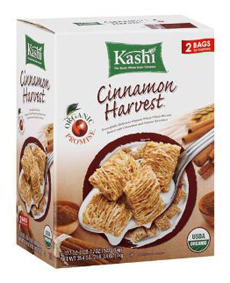
Crunchy nuggets with a cinnamon blush.
Photo courtesy Kashi Company.
|
|
Our grandfather loved Post Shredded Wheat, and we came to love it too—despite the fact that his daughter (Mom) didn’t like it and wouldn’t keep it in the house. So when we went to Grandpa’s, our treat was getting to eat as many bowls of it as we could.
When we left for college, Shredded Wheat became a go-to comfort food, standing in for many a dinner as well as breakfast.
Today we know that Shredded Wheat and similar boxed cereals are whole grain powerhouses. When we saw that Kashi Company’s Autumn Wheat contained 50g of whole grains—even more than the recommended daily value—we switched brands and started each day with a bowl of Kashi. (The flavor is better, too.)
Now the Kashi Company, known for its tasty organic cereals, has launched Cinnamon Harvest: crunchy, bite-size whole wheat biscuits splashed with ground cinnamon and organic evaporated cane juice crystals.
|
Just one serving contains 47g of the 48g recommended daily value (DV) of whole grains, and 20% of one’s daily fiber.
It’s a great snacking cereal, too, and is also available in Island Vanilla, made with finely-ground vanilla beans.
Why Is Whole Grain So Important?
Our article on whole grain cereals explains all.
|
|
|
Permalink
|
|
September 6, 2011 at 7:45 am
· Filed under Honey-Sugar-Syrup, Tip Of The Day
|
|
Our last tip for National Honey Month is courtesy of Ford’s Honey Farm in Newport, New York. How many ways can you enjoy honey?
FAVORITE NEW USE
Poke a hole in the center of a warm biscuit. Fill the hole with honey and enjoy with meals or as a snack.
Consider using hot honey!
TRIED & TRUE USES
Breakfast
Drizzle over yogurt and granola
Mix with butter for a honey butter spread
On bread or toast, English muffins or bagels
On French toast, pancakes or waffles
Over cold or hot cereal
In hot drinks: coffee, hot chocolate, tea
Lunch & Dinner
As a glaze
Drizzled over sweet potatoes or carrots
With the bread basket, in addition to, or instead of, butter
Dessert
Drizzle over ice cream and frozen yogurt
In cakes, pies and cookies, instead of sugar
In the center of a baked apple
Snacks
As a dip for fruit (apples dipped in honey are a favorite)
In iced tea
In smoothies and shakes
Mixed with peanut butter as a spread
Right off the spoon, when you need a sweet treat
Other favorite uses? Tell us!
TYPES OF HONEY
Types of honey based on processing techniques
The different forms of honey
How many monofloral honeys have you tried? There are numerous different types.
CHECK OUT WHAT’S HAPPENING ON OUR HOME PAGE, THENIBBLE.COM.
|
|

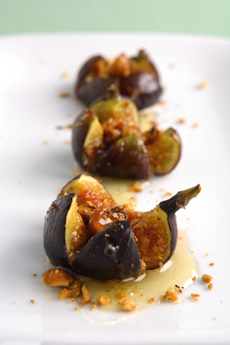
[1] Drizzle honey over fruit, such as roasted figs or fresh-cut apple slices (photo © Scott Karcich | iStock Photo).
[2] Add honey to your smoothie, drizzle it over ice cream and berries (photo © National Honey Board).
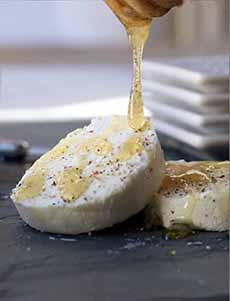
[3] One of our favorite treats: goat cheese and honey (photo © Belle Chevre). |
|
|
|
|
Permalink
|
|
September 6, 2011 at 7:12 am
· Filed under Recipes, Vegetables-Salads-Herbs
|
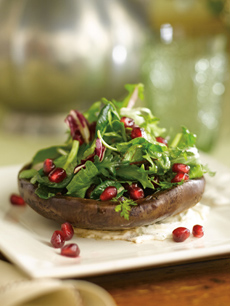
Beautiful and delicious: grilled portabella
photo and recipe courtesy
PomWonderful.com. |
|
One popular mushroom, Agaricus bisporus, is known by quite a few names. But a portabella by any other name is still one of the tastiest mushrooms around (not to mention, the largest cultivated mushroom).
When young, the mushroom has a closed cap and is known as a crimini or brown mushroom, and can be used in the same way as a white button mushroom (but the crimini is much tastier).
When mature, with the gills exposed, the mushroom is called a portabella. (Additional names for the portabella include Italian mushroom and Roman mushroom, among others.)
The cap averages 4 to 5 inches in diameter, larger than a burger. The mushroom can grow up to 8 inches in diameter—an inch larger than a salad plate.
One of the nicest features of the portabella is its thick cap, the thickest in the mushroom world. This feature provides a unique meatiness—both in texture and flavor—and grilled portabellas are often enjoyed as a stand-in for meat in vegetarian dishes.
|
|
Due to the popularity of the species, smaller strains of Agaricus bisporus with darker flesh were bred and are sold as baby portobello, baby bella, crimini, mini bella and portabellini mushrooms.
Now for the spelling:
Is it portabella, portobella or portobello?
All three spellings are correct, with portobello being the most common. Call them whatever you want: Just call them for dinner!
This recipe, by chef and restaurateur James Boyce, makes a beautiful presentation as a first course or a light lunch entrée.
The grilled portabella is filled with herbed salad and rests on a bed of baked goat cheese.
How many types of mushrooms have you tried? See our Mushroom Glossary.
|
|
|
Permalink
|
© Copyright 2005-2026 Lifestyle Direct, Inc. All rights reserved. All images are copyrighted to their respective owners.