|
What are the “mother sauces?” Today’s tip, from chef Johnny Gnall, explains them and sets you on the path to making each one. This article continues with part 2, the secondary sauces made from the mother sauces. If you have questions or suggestions for tips, contact JohnnyGnall@hotmail.com.
When Georges Auguste Escoffier* laid the foundation for French cooking that would become so significant for modern cuisine, a cornerstone of that foundation was what he called the “mother sauces.”
These five sauces are the basis for virtually every sauce in Escoffier’s arsenal, and their applications are no less relevant today.
If you can perfect the five mother sauces, you can take them in any flavor direction you choose, from Asia to Africa to Scandinavia, simply by adjusting the flavors and seasonings you choose to add to them. The techniques are classic French, but the sauces themselves are versatile enough to work with whatever you’re cooking for dinner.
Each mother sauce is comprised of two basic parts: a liquid and a thickening agent. Each sauce has its variations and additional ingredients, but the liquid and thickener are the important parts. So without further ado, allow me to introduce the five mother sauces.
________________
*Escoffier, 1846-1935, was one of the most important figures in the development of modern French cuisine. A chef, restaurateur and culinary writer, Escoffier simplified and modernized the ornate haute cuisine style of the great French chef Antoine Carême (1784-1833). Escoffier’s book, Le Guide Culinaire, is still used as a major reference work by chefs and culinary students.
________________
1. TOMATO SAUCE
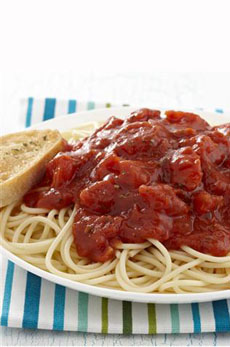
Tomato sauce (photo #2) is is probably the most familiar of the mother sauces, and one you have eaten with pasta or meatloaf more than a few times. To make it:
Begin by rendering 4 ounces of salty cured pork: bacon, pancetta, pork belly, whatever you have to work with. (You can skip this step and use olive oil to eliminate calories and cholesterol, but you won’t get the same roundness and depth of flavor in the finished product.)
Once the pork is rendered and crispy, add 2 cups of diced carrots and onions, season with salt and pepper, and sweat them until soft. Add a quarter cup of flour and stir to incorporate until you have a roux† consistency (see thickeners).
|
|

[1] Eggs Benedict topped with hollandaise sauce (photo © American Egg Board).
[2] Perhaps the most popular of the mother sauces in American cuisine: tomato sauce (photo © McCormick).
|
|
Next, add a quart of chopped tomatoes, a quart of water, and a tablespoon of tomato purée, then stir and simmer.
The seasonings vary depending on whom you ask, but they usually include some combination of bay leaf, garlic, oregano, thyme or other herbs, plus some sugar (though purists may argue staunchly against this). Don’t forget to season your sauce with salt and pepper as you go, and taste it often as it simmers. If it needs more of something, add it!
________________
†A roux, pronounced rue, is a paste made of softened butter and flour that is used to thicken sauces, soups, stews and ragouts.
________________
|
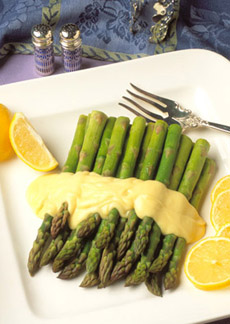
[3] Asparagus with hollandaise sauce (photo © American Egg Board).
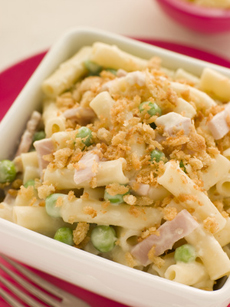
[4] Rigatoni with béchamel sauce and breadcrumbs (photo Monkey Business | Fotolia).
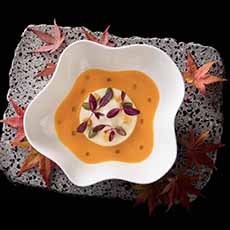
[5] Velouté is a mother sauce that is also served as a rich soup. Here, a butternut squash velouté from Joel Robuchon (photo © L’Atelier Joel Robuchon NYC). |
|
2. HOLLANDAISE SAUCE
You may know it best from Eggs Benedict at Sunday brunch (photo #1), but hollandaise (HOLL-un-days) is actually the basis for a number of sauces, Béarnaise being one of the more notable. As it is egg-based, it’s definitely the richest of the mother sauces, which also seems to make it the most luxurious. Hence, it is a favored presence in lavish or celebratory dishes.
To start, put together a double boiler, or bain-marie, by setting a metal bowl over a pot half full of water, set to a simmer (not a boil). The steam from the simmering water heats the bowl gently, allowing you to cook the eggs more slowly and carefully than you’d be able to do over a direct flame. If specificity is your thing, hollandaise is best cooked at just under 160°F; but as long as you use a bain marie, you don’t have to measure the temperature so precisely.
Combine 4 egg yolks and 2 ounces of white vinegar in the bowl and whip with a wire whisk until the eggs reach the “ribbon stage.” This means that when you pull your whisk out of the whipped yolks, they should fall back into the bowl in a smooth, gentle stream to form a temporary pile of what actually looks like ribbons (sort of like a good cake batter).
Once you have achieved ribbons in the yolks, it’s time to start adding the butter. Clarified butter is ideal, but not necessary; just make sure it’s melted, smooth, and warm but not hot (around 130°F). Then, start drizzling it in a few drops at a time, whisking as briskly as possible. Once you begin to have a thickened, velvety sauce, you can add the butter more quickly. But early on in the emulsification process the consistency is relatively fragile, and adding too much butter too fast will cause the sauce to break. If the eggs start to pull away from the sides of the bowl, it means that things are getting too dry: Take the sauce off the heat for a moment and whisk in a few drops of warm water until your sauce is rehydrated.
When you’ve added the last of the butter (feel free to leave a bit behind if you reach a thickness and consistency you’re happy with), season with salt, white pepper, hot sauce (like Tabasco) and lemon juice, in scant amounts of each or to your liking. Poach a couple of eggs and toast the English muffins and it’s Benedict time! (Try these recipes for Portabella Eggs Benedict and Corned Beef Hash Eggs Benedict.)
3. BÉCHAMEL SAUCE
A common start to many favorite cream soups, a béchamel (BAY-sha-mell) is relatively easy sauce to make.
Start with a half cup of butter and a half cup of all-purpose flour; incorporate the two together by stirring continuously over medium heat with a rubber spatula to make a white roux.
In a separate pot, heat a cup of milk with half an onion and a bay leaf; when it begins to simmer, whisk the heated milk into the roux until combined smoothly.
Let the sauce simmer, very lightly, for ten to fifteen minutes on low heat, then season with just a touch of nutmeg, salt and white pepper. Even the tiniest bit of nutmeg works brilliantly to complement the subtle sweetness of the milk; the flavor profile of this Mother Sauce has more complexity than you’d expect.
|
|
4. VELOUTÉ SAUCE
The simplest of the mother sauces, a velouté (vuh-loo-TAY) is a common start to dishes involving more delicate flavors and ingredients. If you’re eating fish with a sauce that’s not some variation of a buerre blanc, it’s likely that sauce started with a velouté.
Start by making a roux, just as with béchamel; then whisk in a white stock (usually meaning a stock with a base of chicken or fish, as opposed to beef, veal, etc.) until you reach creamy consistency.
Thickness and seasoning vary based on who’s cooking, but a neutral velouté typically contains no more than a pinch of salt and is the approximate consistency of whipping cream (in its natural, unwhipped state).
Aim to base your white stock on the protein with which you plan to pair your finished sauce. So if you’re serving chicken, make a velouté out of chicken stock; with fish, use fish stock.
5. ESPAGNOLE SAUCE
Though also often called simply ”brown sauce,” espagnole (ESS-pon-yole) allegedly earned its name when Spanish cooks added tomatoes to a French veal-based sauce, and the improvement stuck. While it is slightly more complicated, espagnole sauce incorporates several of the procedural steps from previous mother sauces.
Espagnole begins with a mirepoix,‡ almost as if you’d skipped the salt pork step in the tomato sauce. The difference here is that the fat is butter (about 4 tablespoons per cup of diced mirepoix), and you should cook it over higher heat to give the mirepoix some color. Once it’s soft and getting brown, add flour (an amount roughly equal to the butter), stirring to incorporate until you have a roux consistency. Get the roux a few shades browner, and you have your base.
Now that you’ve achieved a dark mirepoix/roux mixture, whisk in a brown/dark stock, like beef or veal stock, exactly as in the procedure for velouté. Add some tomato paste (about a tablespoon per cup of mirepoix) and season with bay leaf, salt and pepper.
Let it all simmer for a while to break down the vegetables and let the flavors come together.
Espagnole is an ideal start for meaty gravies and can get quite rich the longer it cooks, due to the gelatin in the stock. Feel free to add water if your sauce gets too low or too thick for your liking, or you want to cook it for longer to extract more flavor.
________________
‡Pronounced MEER-uh-PWAH, a combination of carrots, celery and onions.
________________
WHAT NEXT?
These five sauces are the basis of literally hundreds of variations, so it’s worth it to take the time to master them. Be patient as you cook them and pay attention to how they react during different steps, as this will give you clues on how to fix them if they aren’t coming along the way you expected.
If your hollandaise breaks, for example, you can start it over and use the broken sauce in place of the original melted butter, adding it to new yolks. Just make sure to add it even slower at the beginning and whisk it even faster.
Once you feel completely comfortable with these five “mothers,” it’s time to start adding ingredients, both to replicate classic sauces and to create new ones that reflect your interests. Add cheese to béchamel and It’s a mornay, a classic sauce.
But what if you decide to add adobo chiles or chipotle paste to a béchamel?
The sky’s the limit.
CONTINUE TO PART 2, THE SECONDARY SAUCES
Tomato sauce becomes Creole sauce, hollandaise becomes béarnaise and other transformations, here.
|
|