THE NIBBLE BLOG: Products, Recipes & Trends In Specialty Foods


Also visit our main website, TheNibble.com.

TIP OF THE DAY: Track Down Or Whip Up Some Malaysian Food

It’s both easy and hard to describe Malaysian food. It’s a culinary adventure: a blend of Chinese, Indian and native Malay cuisines, sprinkled with Middle Eastern, Portuguese and Southeast Asian influences including Thailand, its neighbor to the north.

The cuisine represents the peoples who populate Malaysia, and those traders who passed through, dating back to the 15th century and earlier.

It’s an exciting cuisine: Whatever recipe you cook (or order), it’s delicious. The seasonings that make the meats, noodles, seafood and vegetables taste so special include banana leaf, bean sprouts, belacan (dried shrimp paste), coconut cream and coconut milk, curry leaf, galangal, kaffir lime leaf, laksa leaf,* lemongrass, tamarind and sesame oil. Spices include cardamom, clove, coriander, cumin, fenugreek, shallot, star anise and turmeric.


The two parts of Malaysia—peninsula and island—are highlighted in green. Map courtesy Wikimedia.


Unfortunately, there’s far too little Malaysian cuisine in the U.S. Chinese, Japanese, Thai and Vietnamese restaurants are represented in most big cities, but Malaysian eateries remain a trend waiting to happen. Perhaps that’s because most of us couldn’t pinpoint Malaysia on a map. So here it is in the map above: the two land masses highlighted in green.

Malaysia is a constitutional monarchy in the middle of Southeast Asia, separated by the South China Sea into two regions, Peninsular Malaysia and East Malaysia (Malaysian Borneo). Peninsular Malaysia is immediately south of Thailand; the island shares borders with Indonesia and Brunei. The major cities and most of the population are on the peninsula, including the capital city, Kuala Lumpur, Malacca and Penang.

India lies west, across the Bay of Bengal. Malacca, a port on the west coast, was the center of the 16th century spice trade, attracting British, Dutch and Portuguese traders.

 
*Laksa is a fragrant herb with an intense lemony flavor and hints of eucalpytus, used in Malaysian stews.
 
THE DELIGHTS OF MALAYSIAN CUISINE

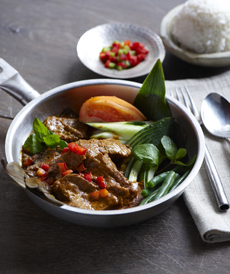
Highlights of Malaysian cuisine include rice- and noodle-based dishes, curries and stews, and Indian-style breads. The “national dish” is nasi lemak: a rice dish steamed with coconut milk and local herbs (ginger, lemongrass and pandus leaf) and served with with fried anchovies, peanuts, sliced cucumber, hard-cooked eggs and sambal, a spicy chile paste. A curry or a spicy meat stew (rendang—see photo below) can be added for a more substantial meal.


Beef rendang, one of Malaysia’s most popular
dishes. Photo courtesy Tourism Malaysia.
  But why talk about the food, when the Malaysian government has done such a good job of promoting it with photos and recipes?

MalaysiaKitchenNYC.com is a lovely website that explains the cuisine while providing lots of recipes. This week the home page features an exotic dish, ais kacang or air batu campur (literally, “red bean ice”).

It’s a dessert: a brightly-colored dish made with different flavored syrups, jellies and dressings on a base of cubes of agar agar and cendol, grass jelly, palm seed, red beans, sweet corn, form the base. It’s a popular treat at Malaysian coffee shops and food courts.
But don’t be spooked by the unfamiliar: Make the featured recipe of the week, beef short ribs rendang.

 
If you have access to an international food market, you may be able to find all the ingredients you need to create a memorable Malaysian dinner. You can also get like-minded friends in on the action, and have everyone prepare a different dish.

FIND A MALAYSIAN RESTAURANT

There is a scattering of Malaysian restaurants in California, Connecticut, New Jersey and New York City: Use this Malaysian restaurant locator to find the ones nearest to you.

CULINARY TRAVEL

Tourism Malaysia has developed culinary tours to highlight this beautiful country and its cuisine. Check with your travel agent or the two Tourism Malaysia offices in Los Angeles and New York City: TourismMalaysia.com.
  

Comments off

PRODUCT: Sparkling ICE Calorie-Free Soda


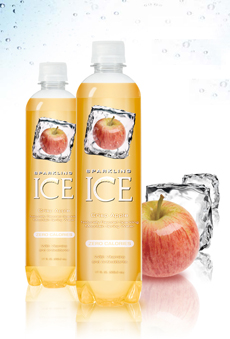
Crisp Apple Sparkling ICE, calorie-free, is a delicious substitute for sparkling cider. Photo courtesy Talking Rain Beverage Company.
 

Sparkling ICE is a line of zero-calorie soft drinks—the company calls them flavored sparkling waters (*see the footnote below for the difference between soda and flavored sparkling waters—produced by Talking Rain Beverage Company of Preston, Washington. Located in the foothills of the Cascade Mountains, the source water is from a pristine artesian spring that originates in the Cascades.

The sweetener is sucralose, the generic form of Splenda. The line is enhanced with vitamins and antioxidants. Perhaps it’s the mountain spring water, along with natural flavors, that has created such charming tastes.

Spakling ICE is made in Black Raspberry, Coconut Pineapple, Kiwi Strawberry, Lemonade, Lemon Lime, Orange Mango, Peach Nectarine, and Pink Grapefruit.

But for us, the star is Crisp Apple, which has the flavor of sparkling cider. We had to check the label to be sure it really was zero calories. What a great way to enjoy the taste of a crisp apple!

Whether you want an apple or an Appletini, spare the calories and start with a bottle of Crisp Apple Sparkling ICE.


You can check the store locator on the Sparkling ICE website, or head to Amazon.com, where all the flavors are sold.

We’d prefer a case of Crisp Apple Sparkling ICE to most of the gifts we tend to receive. Friends and relatives, please take note!
THE DIFFERENCE BETWEEN SODA AND FLAVORED, SWEETENED SPARKLING WATER

Sparkling water is water that is carbonated, a process discovered in 1767 by an English chemist, Joseph Priestley. Swedish chemist Jöns Jacob Berzelius added flavors (spices, juices and wine) to carbonated water in the late 18th century. This led to the evolution of soda fountains in pharmacies.

In the early 19th century, American pharmacists added birch bark, dandelion, fruit extracts, sarsaparilla and other flavorings to the sparkling water, which was called “soda water” because it is made by infusing with carbon dioxide gas and bicarbonate of soda (sodium bicarbonate, or baking soda) a stabilizing element.

Soda fountains became ingrained in the popular culture—like today’s coffee bars—with many Americans frequenting the soda fountain on a daily basis (source: Wikipedia). In the 1970s, unsweetened, flavored sparkling water appeared: club soda, mineral water and seltzer. These bottled drinks are differentiated from sodas by their lack of added sweetener.

There are different types of bubbly—fizzy-sparkling water:

  • Carbonated water is a broad term that encompasses all fizzy waters. The term is used interchangeably with sparkling water and soda water.
  • Club soda has a pinch of salt added to it. It can be sodium chloride (table salt), sodium bicarbonate or potassium bicarbonate.
  • Seltzer is totally salt-free, the sodium bicarbonate is left out. Seltzer is what you get when you carbonate water at home with a Sodastream or other device.
  • Mineral water is something completely different: It’s plain water with a sufficient level of dissolved minerals to differentiate it from spring water. See our Water Glossary for the different types of water.
  •  
    So what’s the difference between soda and flavored sparkling water? Soda (not club soda) is sweetened, flavored carbonated water; “flavored sparkling water” is sweetened flavored carbonated water; it can also be flavored and unsweetened, in which case it is also called flavored club soda.

    In sum, soda and flavored sparkling water are the the same thing.
    FIND MORE OF OUR FAVORITE SOFT DRINKS.


    Comments off

    ACADEMY AWARDS RECIPE: Oscar Statue Cookies

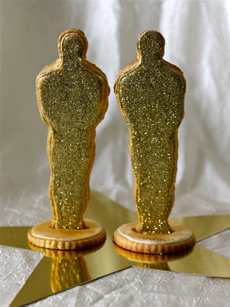
    You’ve got plenty of time between now and Sunday night to bake a batch of these impressive Oscar statuette cookies, developed by Lauryn Cohen of BellaBaker.com.

    You don’t even have to buy an Academy Award-shaped cookie cutter: Here’s a free downloadable Oscar cookie template and circle for the statuette base..

    The recipe makes approximately two dozen coookies.

    ACADEMY AWARD (OSCAR STATUETTE)
    COOKIES RECIPE

    Ingredients

  • 2 cups all purpose flour
  • 1 teaspoon baking powder
  • 1/2 teaspoon salt
  • 1 cup sugar
  • 1 stick (8 tablespoons) unsalted butter
  • 1 egg
  • 1 egg yolk
  • 2 teaspoons pure vanilla extract
  •  


    Everyone wins with an edible Oscar. Photo courtesy BellaBaker.com.

     
    Preparation For Dough

    The dough can be made in advance and kept in the refrigerator for up to 4 days.

    1. WHISK flour, baking powder and salt together in a small bowl.

    2. COMBINE cream butter and sugar together in the bowl of a stand mixer and mix on medium speed for 2-3 minutes, until mixture is pale and blended.

    3. ADD eggs, one at a time, mixing until eggs and extra yolk are fully incorporated into sugar mixture. Add vanilla extract and beat. Reduce mixer to low and add flour mixture, a little at a time, until dough is fully combined, taking care not to over-mix.

    4. DIVIDE into two disks and wrap in plastic. Refrigerate dough for at least one hour, or preferably 2 to 3 hours.


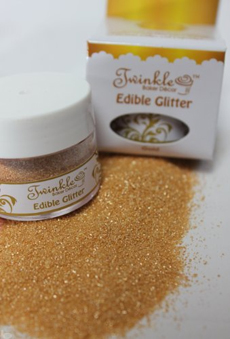
    Coat the royal icing with edible gold glitter:
    You’re ready to hand out the awards! Photo
    courtesy The Baker Shop.
     

    Preparation For Baking

    1. PREHEAT oven to 350°F. Remove dough from the refrigerator and let it sit for a minute or two so it is easier to roll out.

    2. PLACE dough between two sheets of parchment paper and roll out with a rolling pin to approximately 1/8″ in thickness.

    3. CUT out statuette and circles with cookie cutter or template, and place on a baking sheet lined with parchment paper. If you are using the template, simply place it on top of dough and cut around it with a sharp knife. You may already have a 2.5″ diameter circle cookie cutter for the base. If not, look for a small cup or glass to use in its place.

    4. CUT slits into the middle of the circle cookies that are big enough to fit the base of the Oscar cookies. Bake 10-11 minutes, or until cookies are just starting to become golden in color around the edges. Remove from oven, and if the slit in the circle cookies has filled in during baking, use a sharp knife to re-cut the slit before the cookie cools.

     
    ROYAL ICING RECIPE

    Ingredients

  • 4 cups powdered sugar
  • 2 tablespoons meringue powder
  • 6 tablespoons water
  • Edible gold glitter (if you can’t get the glitter, you’ll still have gold-tinted icing)
  • Small paint brush
  •  

    Preparation

    1. MIX all ingredients together for 7 to 10 minutes, until icing stiffens. If icing appears too stiff, add more water, one teaspoon at a time. You want the icing to be thin enough that you can pipe it easily. Tint the royal icing gold (see instructions below) and frost the circle cookies for the base.

    2. DECORATE cookies when cool. Place royal icing into a piping bag fitted with a very small round tip.

    3. OUTLINE the outside of the cookie. Keep the tip about 1/2 inch above the cookie as you ice. This helps achieve a straighter line.

    4. FILL IN or “flood” the cookies, adding about a teaspoon of water to the remaining royal icing until it becomes more of a liquid consistency. Fill a squeeze bottle with the “flood” icing and squeeze the icing inside the outline you just created, so it almost covers the cookie. Then take a toothpick and gently move it around to help fill in the cookie completely.

    5. DRY the cookies completely (usually 1 to 2 hours). Then, lightly moisten the surface of each cookie with water using a paint brush. Coat in edible gold glitter. Affix statue to base by inserting statuette cookie into base.
     
    You’ve worked hard: Give yourself an award!
     
    TO TINT ICING GOLD

    1. PLACE 10 drops of yellow food color in a mixing dish. Add one drop of red food color; mix with a toothpick.

    2. TEST the color on a piece of dough or white bread; let sit for 3 minutes to see the color when dried. If the color is too light, add another drop of red to your mixture and retest; if the color is too dark or too orange, add more yellow.

    3. BLEND color, a bit at a time, into the royal icing.
      

    Comments off


    © Copyright 2005-2026 Lifestyle Direct, Inc. All rights reserved. All images are copyrighted to their respective owners.