|
National Bologna Day is October 24th.
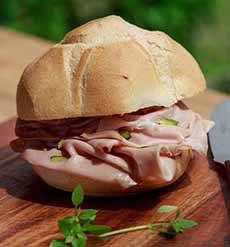
Until we began THE NIBBLE, we hadn’t had a bologna sandwich since grade school, when Mom would make one up once a week or so, alternating with a BLT, ham, PB & J, or tuna sandwich.
Yet to other people, a bologna sandwich is a culinary staple. Beyond the sandwich, we had a college friend who would snack on bologna and cheese stacked between Ritz crackers, and add bologna strips to her pizza.
> Beyond Italy: The different types of bologna are below.
Also check out:
> The year’s 27+ sandwich holidays.
> The year’s 24 pork holidays.
The year’s 75 meat holidays.
BOLOGNA HISTORY
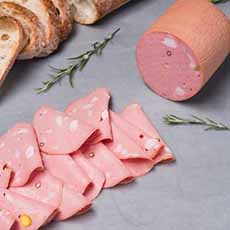
Bologna (boe-LOE-nya), also Americanized (unfortunately*) to baloney, is a type of cooked pork sausage that derives from Italian mortadella.
It has been made for at least 500 years in Bologna, the capital of the Emilia-Romagna region of Italy.
A sausage mentioned in a document dated 1376, of the official body of meat preservers in Bologna, mentions a sausage that may be mortadella [source].
Traditionally, the pork filling was ground to a paste using a large mortar (mortaio in Italian) and pestle.
Given that “della” means “from the,” the name can reference meat ground from the mortar.
Mortadella by that name has been made in Bologna for more than 500 years.
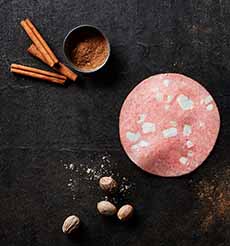
The recipe includes ground pork studded with cubes of white fat and seasoned with anise, coriander, pepper and pistachio nuts.
According to one source, in 1661, mortadella was such a delicacy that “the papacy officially laid down the legal definition” for it, to protect its integrity as a “subtly seasoned delicacy made of lean pork speckled with lumps of lard.”
American-style bologna is believed to have come to the U.S. with German immigration, which began in the mid-19th century. Some of the strongest bologna traditions hail from regions where German immigrants settled†.
Mortadella came to the U.S. with Italian immigrants. The Great Italian Immigration, as it is called, began in the 1880s [source].
Bologna became broadly available in the early 20th century. It had a good shelf life, and a bologna sandwich could be carried to work, school, or on a trip with no need for refrigeration.
Bologna was a more affordable cold cut than ham or salami, not to mention the even pricier turkey and roast beef.
The key to its low cost was that bologna was made out of typically discarded or fatty parts of meat. (Today, artisan bologna, made from quality cuts of pork and beef, is available.)
THE DIFFERENCES BETWEEN BOLOGNA & MORTADELLA
Mortadella is considered the original bologna from Italy, and is often sold in Italian markets in the U.S., while all delis and supermarkets carry bologna. The two are interchangeable in use, but have points of differentiation.
Many Americans are less familiar with mortadella, which was banned from import into the U.S. from 1967 to 2000 due to an outbreak of African swine fever in Italy.
Ingredients: Mortadella is traditionally made with pork from whole muscle cuts. Bologna is more often made with pork scraps and sometimes beef. Mortadella can include inclusions like olives, pistachios, or truffles; bologna typically does not.
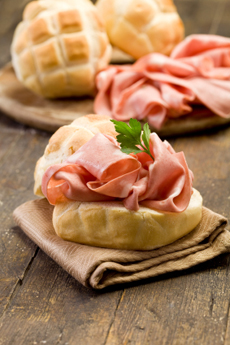
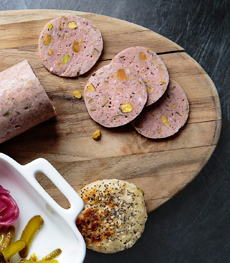
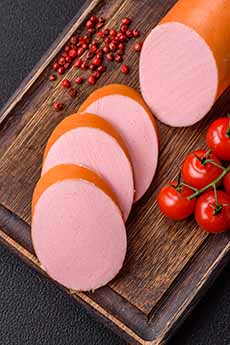
Appearance: Mortadella has an irregular, mottled appearance due to visible cubes of pork jowl called lardelli (photos #2, #3, and #4). Bologna is thoroughly ground, emulsified, and uniform in appearance.
Texture: Mortadella has a more varied texture due to the pieces of pork jowl and any inclusions. Bologna has a uniform texture.
Flavor: Mortadella has a rich pork flavor with a hint of spice. Bologna can be bland by comparison.
Production: Mortadella is made by slowly cooking the sausage while spraying it with water to preserve moisture. Bologna is mass-produced.
Size and shape: A roll of mortadella is often larger and rounder, than the smaller-diameter bologna.
Preservatives: Bologna typically contains more preservatives and chemical additives than mortadella.
BOLOGNA & MORTADELLA TODAY
Today, U.S. government regulations require bologna to be made without the visible pieces of lard, to distinguish it from mortadella.
U.S. standards allow bologna to be made from beef, chicken, pork, turkey, venison and others (bison, goat, etc.), or from soy protein (vegan bologna).
Nitrates, the preservatives that give cooked pork products a pink color, are used in American bologna and mortadella.
As is typical with sausages, scraps of meat are mixed with spices, then cooked and stuffed into casings (originally made from animal intestines, which are still used in all-natural sausage).
The nut-averse can find American mortadella made without the pistachios. During the holiday season, you can find premium mortadella made with truffles.
Bologna can be transformed with flavoring, such as Cajun, jalapeño, garlic or barbecue—available year-round.
Americans eat 800 million pounds of bologna annually.
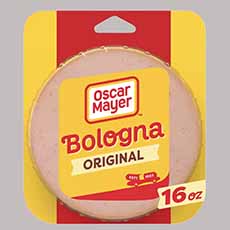
Oscar Mayer (photo #9) is the most popular bologna brand thanks to its 1973 jingle “My bologna has a first name….”
> Here’s a very classy version of the jingle.
__________________
*“Baloney” is slang for “nonsense.” It appears to have entered American English around 1922, and was popularized in the 1930s by New York Governor Alfred E. Smith. The original term was used in the mode of “nonsense” or “rubbish,” believed to be a nod to either Irish blarney, or the odds and ends used to make bologna sausage.
Continued below: Bologna Variations In Europe
|