THE NIBBLE BLOG: Products, Recipes & Trends In Specialty Foods


Also visit our main website, TheNibble.com.

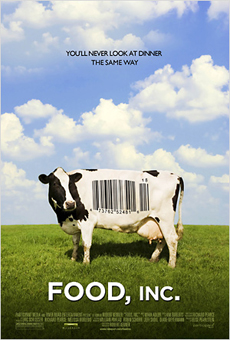
ENTERTAINING: Have A Film Party For “Food Inc.” on April 21st

How much do we know about the food we buy at our local supermarkets and serve to our families?

Though our food appears the same as it did to our grandparents—a tomato still looks like a tomato—it has been radically transformed, and not for the better. See for yourself in the eye-opening documentary, Food, Inc., which will be shown on PBS on Wednesday evening, April 21 (check local listings for time). The film is presented by POV, the award-winning series that features the work of today’s best independent documentary filmmakers.

In Food Inc., producer-director Robert Kenner and investigative authors Eric Schlosser (Fast Food Nation) and Michael Pollan (The Omnivore’s Dilemma and his latest, a must-read, In Defense Of Food) lift the veil on the American food industry, revealing distressing facts about what we eat, how it’s produced, who we have become as a nation (thanks to big corporations and their lobbyists) and where we may go from here.

Invite your family and friends over for a potluck dinner (we suggest a buffet). Then watch Food, Inc. and discuss the many issues it raises.


food-inc

Be sure to watch Food Inc. You’ll never
look at food the same way again.

Visit the POV website from April 22 to May 3 to get planning tips and recipes and enter for a variety of gifts.

The film will also be streaming online in its entirety for one week after the broadcast, from April 22nd to April 29th. The Food, Inc. DVD is also on sale (just $9.99 at Amazon.com).

Comments off

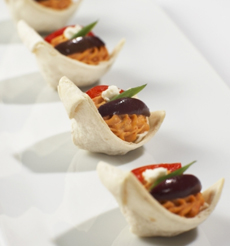
ENTERTAINING: Hummus Swans

hummos-swans-230

Hummus glides in a flatbread swan. Photo
courtesy Kabobs.com.

How cute are these hummus swans?

We saw them at Kabobs.com and will have to call to see if they can teach us to fold flatbread into swans.

In the interim, if you need a tasty hors d’oeuvre, combine the same flavors without the swan:

1. Cut squares or wedges of flatbread.
2. Pipe a red pepper hummus “rosette” from a pastry bag.
3. Add a small bit of feta cheese, a slice of kalamata olive and a slice of peppadew.
5. Garnish with a slice of chive.

Find more hors d’oeuvre recipes in our Hors d’Oeuvres & Cocktail Snacks section.

Comments off

RECIPE: Eggs Benedict & Eggs Benedict History

April 16th is National Eggs Benedict Day.

Credit for this recipe is given to Chef Charles Ranhofer of Delmonico’s Restaurant in New York City—which also happened to be the first restaurant opened in the U.S., starting with a small pastry café in 1827 and expanding into a restaurant two years later.

At that time there were no public dining rooms or restaurants. Men could stop into a tavern for a beverage and what amounted to “bar food.”

People ate all their meals at home or, if traveling, at the inn or hotel. Otherwise, hungry people got food from street vendors.

In the 1860s, a regular patron of Delmonico’s, Mrs. LeGrand Benedict, arrived for lunch and found nothing appealing on the menu.

She discussed her tastes with the chef, who created on the spot what would become an iconic recipe.

In his cookbook, The Epicurean, published in 1894, he called the recipe called Eggs à la Benedick, inadvertently misspelling her name.

  portabella-benedict-230

Photo of Portabella Eggs Benedict courtesy
of the Mushroom Council.

The recipe is relatively easy: toasted English muffins topped with a round of cooked ham “an eighth of an inch thick and of the same diameter as the muffins one each half.” A poached egg is placed atop each muffin half, and the whole is covered with Hollandaise sauce.
 
 
VARIATIONS: MORE EGGS BENEDICT RECIPES

Here’s an updated version of the Eggs Benedict recipe, substituting a portabella mushroom for the English muffin.

Here are substitutes for the English muffins, ham/bacon and hollandaise:

  • American Casual: Burger Eggs Benedict.
  • Comfort food: Grilled Cheese Eggs Benedict.
  • Custom Eggs Benedict: Mix & Match Your Favorite Ingredients.
  • Down-Home: Corned Beef Hash Eggs Benedict.
  • Down Home 2: Corned Beef Hash Patties.
  • Format: Eggs Benedict Casserole.
  • From A Sandwich Favorite: BLT & BLAT Eggs Benedict.
  • Fusion Food: Grilled Cheese Eggs Benedict.
  • Luxury: Surf & Turf Eggs Benedict (lobster and filet mignon).
  • No Carbs: Portabella Eggs Benedict.
  • Reinvented Eggs Benedict.
  • Scandinavian: Icelandic Eggs Benedict, with smoked salmon and skyr.
  • Steak Lovers: Filet Mignon Eggs Benedict.
  •  
    Plus A Related Recipe:

  • Potato & Crab Hash With Poached Eggs.
  •  
     
    Find more egg recipes on the pull-down menu at the upper right.


    CHECK OUT WHAT’S HAPPENING ON OUR HOME PAGE, THENIBBLE.COM.


    Here are updated versions of the Eggs Benedict recipe, but don’t forget Classic Eggs Benedict.

    Comments off

    Parmigiano Reggiano vs. Parmesan Cheese: A Big Difference

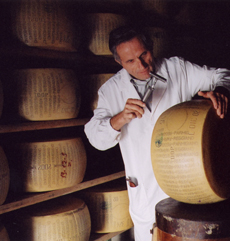
    checking-quality-230
    [1] Checking the quality of an aging wheel of Parmigiano-Reggiano (all photos ©
    Parmigiano-Reggiano Consorzio).

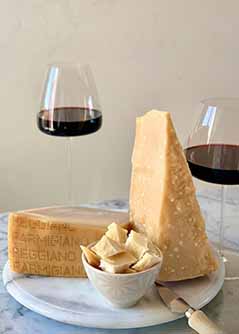
    Parmigiano Reggiano & Glasses Of Red Wine
    [2] Aged Parmigiano-Reggiano is an elegant pairing with the finest red wines.


    October 27th is National Parmigiano-Reggiano Day. It deserves a celebration: It’s more than 900 years old (and extremely delicious)!

    The annual holiday honors the “King of Cheeses,” authentic Italian Parmigiano-Reggiano. It was established in 2012 by the Parmigiano Reggiano Consortium (Consorzio Parmigiano-Reggiano), the cheese’s governing body.

    Parmigiano-Reggiano is more than a great cheese for pasta, pesto, risotto and Alfredo sauce.

    Shave it onto salads, eggs and sandwiches. Add it to cheese plates. Enjoy it with a glass of hearty red wine.

    It loves to be paired with apples, figs, grapes, kiwi, peaches, pears and walnuts.

    Italians enjoy it for dessert, drizzled with a few drops of aged balsamic vinegar.

    Guests love to be served large chunks of the cheese with a variety of dipping sauces—like pesto, garlicky tomato sauce, olive tapenade, parsley sauce and fruit chutney—on individual plates, or on a communal plate of skewers.

    And as you can see in photo #2, there’s no better cheese to enjoy with a medium- or full-bodied red wine than Parmigiano-Reggiano.

    Below:

    > The difference between Parmigiano-Reggiano and generic Parmesan.

    > What happens to wheels of Parmigiano-Reggiano that don’t pass the 12-month test.
     
    Elsewhere on The Nibble:

    > The history of Parmigiano-Reggiano cheese.

    > The history of cheese.

    > The different types of cheese: a photo glossary.

    > The great Italian grating cheeses: Parmigiano-Reggiano, Asiago, Grana Padano and Pecorino Romano.

    > The year’s 30 cheese holidays.


    THE DIFFERENCE BETWEEN PARMIGIANO-REGGIANO & GENERIC PARMESAN

    Anyone, anywhere can make and sell a cheese called “Parmesan.” They follow a basic recipe and are under obligation to nobody to adhere to any standards, including aging it until full flavors develop.

    Parmigiano-Reggiano, on the other hand, is D.O.P. name-protected (Denominazione d’Origine Protetta). This is a legal protection for the consumer that guarantees that you are buying an authentic Parmigiano-Reggiano, made by a trained artisan to exacting specification, produced in a specific geographical area, from milk from specific herds of animals raised in the same area, using techniques honed for centuries. Even the feed of the cows is dictated.

    All of this activity is strictly supervised by a consortium (consorzio) that ensures that every wheel stamped with the official seal tastes exactly as it should.

    After 12 months of aging (the minimum), each wheel is inspected and sometimes, if other tests for flaws fail, a thin probe will be inserted to draw out a small piece of the interior core (see photo). If the cheese does not pass, the exclusive pin-dot pattern on the sides is scraped off. The cheese can be sold as cheese for grating, but not as Parmigiano-Reggiano.

    If it does pass, it can go on aging for up to 36 months.

    Why are the words, Parmigiano-Reggiano and Parmesan, capitalized? Because they refer to the city of Parma in Italy, the center of making this great cheese.

    However, both cheeses have a place at your table.

  • For occasions where the flavor of the cheese will shine through—on pasta, risotto, or a cheese plate, for example, go for authentic Parmigiano-Reggiano.
  • When the flavor of the cheese will be largely blended into other ingredients—breading, cheese balls or recipes with hot chiles, for example—you can go for the generic Parmesan and save money.
  •  
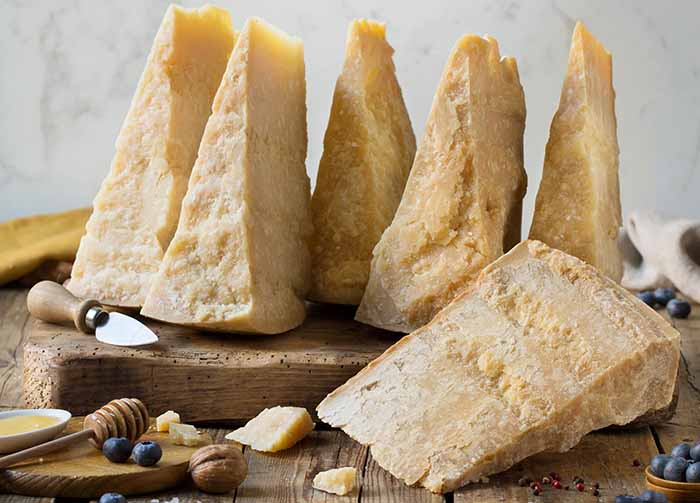
    Six Wedges of Parmigiano Reggiano
    [3] Check out this “tasting plate”: six wedges of Parmigiano Reggiano aged for 18, 24, 36, 48, 60, and 72 months. We discovered it at Emilia Food Love. The crunchy, white, sand-like crystals found in matured Parmigiano-Reggiano are tyrosine crystals, an amino acid that crystallizes as proteins (specifically the casein) break down during the aging process.
     
     
    WHAT HAPPENS TO WHEELS THAT DON’T PASS THE TEST?

    In the world of the Consorzio del Formaggio Parmigiano-Reggiano, quality control is brutal. Every single wheel is inspected by a master grader (battitore) using a small hammer to listen for structural flaws like eyes (holes) or cracks (photo #1).

    If a wheel fails the test during the aging process (usually at the 12-month mark), it’s stripped of its identity (the markings on the rind) to protect the Consorzio’s reputation.
     
    What Happens To Rejected Wheels?

    They Are Declassified. If a wheel has significant structural or flavor defects, the official branding marks are literally scraped or planed off the rind. The characteristic pin-dot “Parmigiano-Reggiano” lettering is removed so that the consumer cannot identify it as the top-tier product. The Consortium’s oval certification mark is never applied.

    Reclassification as Mezzano. Wheels with very minor internal holes or slight structural flaws—but still excellent flavor—are classified as Mezzano (Medium). These rinds are marked with parallel grooves or scratches around the entire circumference. They are sold at a much lower price and are intended to be eaten young (around 12–15 months) rather than aged further. These often appear in Italian supermarkets labeled simply as “table cheese.”

    Downgrading to Zabros, i.e. Generic Grating Cheese. If a wheel is deemed unfit even for the Mezzano category, it cannot be given any name associated with the region. These wheels are often sold to large-scale food processors. They are shredded or grated and sold as generic “hard grating cheese” for use in premade frozen meals, canned soups, or industrial pesto. Because the flavor profile is still high-protein and savory, they are excellent for industrial melting applications where the structural “crumb” of the cheese doesn’t matter.

    Extreme Failures Become Animal Feed. In rare cases, a wheel is biologically “off”—the fermentation gone wrong or mold penetrates into the paste). The cheese is discarded entirely. However, because it is essentially a concentrated block of protein and calcium, it is occasionally processed into high-end animal feed for local livestock.
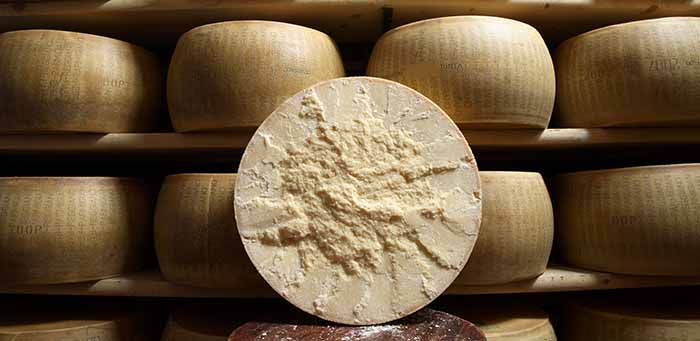
     
     
    Wheels Of Parmigiano Reggiano
    [4] Wheels that don’t check all the boxes are “decommissioned.”
     

    CHECK OUT WHAT’S HAPPENING ON OUR HOME PAGE, THENIBBLE.COM.


    Comments off

    RECIPE: Egg Salad For National Egg Salad Week

    National Egg Salad Week is the first week in April, reason to explore what makes a really great egg salad.

    Hard-cooked eggs with mayo isn’t egg salad, but a recipe called Eggs Mayonnaise.

    It’s pretty dull.

    You can add celery and onions to make egg salad and call it quits at that—but you can do so much better!

    Check out our deftly seasoned egg salad recipes and many variations of the basic recipe.

    We’ve also included the history of mayonnaise—because where is egg salad without it?

    And to follow it up, the history of egg salad (which, needless to say, comes after the invention of mayonnaise).

  • You can make your own mayonnaise for the egg salad—much more delicious than store-bought. Here’s Julia Child’s mayonnaise recipe.
  • Find more of our favorite egg recipes, and how to make the perfect hard-cooked eggs.
  •  

    egg-salad-230
    Check out our yummy ideas for egg salad (photo by Falcatraz | iStock Photo).


    Comments off

    The Nibble Webzine Of Food Adventures


    © Copyright 2005-2026 Lifestyle Direct, Inc. All rights reserved. All images are copyrighted to their respective owners.