THE NIBBLE BLOG: Products, Recipes & Trends In Specialty Foods


Also visit our main website, TheNibble.com.

TIP OF THE DAY: Create A Special Christmas Mocktail

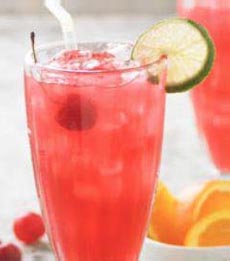
Ocean Spray Mocktail

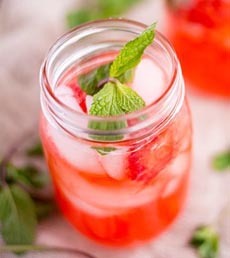
strawberry-mint-lemonade-asweetpeachef-230

A fun mocktail is a treat for non-drinkers. Top photo courtesy Ocean Spray. Bottom photo courtesy ASweetPeaChef.com.

  If you serve alcohol at parties, you’re bound to have some non-drinkers, designated drivers, and probably, drinkers who shouldn’t have another.

Most hosts address the need with soft drinks and mineral water. But special occasions merit an extra step: a holiday mocktail.

It’s easy to make it look and taste interesting, and those who can’t drink will feel special.

For your Christmas mocktail, we suggest something red and green: a red- or rosy-hued drink with a green garnish.

  • Determine on the proportions, e.g. 2 parts cranberry juice and 1 part soft drink.
  • Decide if you want to serve a tall or short drink.
  • Consider a low-calorie option: The juice and soft drink ingredients both have diet versions, which will be especially appreciated by calorie-counting guests.
  •  
    CHRISTMAS MOCKTAIL #1: CRANBERRY GINGER

    Ingredients

  • Cranberry juice*
  • Ginger ale
  • Ice cubes
  • Garnish: stemmed cherry†, lime wheel or mint leaves
  •  
    CHRISTMAS MOCKTAIL #2: CRANBERRY ORANGE

    Ingredients

  • Cranberry juice*
  • Orange soda‡
  • Garnish: stemmed cherry†, lime wheel or mint leaves
  •  
    You can make the drinks a deeper red color with grenadine.
    _____________________________________________
    *Our favorite cranberry juice is Knudsen’s. Ocean Spray has several 100% juice flavors: plain or blended with blueberry-blackberry, cherry, grape, orange, pomegranate, raspberry, etc. Use 100% juice instead of “juice cocktails” or “juice drinks,” which are typically sweetened with high fructose corn syrup.

    †The best maraschino cherries by far are the all-natural (and kosher-certified) Tillen Farms Merry Maraschino Cherries. They are “maraschino red” in color but taste great—nothing like the traditional varieties. The company also makes Bada Bing Cherries, with the deep burgundy hue of bing cherries. If you buy multiple packs online, use the extras as stocking stuffers.

    ‡San Pellegrino Aranciata (orange) and Aranciata Rossa (blood orange), and Boylan’s Orange, are the only ones we’ve found that use sugar instead of high fructose corn syrup. San Pellegrino is less sweet and more elegant; Boylan’s is conventionally sweet.
      

    Comments off

    TIP OF THE DAY: Cranberry “Mistletoe” Kissing Ball

    You don’t need to buy mistletoe to encourage people at holiday get-togethers to kiss. Instead, substitute this “holiday kissing ball” from Ocean Spray.

    First head to the crafts store, then pick up fresh whole cranberries. You can pick up an extra bag or two for a Valentine Kissing Ball (and if you prefer, a foam heart instead of a ball).

    DIY CRANBERRY KISSING BALL

    Ingredients

  • 5” styrofoam ball
  • Red acrylic craft paint
  • 24-gauge beading wire
  • Hot glue gun/glue sticks -or- wooden toothpicks
  • 1-2 12-ounce bag(s) Ocean Spray fresh cranberries
  • Optional: shellac spray
  • Trim of choice: ribbon, mistletoe, holly, ivy, bells
  •  
    Preparation


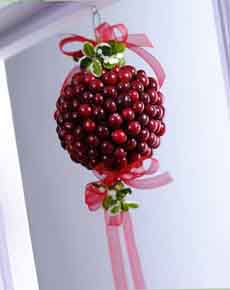
    Cranberry Kissing Ball
    A kissing ball, mistletoe optional. Photo courtesy Ocean Spray.

     
    1. PAINT the foam ball with red craft paint. Set aside to dry.

    2. CUT an 18″ piece of wire and fold it in half. Push the folded wire all the way through the center of the ball, leaving a 1″ wire loop extending at bottom of ball and 3″ of wire extending at top.

    3. ATTACH the cranberries to ball with a hot glue gun or toothpicks, covering the ball completely. Spray with shellac for longevity (otherwise, the berries soften after 5 days or so, and the appearance will diminish). NOTE: The glue gun is a better choice. If you don’t have one, you can pick one up when you buy the foam ball at the crafts store.

    4. TWIST the two wires at top of ball into a simple hook for hanging. Use ribbon to tie the desired holiday trim to wire above and below ball, and hang with a hook.

    5. FIND someone to kiss and guide him/her underneath the ball.
      

    Comments off

    TIP OF THE DAY: Freeze Your Hot Appetizers

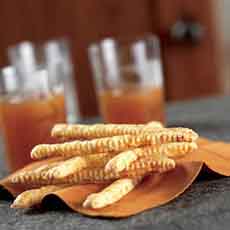
    Cheese Straws

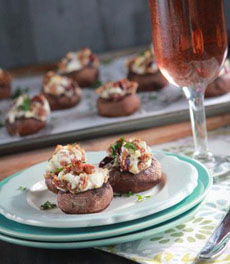
    Stuffed Mushrooms
    TOP PHOTO: Homemade cheese straws, made in advance, frozen and heated in the oven. Photo courtesy Cabot Cheese. BOTTOM PHOTO: Stuffed mushrooms. Photo courtesy GoodCook.com.

      If you want to serve hot hors d’oeuvre on Christmas, New Year’s Eve or other party times, here’s a tip we learned years ago from our friend Carol’s mother, a hostess whose board was almost groaning under the weight of her lavish spreads:

    Make fancy appetizers in advance, freeze them and simply heat them when guests arrive.

    Just about every hot hors d’oeuvre can be made up to six weeks in advance and popped into the freezer. Then when the first guests arrive, just pop a baking sheet in the oven.

    What can you make? For starters, these 10 crowd favorites:

  • Cheese straws
  • Chicken or beef skewers/brochettes
  • Chinese dumplings
  • Crab cakes
  • Mini quiches
  • Party meatballs
  • Pigs in blankets
  • Savory cheesecakes
  • Spanakopita or anything in phyllo or other pastry
  • Stuffed mushrooms
  •  
    Another time saver: These frozen bites can generally be heated at the same oven temperature for about the same amount of time, so you don’t have to babysit the oven.
     
    HOW TO FREEZE YOUR HORS D’OEUVRE

    As with anything you stick in the freezer, use airtight containers or heavy-duty resealable plastic bags.

  • Place a piece of parchment or wax paper between layers to keep the frozen hors d’oeuvre from sticking to each other.
  • Prevent freezer burn by pushing all the air from plastic bags before sealing, then double-bag them. Green tip: You can wash the bags, turn them upside down to dry (e.g., over a bottle) and reuse them.
  • If you’re only using some of the pieces in the bag or container, quickly return the others to the freezer. Partial thawing and refreezing can turn them mushy.
  •  
    WHAT DOES “HORS D’OEUVRE” MEAN?

    Hors d’oeuvre (pronounced or-DERV and spelled without an “s” at the end in French, whether singular or plural) are one- or two-bite tidbits served with cocktails. They can be placed on a table for self-service, or passed on trays by the host or a server.


    The ancient Greeks and Romans served bits of fish, seasoned vegetables, cheese and olives before the main meal. By the time of Renaissance Italy, the hors d’oeuvre had become more elaborate. Which brings up the meaning of the term:

    Hors d’oeuvre is French for “outside the [main] work,” referring to foods served outside of the main meal. From the late 17th century through the mid-19th century, popular hors d’oeuvre for the affluent French included clams and oysters on the half shell, stuffed eggs, slices of beef tongue and quail tidbits. [Source]

    Talk about excess: In the 19th century, extending into the 20th century, salted nuts, olives, and crudités—the “relish tray” of raw carrots, celery, radishes and the like–would be on the table throughout the meal so people could fill in between courses.

    Technically, the term hors d’oeuvre refers to small, individual food items that have been prepared by a cook. Thus, a cheese plate is not an hors d’oeuvre, nor is a crudité tray with dip, even though someone has cut the vegetables and made the dip.

    Canapés—small crustless pieces of bread† or pastry with a savory topping—arose in France in the 18th century, with Britain adopting the practice in the 19th century.

    Canapés have been joined in modern times by hot options such as baby lamb chops, brochettes (skewers), cheese puffs, crab cakes, mini quiches and many other options. A more modern approach is the mixed appetizer plate, several pieces plated and served as an appetizer (first course). [Source]


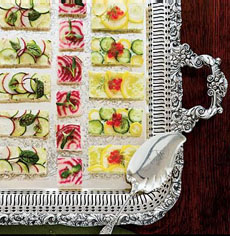
    Canape Tray

    Canape Tray
    Classic French canapé trays. TOP PHOTO: Caviar Russe serves them on a silver tray. BOTTOM PHOTO: Payard sells canapeés that you serve on your own fancy tray.

    _________________________________________

    *A 17th century English idiom, “groaning board” refers to a dining table laden or buffet with a large amount of food. In old literature, we see it referred to regularly by characters staying or supping at a tavern. The “groan” refers to the purported creaking and groaning noises produced by the wood of the table under the weight of the food. At the time, “board” was another word for “table” (and is the genesis of “room and board” and “boarding house”). At major feasts, the large table required was often a long board held up by trestles—think sawhorse held up by wooden legs.

    †Stale bread was often used as a base for the toppings, as it had hardened into the consistency of toast. The crusts were always removed to make them more elegant.


    Comments off


    © Copyright 2005-2026 Lifestyle Direct, Inc. All rights reserved. All images are copyrighted to their respective owners.