THE NIBBLE BLOG: Products, Recipes & Trends In Specialty Foods


Also visit our main website, TheNibble.com.

Langres & Other Cheeses To Serve With Champagne On New Year’s Eve

Whether you’re hosting a fête or staying at home with loved ones to avoid the crush of revelers, it’s likely that corks will be popped and bubbly poured. We always like to offer a special cheese to accompany Champagne or other sparkling wines.

Double- and triple-creme cheeses are sumptuous with Champagne. Brie and Camembert are typically* double-crèmes (here’s the difference between Brie and Camembert).

Triple-crème cheeses are quite a bit richer and creamier, and a voluptuous pairing with Champagne or another sparkler. Look for:

  • Brillat-Savarin
  • Explorateur
  • St. André
  •  
    And then there’s Langres.

    Langres (pronounced LAHN-gruh) is a cheese from the former French region of Champagne-Ardenne (it merged in 2016 with the neighboring regions of Alsace and Lorraine to form the new region Grand Est in the northeast of the country, bordering Belgium).
     
     
    WHAT TO KNOW ABOUT LANGRES CHEESE 

    Langres is a cow’s milk cheese, cylindrical in shape, weighing about 180g (6.3 ounces). It is a full-bodied cheese with a pronounced aroma, although it is a less pungent cheese than Époisses de Bourgogne (its neighbor and the local competition). Langres is from the same cheese family as Époisses and Muenster.)

    The rind of the cheese is sticky and shiny, showing off its magnificent orange color, the result of many washings with brine or Marc de Bourgogne during the maturing period, and rubbing with annatto, a natural orange-red dye derived from a tropical tree.

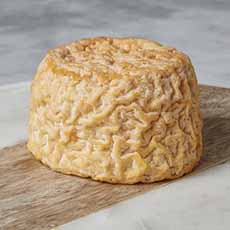
    The “brain”-like ridges in the rind are created by Geotrichum candidum, a fungus applied to set cheese after the milk has been coagulated and the whey has been drained. But we’re getting ahead of ourselves!
     
     
    How The Cheese Is Made

    This triple crème cheese is produced with whole cow’s milk enriched with cream, which provides the triple crème creaminess.

    After coagulation with rennet enzymes, the cheese curds are poured into cylindrical molds. They are then placed in humid cellars to mature. Ripening typically takes 5 to 6 weeks. The result:

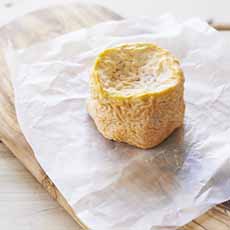
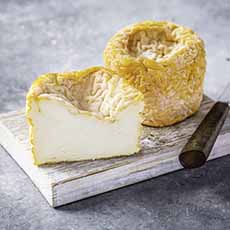
    Because the cheese is not turned, it forms a concave well on the top (photos #1, #2, #7), which is called the fontaine or cuvette in French. This depression is intentional; you can pour Champagne or Marc de Champagne in it to further flavor the cheese.

    The rind is delicious and should definitely be eaten.

    The paste is soft, creamy in color and slightly crumbly; it has a bloomy white Penicillium candidum rind.

    The flavor of the cheese is distinct without being aggressive. Some have described the finish as soaked in honey and truffles.
     
     
    How To Pair Langres Cheese

    In addition to Champagne, Langres goes well with red Burgundy and Marc de Bourgogne. For connoissers, serve a flight of all three.

    For a white wine, choose a substantial dry white wine, such as a Pouligny-Montrachet.

    Enjoy Langres alone with the wine, on a cheese board, or with a salad.

    An idea from Murray’s Cheese: Turn it into hors d’oeuvres on rye crackers with thin slices of cornichons and a small dollop of Dijon mustard.
     
     
    THE HISTORY OF LANGRES CHEESE 

    Langres has been produced in the Champagne region since at least the 13th century, when it is mentioned in a song composed by the Dominican prior of the city of Langres.

    A more formal written reference appears in 1874 in a book on cheese written by A. F. Pauriau, “La laiterie, art de traiter le beurre, de fabriquer les beurres et les principaux fromages français et étrangers” (“The dairy farm, the art of handling and making butter and manufacturing the main French and foreign cheeses”) [source: Official Journal Of The European Union, C247/11, 25.8.2011).

    At that time, the cheese was produced on local farms from cow’s milk and sold mainly in the market town of Langres, where 14 affineurs (establishments that age cheese) bought the young white cheese and matured it.

    It appears that cheeses of different sizes existed back then: small cheeses for consumption in the relatively short term, and larger cheeses that were better adapted to long-term storage and sale to further destinations.

    Little by little, wholesalers established themselves to deliver a broader commercial reach. In the 19th century, the cheeses made their way to Paris, Châlons, Bar-le-Duc, Nancy, the departments of Corrèze and Allier, and even to Geneva, spreading the reputation of the cheese.

    World War I (1914-1918) marked the beginning of a decline in artisan farm production of Langres, which continued until the end of the 1940s.

    To meet demand, farm-made Langres was gradually superseded by factory production in facilities that had arisen since the beginning of the 20th century.

    But in 1950, some artisanal cheese-makers began to make Langres again. In 1981 the consortium, Syndicat Interprofessionnel du Fromage de Langres was established.

    In 1986 it began working to obtain a registered designation of origin for Langres, to cement the domestic and international reputation of the cheese.

    The cheese was finally awarded an appellation d’origine contrôlée (A.O.C.) in 1991.

    It has held a P.D.O. (Appellation d’Origine Protégée, Protected Designation of Origin) since 2009.

    In the European Union’s protected designation of origin system, P.D.O. has replaced France’s A.O.C. designations for all products except wine.
     
     
    ABOUT TRIPLE CRÈME CHEESES 

    While all dairy cheeses are made from milk, with a triple crème heavy cream is added to the milk to create the richest, most buttery cheese.

    In order to qualify as a triple créme, the cheeses must have more than 72% butterfat content, which provides the smooth texture.

    Triple crèmes are a type of bloomy rind cheese and also are aged about two weeks.

    As with other cheeses that have short aging periods, the flavors are mild and the aromas are subtle. Examples include Brillat-Savarin, Explorateur, and St. André. This group of cheeses pairs well with Champagne and other sparkling wines.


  • The Different Types Of Cheese
  • The History Of Cheese
  • Double & Triple Crème Cheeses
  • Cheeses With Champagne
  • Goat cheese crottins
  • Pairing Cheese With Beer & Wine
  • Pairing Fruit & Cheese
  •  

    Langres Cheese PDO
    [1] Langres, rich and creamy, with a concave top meant to be filled with Champagne. During the maturing process, the Langres is not turned, resulting in the development of the well on top. (photo © The Courtyard Dairy).

    Langres Cheese PDO
    [2] What’s inside. Langres was declared a CDO (Certified Designation of Origin) in 1991 and then a PDO (Protected Designation of Origin) in 2012 (photo © Cartmel Cheeses).

    Langres Cheese PDO
    [3] The “brain”-like ridges in the rind are created by Geotrichum candidum, a fungus.applied to set cheese after the milk has been coagulated and the whey has been drained (photo © Murray’s Cheese).

    Langres Cheese PDO
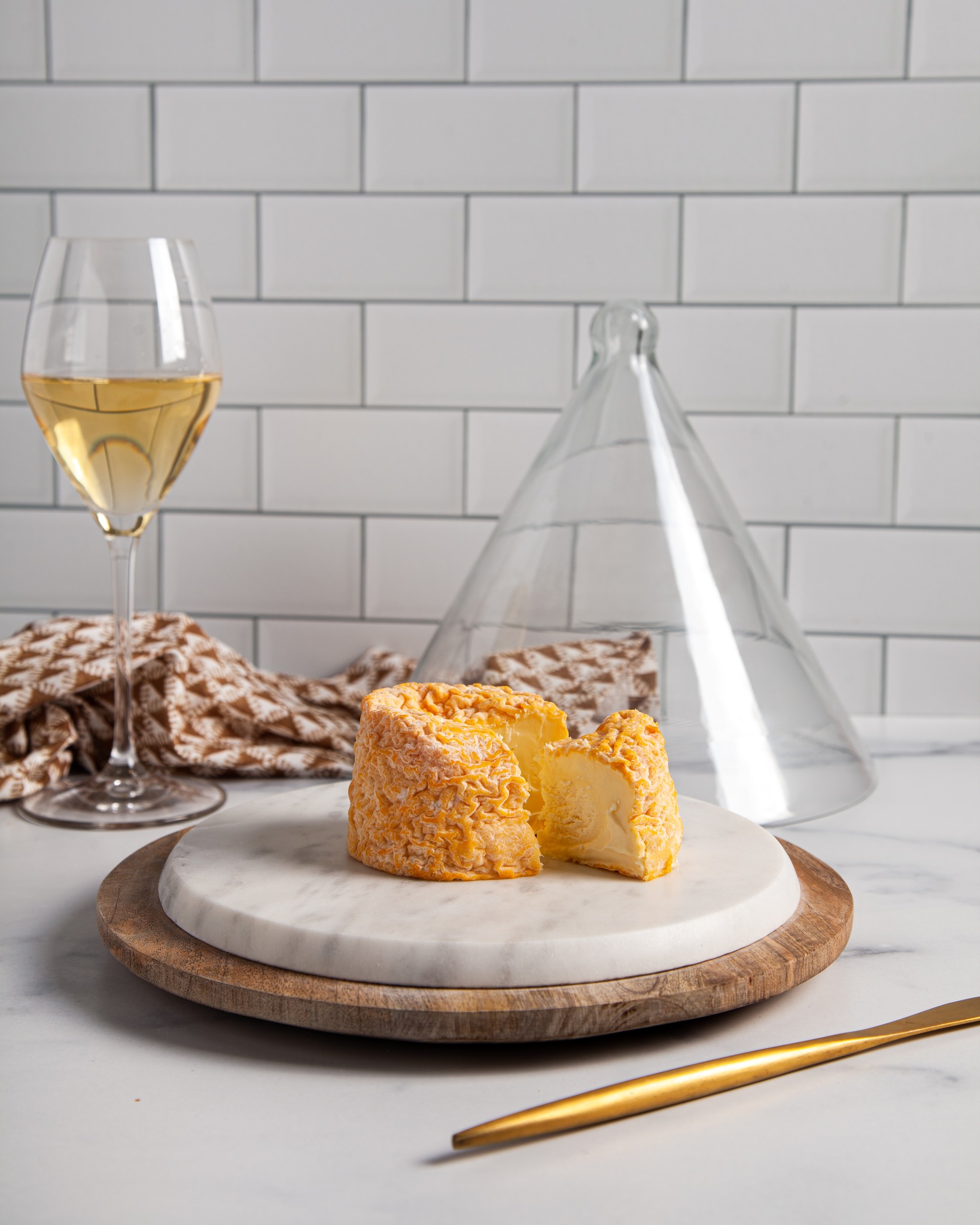
    [4] Champagne and Langres: a perfect pairing (photo © Fromage From Europe | Facebook).

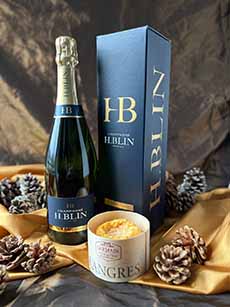
    Langres cheese with a bottle of Champagne
    [5] A great hostess gift: a bottle of Champagne and a round (or two!) or Langres (photo © Lighthouse Provisions).

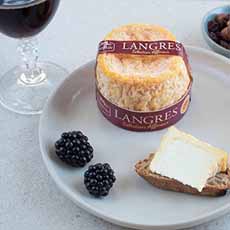
    Langres cheese with a glass of red Burgundy
    [6] Langres is also delicious with a red Burgundy (photo © Fromagerie Germain).

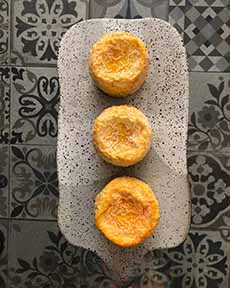
    Three 8-ounce rounds of Langres cheese on a cheese board
    [7] Langres looks great on the cheeseboard, The cheese is matured with successive washings, which engender the beautiful orange color. Ithas a pungent, intense and characteristic aroma which gives way to a fairly mild taste.


    CHECK OUT WHAT’S HAPPENING ON OUR HOME PAGE, THENIBBLE.COM.


    Comments off

    Galette Des Rois, Epiphany Cake, A Delight Throughout January

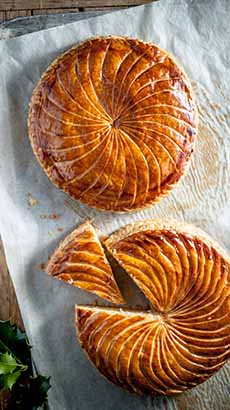
    Galette Des Rois from Chef Raymond Blanc
    [1] Galette des Rois from the acclaimed French pastry chef Raymond Blanc. Here’s his recipe (photo © Raymond Blanc).

    Gateau des Rois, Epiphany Cake, with a gold paper crown
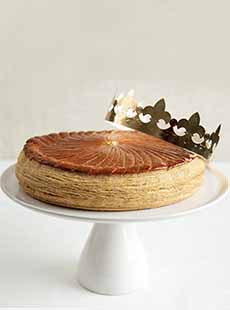
    [2] Many bakeries provide a gold paper crown so the person who gets the slice with the fève (charm) can be crowned king or queen. You can buy this cake and crown from Goldbelly (photo © Goldbelly | Blogspot). You can also buy the crowns on Amazon or make your own.

    Individual Galette Des Rois
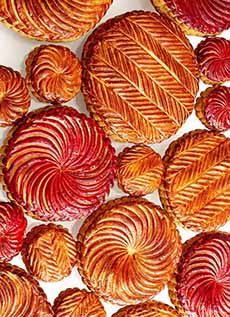
    [4] Galette cookies from Joy The Baker: rough-puff pastry with pistachio-rose filling. Here’s her recipe (photo © Joy The Baker).


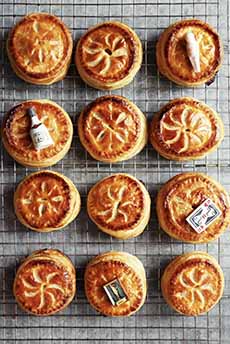
    [5] Pierre Hermé’s galettes, some garnished with glazed apple slices (photo © Pierre Hermé).

    A brioche and fruit Galette des Rois from southern France
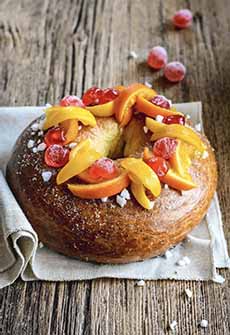
    [6] A brioche Galette des Rois, the style in southern France, is topped with candied fruit and pearl sugar. Here’s the recipe (photo © Pardon Your French).

    A Cherry Galette, a rustic pie made without a pie pan. In this classic fruit galette, the crust is folded up by hand over the filling (which can be savory instead  width=
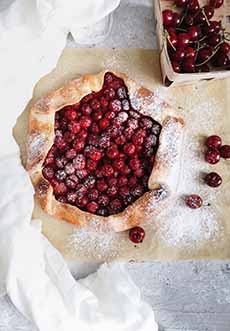
    [7] A cherry galette. The fruit or vegetable filling is placed in the center of a circle of dough, which is folded up to create a partial crust (photo © Uliana Kopanytsia | Unsplash).

    Buckwheat Galette (Crepe) Filled With Sauteed Mushrooms
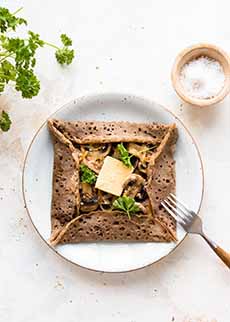
    [8] A Galette Bretonne is a buckwheat crêpe with a savory filling. Here it’s sautéed mushrooms, but eggs with ham is another popular choice. Here’s the recipe (photo © Cooking With Elo).

    Galette Des Rois shaped like a teapot
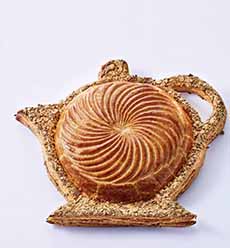
    [9] How about a teapot-shape galette (photo © Maison Lenotre).

    Fancy Galette Des Rois shaped like an almond
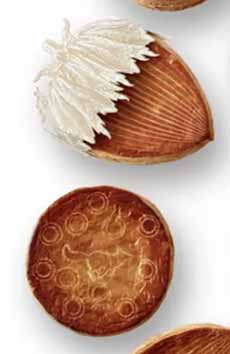
    [10] Or a galette shaped like an almond, after the frangipane inside. The galette below it has a fox etched in the pastry, running across the top (photo © Yann Couvreur Pâtisserie).


    Our Top Pick Of The Week is the first “official” cake of the New Year. Galette des Rois, or Epiphany Cake.

    You can probably pick one up from your nearest French bakery, or order online from any number of sites, including The French Confection and Goldbelly.

    At Goldberry the Galette des Rois, from Chef Daniel Boulud, is shipped uncooked and frozen and you bake it yourself. How’s that for a “homemade” masterpiece (photo #2)?
     
     
    A NOTE ABOUT EPIPHANY, THE HOLIDAY FOR WHICH THE GALETTE IS SERVED

    Celebrated on January 6th, Epiphany marks the end of the Christmas season (it’s the twelfth day of Christmas) and the beginning of Carnival (which concludes with the beginning Lent). It’s a religious feast day commemorating the arrival of the Magi (the Three Kings, les trois Rois in French) in the Bethlehem manger, bearing gifts for Baby Jesus.

    The terminology can get confusing to those not schooled in the tradition.

  • Epiphany is also known as Three Kings Day, the Day of Kings and Feast Of The Kings (Fête des Rois in French).
  • Galette des Rois is also called Cake Of The Kings, King Cake, and Epiphany Cake.
  • In the south of France, the cake is a different recipe and called the Gâteau des Rois (gâteau is French for cake).
  • The French Galette des Rois, King Cake, is not related to the Mardi Gras King Cake in Louisiana. It may have been the inspiration for the multicolored American King Cake, but only the names are the same. The French cake is made with puff pastry; the Mardi Gras cake is a yeast cake.
  • The French cake is eaten from Epiphany until the end of January. In New Orleans, the cake is consumed during the entire pre-Lenten season, from Epiphany through Mardi Gras.
  •  
    You don’t have to be Christian to enjoy the cake; you can buy one or make one and recount the history of the cake as you eat it with friends and family.

    To recap: Yes, you can eat Galette de Rois for the entire month of January. It’s a great occasion to invite people over for coffee and cake.
     
     
    THE HISTORY OF GALETTE DES ROIS

    You may read that the tradition of Galette des Rois dates back to the Roman times when festivals were organized to honor the gods. Ahem: Neither Jesus nor the three Wise Men existed then, so the source of a feast to commemorate them is a [big] stretch.

    However, it can be said that some Christmas traditions and customs do stem from the pagan Roman festival of Saturnalia, which honored the god Saturn, whose reign was depicted as a Golden Age of abundance and peace [source 1, source 2].

    As Christianity became the dominant religion in Rome, it adopted pagan traditions to make Christianity more accessible and appealing to potential converts.
     
     
    The Origin Of The Galette Des Rois

    Some sources say that the French have been serving up Galette des Rois since the 13th or 14th-century [source 1, source 2].

    It was initially known as Gâteau des Rois.

    Note that a gâteau is a raised cake, whereas a galette is generally flat, crusty and often filled. The style, the terminology, or both may have changed over time.

    Purportedly, the dessert was created to honor the three kings who traveled thousands of miles to visit the baby Jesus in Bethlehem.

    But, says master French pâtissier Raymond Blanc, OBE (Order of the British Empire), “this story is a load of old baloney!” (Here’s M. Blanc’s recipe for Gateau des Rois [photo #1]).

    It was really created in more modern times, says Blanc, the chef patron at Le Manoir aux Quat’ Saisons, a hotel-restaurant in Great Milton, Oxfordshire, England.

    The inventor was an enterprising French pâtissier who saw the income opportunity. However, we couldn’t verify either story.

    Later, Spanish and French settlers brought the Galette des Rois to America, where it may have inspired the Mardi Gras King Cake [source].

    Regardless of the origin story, Galette des Rois has turned into a traditional party dessert. Children eagerly await finding the charm (fève‡‡) hidden in the filling. Whoever gets the slice with it becomes the King or Queen for the day, and everyone else must obey their commands.
     
     
    SO WHAT EXACTLY IS THE GALETTE DES ROIS? 

    The galette is a frangipane* pithivier†. The latter is a pie made from two disks of flaky puff pastry (pâte feuilleté) surrounding a filling, sweet or savory†. Galette de Rois is filled witn frangipane, almond cream.

  • Fève: Each cake comes with a hidden charm or other trinket, called a fève (it was originally a bean, representing baby Jesus)‡‡, baked into it.
  • A gold paper crown, provided by the baker, sits on top for the initial presentation. The person who gets the slice with the charm becomes “king” or “queen” for the day, and gets to wear the gold paper crown.
  • The king or queen: It’s an entailed honor: By tradition, the king or queen has to provide next year’s galette‡.
  •  
    Most people head to the nearest French bakery to buy a Galette des Rois. But you can bake one: Here’s an Epiphany Cake recipe from the two-Michelin-star French chef Héléne Darroze.
     
     
    The Different Meanings Of “Galette” 

    Rustic tart: Pastry aficionados may think of a galette as a rustic pie or tart filled with fruit or vegetables (asparagus, mushrooms, or tomatoes, e.g.—photo #7). This galette, often referred to as a fruit galette, was originally made before the existence of pie plates when the crust was folded up and pleated by hand.

    Buckwheat crêpe: In Haute-Bretagne (Upper Brittany, France), the Galette Bretonne is a buckwheat crêpe loaded with savory fillings (photo #8).

    Galette des Rois from Northern France (photos #1 and #5) is a flat, circular cake, a combination of pâte feuilleté (puff pastry) and frangipane filling.

    In fact, the term galette evolved from the Old French galete and gale in the Norman dialect, meaning a kind of flat cake.

    Southern Galette des Rois: In the south of France, in Provence, the recipe is different: It’s an orange blossom-flavored, brioche-style cake covered with candied fruit and a sprinkle of pearl sugar (photo #6). This style can also be found in Spain and other Spanish-speaking countries.

    Variations:

    Today, pâtissiers across France make their own versions of the traditional galette, from Pierre Hermé’s rice pudding and caramel galette to others covered in edible gold dust [source].

    Check out the shapes in photos #9 and #10.

    There’s also a galette with a shortbread crust instead of puff pastry, popular in Western France [source and a chocolate-pear recipe].

    Some pastry chefs switch out the frangipane for apple, caramel, chestnut, pistachio, or raspberry filling [source]. Here’s a recipe for a chocolate-pear and raspberry galette.

    Pastry chef Cédric Grolet at the Meurice in Paris topped the crust with a mix of 10 different organic grains and seeds (white, red and black quinoa, pumpkin, sesame and sunflower seeds, almond, kasha, blond and brown linen seeds).

    Some depart totally, like the Mille-Feuille des Rois from Pierre Marcolini, who presents a square shape made with cocoa puff pastry, and a filling made with grand cru chocolate and hazelnut praline.

    On a more tame note, some chefs like Dominique Costa at the Péninsula in Paris top the puff pastry with crunchy slivers of roasted and caramelized almonds and hazelnuts, with slivers mixed into the frangipane. Oh là là!

    And Pierre Hermé, who can be extremely creative, garnishes some of his traditional galettes with simple glazed apple slices (photo #5).

    Other versions of the Galette des Rois are made in Belgium, Germany, Portugal, and Switzerland.
     
     
    GALETTE, PIE, & TART: THE DIFFERENCE 

    Pies are baked in a sloped pie pan, either open face or with a top crust. Both variations have crimped edges. flaky shortcrust pastry

    Galettes are free-form (i.e., formed by hand), and baked on a baking sheet. The edges of a fruit galette are folded up over the filling, leaving a wide opening of filling at the center.

    Galette de Rois from northern France, however, takes the form of a large, flat, round, filled, pastry, not what we think of as a conventional pie.

    Tarts are baked in a special pan, usually fluted with a removable bottom so they can easily be unmolded before serving.
    The pastry is stiff pâte sucrée pastry that enables the tart to “stand up straight” without any assistance.

    Here’s more on the differences between cakes, gateaux, tortes, tortas, and tarts.

    Note that relatively recently, the terms pie and cake were used interchangeably. A prominent example is Boston Cream Pie, which is a layer cake.

    > The different types of pastry.

    > The different types of pies and pastries: a photo glossary.

    > The history of Galette Des Rois.
     
     
    ________________
     
    *What is frangipane? Frangipane is a dense pastry cream flavored with almond paste. The almond paste base is enriched with sugar, butter and eggs. (Alternatively, milk, sugar, flour, eggs and butter are mixed with ground almonds). It is related to marzipan, which also has a base of almond paste. A key difference is that frangipane is a spreadable cream, and marzipan is a semi-hard almond candy.

    †A pithivier is a round, enclosed pie made from two disks of puff pastry, with a filling stuffed in between. The top has the appearance of a hump and is traditionally decorated with spiral lines drawn from the top outwards with the point of a knife, plus scalloping on the edge. It is named after the French town of Pithiviers, assumed to be the origin. The pie is traditionally finished with an egg wash shine to the top of the crust, or by caramelizing a dusting of confectioner’s sugar at the end of baking, or both. The filling of the pithivier is often frangipane (sometimes combined with fruit such as cherry or plum), but savory pies with vegetable, meat or cheese filling can also be called pithivier [source].

     
    ‡The protocol is this: The galette is cut into as many slices as there are people present, plus one extra slice. This extra slice is called the part du Bon Dieu (God’s slice), the part de la Vierge (the Virgin Mary’s slice), or the part du pauvre (poor man’s slice, offered to the poor).

    ‡‡The fève: Here’s more about the feve, an essential part of a Galette des Rois. Centuries ago, at the beginning, an uncooked bean was baked into the galette. Wealthier families used a gold coin. In more recent times, the fève has become a charm of baby Jesus or another cultural representation, from a tiny race car to a cartoon figure.


    CHECK OUT WHAT’S HAPPENING ON OUR HOME PAGE, THENIBBLE.COM.


    Comments off

    Americans Drink 1.2 Billion Glasses Of Eggnog (Whew)

    Americans are set to consume 1.2 billion glasses of eggnogs this holiday season.

    Eggnog is a holiday tradition for many people: those who like rich, creamy drinks laden with spirits.

    It’s a velvety concoction that marries the richness of cream and milk with the warmth of sugar and the complexity of beaten eggs.

    To this creamy base, a whisper of nutmeg and a generous measure of vanilla extract are typically added.

    For those inclined to spirited versions, a pour of bourbon, rum, or brandy turns the drink into a toast-worthy treat.

    Some people start eggnog consumption with Thanksgiving. Others wait until Christmas or New Year’s Eve. And don’t forget New Year’s Day.

    Wealth of Geeks surveyed 3,000 merry souls to gauge how many spiked eggnogs they typically drink over the festive season.

    They determined that the average American will drink 6 eggnogs this month, which equates to an astonishing 1.2 billion due to be consumed.

    (Editor’s Note: It looks like we’re way behind in our eggnog consumption and need to catch up by the New Year’s Day.)

    (Editor’s Note #2: Eggnog is a closed compound noun, a word derived from two separate words joined together without a space between them. I.e., not egg nog.)
     
     
    WHEN TO DRINK EGGNOG

    When it comes to drinking alcoholic, the unofficial rule is that it’s acceptable to have your first at 5 p.m.—no earlier. ’It’s five o’clock somewhere.”

    There’s an exception for brunch, of course: Enjoy your Bellini or Mimosa as early as you like, as long as it accompanies food.

    Thus, can you have eggnog at breakfast or brunch?

    Why not?

    It goes especially well with pancakes and bacon.

    And if you’re concerned about drinking too much eggnog, Dry January is coming up (consume no alcohol from January 1st through January 31st).
     
     
    MORE EGGNOG

    > December 24th is National Eggnog Day.

    > The history of eggnog.

    > How eggnog got its name.

    > Eggnog recipes.

    > Eggnog-flavored desserts.


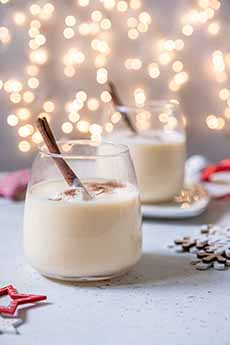
    2 cups of eggnog with festive holiday lights
    [1] Egg nog, so rich and silky (photo © Odelinde | Panther Media).

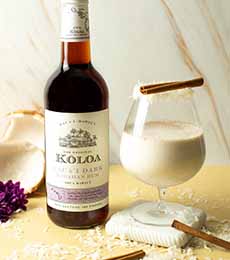
    Coquito Egg Nog Recipe
    [2] Take your pick: Bourbon, brandy, rum, or a mixture (photo © Koloa Rum).

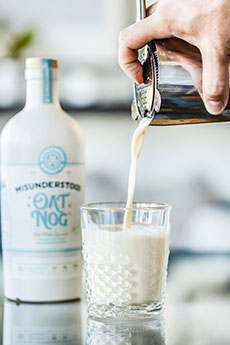
    Vegan (non-dairy) eggnog made with oat milk
    [3] You can make (or buy) dairy-free eggnog (photo © Misunderstood Whiskey | Unsplash).


    CHECK OUT WHAT’S HAPPENING ON OUR HOME PAGE, THENIBBLE.COM.


    Comments off


    © Copyright 2005-2026 Lifestyle Direct, Inc. All rights reserved. All images are copyrighted to their respective owners.