THE NIBBLE BLOG: Products, Recipes & Trends In Specialty Foods


Also visit our main website, TheNibble.com.

PRODUCT: Bombay Sapphire Gin & Bombay Sapphire East

Gin and tonic is the world’s favorite gin drink and a classic summer cocktail. After all, it was invented in the heat of India, for soldiers and civilians of the British Raj. (Raj is the Hindi word for reign, and is the term often used to describe the period between 1858 and 1947 before Indian independence, when the British ruled the Indian subcontinent).

India was rife with malaria, and the British troops took daily doses of quinine water (what we now call tonic water), a medicine used to treat malaria, to ward off the disease.

Someone suggested mixing it with gin to make it more palatable, and gin and tonic became the iconic drink of the British Empire.

What name could more reflect the origins of gin and tonic than Bombay Sapphire, a premium brand of gin distributed by Bacardi. Not only the name, but also the photo of Queen Victoria on the label, evoke the historic period. The “sapphire” refers to the Star of Bombay, a 182-carat star sapphire that was given to Mary Pickford by husband Douglas Fairbanks. Pickford bequeathed it to the Smithsonian Institution.

But back to the gin:

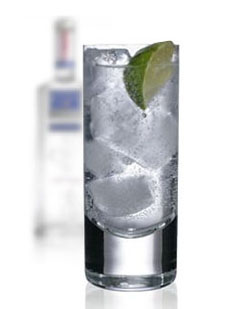
Celebrate the for Labor Day weekend in style. Serve the classic gin and tonic—G&T to its fans.


G&T: the classic summer drink. Photo courtesy Martin Miller’s Gin.

 
HOW GIN IS MADE

Gin is distilled from juniper berries and flavored with a complex layering of botanicals that provide flavor and aroma. Each brand has its proprietary recipe. Bombay Sapphire uses almond, angelica, cassia, coriander, cubeb, juniper berries, grains of paradise, lemon peel, licorice and orris root. (Try to isolate the flavors, the next time you enjoy a shot of gin.)

First the neutral spirit base is triple distilled, and the alcohol vapors are passed through a mesh basket containing the botanicals.

The still is also special: a Carter-Head still constructed in 1948, of which there are only a small number in the world. It provides a lighter, more floral gin rather than those distilled using a copper pot still. The water used to bring the strength of Bombay Sapphire down to 40.0% (80 proof) comes from Lake Vyrnwy, a nature reserve in Wales.


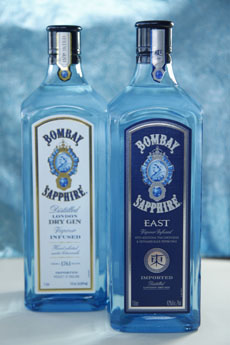
The two* expressions of Bombay Sapphire
gin. Photo by Elvira Kalviste | THE NIBBLE.
 

The original Bombay Sapphire debuted in 1987. In 2011, the brand tested Bombay Sapphire East in New York and Las Vegas. Enthusiastic consumer reaction led to a national roll-out.

Designed specifically to pair with the sweeter American tonic water, East adds two more botanicals, lemongrass and black peppercorns, to the original ten. It is bottled at 42% alcohol (84 proof).

We’re sticking with the first Bombay Sapphire because we go out of our way to use finer tonic waters, like Q Tonic Water and Fever Tree Tonic Water.

They’re made with sugar, not high fructose corn syrup (which the large brands use), which affords more quinine flavor with less sweetness.

Artisan tonic waters also use real quinine instead of synthetic quinine—another reason they taste so much better.

 
THE STORY OF QUININE
Before it was a cocktail mixer quinine was a lifesaver, loaded with medicinal compounds from the bark of the cinchona tree, which grows on the slopes of the Andes Mountains.

For centuries, natives had stripped the bark from the tree, dried and powdered it, then mixed with a liquid to drink as a tonic. The tree was given its name in 1742 by the botanist Linnaeus, who named it after a Countess of Chinchon, wife of a Spanish viceroy to Peru. As the story is told, the countess contracted malaria in Peru in 1638, was successfully treated with the local remedy made from the bark of the tree. The countess introduced the remedy to Europe, upon her return in 1640.

It took 177 years, until 1817, for medicinal quinine, used directly as a medicine to treat malaria, to be isolated and extracted from the bark. This was achieved by French researchers Pierre Joseph Pelletier and Joseph Bienaimé Caventou. The name is derived from the Quechua (Inca) word for the cinchona tree bark, quina or quina-quina, which translates to “bark of bark” or “holy bark.”

Even as a cocktail mixer, tonic water—originally called quinine water—was created not for better mixology, but as medicine. In 1825, British officers of the Indian Army mixed quinine with sugar and water as a prophylactic to ward off malaria. To make the tonic more palatable, they added gin to the mixture. Thus, the gin and tonic—the archetypical drink of the British Empire—began as a medicinal drink.

As medicine, the quinine levels in the original quinine water were very high. Today, they are miniscule—the FDA limits the quinine content in tonic water to 83 ppm. But that’s exactly how consumers want it: A little bit of quinine is tasty. Remember why gin was added in the first place: to try to kill the strong medicinal taste of the quinine.

*Bacardi also markets a less expensive variant of Bombay Sapphire, known as Bombay Original London Dry Gin or Bombay Original Dry. Made with eight botanical ingredients rather than ten, Bombay Original is harder to find than Bombay Sapphire. According to Wikipedia, The Wine Enthusiast reviewer preferred Bombay Original.


Comments off

TIP OF THE DAY: Mixed Heirloom Tomato Caprese Salad

So simple but so delicious, the Caprese salad (insalata caprese in Italian) layers slices of tomato and mozzarella di bufala* with fresh basil. The dressing is a drizzle of olive oil and balsamic vinegar.

The salad is named after the Italian island of Capri, where it was widely popularized in the 1950s following its “discovery” by tourists.

With all the gorgeous heirloom tomatoes now at farmers markets, it’s time to enjoy a daily Caprese salad. For an even more eye-catching salad, use a mix of different colored heirloom tomatoes, as they do at Balducci’s Market.

_________________
*Almost all American mozzarella is made from cow’s milk. But in Italy, by law, mozzarella is made from the milk of the water buffalo, and is called mozzarella di bufala. Water buffalo milk lacks carotene, the yellow pigment found in cow’s milk, so mozzarella di bufala is pure white. Cow’s milk mozzarella is called fior di latte, “the flower of the milk.” Water buffaloes, native to Asia, were brought to Italy in the 1400s.

 
Yellow, red and red cherry heirloom tomatoes grace this Caprese salad. Photo courtesy Balducci’s.

CAPRESE SALAD VARIATIONS

No tomatoes? No problem! Don’t like cheese or lactose intolerant? Substitute tofu. Don’t like basil? Try arugula, spinach or watercress. Not a salad person? Have a Caprese sandwich.

Recipes Without Tomato

  • Caprese Pasta Salad
  • Mango Caprese Salad
  • Plum Caprese Salad
  • Caprese Salad With Watermelon
  •  
    Recipes Without Mozzarella

  • Goat Cheese Caprese Salad
  • Tofu Caprese Salad
  •   

    Comments off

    PRODUCT: Coconut Grater From Microplane


    Your coconut cake deserves fresh-grated
    coconut. Photo courtesy Taste Of Home.
    Here’s the recipe.


    Recently, the folks at Microplane wrote to tell us that their Microplane Elite Extra Coarse Grater was terrific for grating coconut. The grater has large grating holes that give fresh coconut a texture similar to commercial shredded coconut—but if you’re a coconut lover, you’ll really prefer the superior taste and natural crunch of freshly-grated coconut.

    We love moist, grated coconut in and on ambrosia salad, cakes, cupcakes, lemon-coconut bars, macaroons and ice cream. On the savory side, there’s coconut batter shrimp, coconut rice, Thai chicken and soups, numerous Indian dishes and other Pacific Rim cuisine.
    The grater also works on cheeses and root vegetables. The suggested retail is $16.95, and you can buy it online. If you have a friend who makes a great coconut dish, you can make a gift of the grater and a fresh coconut.


    A COCONUT IS A FRUIT, NOT A NUT

    Actually, it’s a drupe—a category of fruits that includes the coffee cherry (bean), mango, olive, most palms (date and coconut palms, e.g.), strawberry and all members of the genus Prunus, including the almond, apricot, cherry, nectarine, peach and plum.

    Here’s what we dug up at the Library of Congress:

    Is a coconut a fruit, nut or seed? Botanically speaking, a coconut is a fibrous one-seeded drupe, a classification of fruit.

    A drupe is a fruit with a hard stony covering enclosing the seed (like a peach or olive) and comes from the word drupa meaning overripe olive. A coconut, and all drupes, have three layers: the exocarp (outer layer), the mesocarp (fleshy middle layer), and the endocarp (hard, woody layer that surrounds the seed). When you buy a coconut at the supermarket the exocarp and the mesocarp have been removed and what you see is the endocarp.


    So why is it called a nut?

    Food names were bestowed long ago, often by explorers and others who had no botanical training.

    Eggplants have nothing to do with eggs, but the early small, white oval varieties looked like eggs to the folks who named them. Grapefruit growing on trees looked like jumbo clusters of grapes. To Columbus’s crew, the heat in chiles reminded them of the black peppercorns back home, so they called chiles “peppers.” They were ignorant of the fact that there is no relation between chiles and peppers.

    The oldest reference to the coconut comes from a 5th century Egyptian traveler, Cosmas, who wrote about the “Indian nut” or “nut of India” (the coconut more than likely originated in the Indian Archipelago or Polynesia). “Coconut” was derived from old Portuguese and Spanish, where coco meant head or skull.

    Why skull?


    It’s not a nut, but a fruit. Photo courtesy Microplane.

     
    The three small holes on the coconut shell resembled human facial features. According to one source, the sailors of Vasco da Gama, who came across the fruit in India and first brought it to Europe, were reminded of a ghost or witch in Portuguese folklore called coco. The first known recorded usage of the term is 1555.
    FOOD TRIVIA: THE PALM TREE IS NOT A TREE

    Botanically, the coconut palm is not a tree since there is no bark, no branches, no secondary growth. The coconut palm is a woody perennial (flowering plant) called a monocotyledon; what we see as the trunk is a very thick, woody stem.

    Other monocotyledons include the true grains (maize, rice, wheat, etc.), the pasture grasses, sugar cane, bamboo, banana, ginger and the amaryllis family—which includes onions and garlic plus flowering plants such as the amaryllis, daffodil, lily, iris, orchids, and tulip.

    Isn’t botany enlightening?
      

    Comments off

    TIP OF THE DAY: Vegetable Bouquet


    Irresistible crudités for kids. Photo courtesy
    Living Locurto.
     

    Hey there, Edible Arrangements: You’re missing out on dazzling vegetable bouquets like these.

    The vegetable arrangements were created by blogger Amy Locurto of LivingLocurto.com, who developed the veggie bouquet concept to entice her children to eat more vegetables.

    Serve them at home, or bring them to parties and barbecues as your contribution. You can make a large basket or bowl centerpiece, or make individual servings in juice glasses.

    VEGETABLE BOUQUET RECIPE

    Ingredients

  • Vegetables: baby carrots, grape or cherry tomatoes in red and orange/yellow, cucumbers, radishes, yellow squash, zucchini and anything else your friends and family like
  • Celery for the stems
  • Fennel, bok choy or other stalk vegetables with leaves at the top
  • Cream cheese, an optional “glue”
  • Flower shaped cookie cutter
  • Long toothpicks/wood skewers
  • Small vases, cups, jars or orange juice glasses to
    hold individual bouquets
  • Water to fill the jars
  •  
    Preparation

    1. CUCUMBER & ZUCCHINI FLOWERS: Cut cucumbers/zucchini into flower shapes and cut small circles for the flower centers. Affix centers with cream cheese.

    2. CARROT, TOMATO & RADISH BLOSSOMS: Affix individual vegetables to the top of long toothpicks.

    3. CELERY LEAVES: Cut the leafy upper stems of celery to fill out the bouquet. If you don’t have enough leafy stalks, use regular celery sticks. Make cuts in the top about 1/2 inch deep as a design element. If you place the tops in water with ice cubes, the “fringe” should open a bit.
     
    You can wash and recycle the skewers.

    Check Out These Nifty Vegetable Cutters

  • Floral cutters set
  • Animal cutters set
  •   

    Comments off

    The Different Types Of French Fries: A Glossary

    Today, August 12th, is National Julienne Fries Day. We’re here to talk French fries, julienned, and beyond.

    First, what are julienne fries? How do they fit in with all the other types of fries?

    Julienne is a French cutting technique, typically for vegetables, in which the food item is cut into long thin strips, similar to matchsticks. Another word for the same cut is allumette.

  • The official julienne size is 1/8 inch × 1/8 inch × 2 inches.
  • The next thicker cut, batonnet, is 1/4 inch x 1/4 inch x 2½ to 3 inches.
  • The baton is the thickest stick cut: 1/2 inch x 1/2 inch x 2-1/2 inches.
  •  
    Fries, or French fries, refer to sliced, deep-fried potatoes. They can be:

  • Made with sweet potatoes instead of white potatoes.
  • Baked instead of fried.
  • Served plain or with a myriad of condiments (barbecue sauce, blue cheese dressing, ketchup, gravy, malt vinegar, mayonnaise, mustard, ranch dressing, Thousand Island dressing.
  •  
    While julienne and baton are the most typical cut, here is a delicious accounting of the different types of fries.

    In the glossary below there are 30+ different types of fries for you to try!

    National French Fry Day is the second Friday in July (it was formerly a fixed date, July 13th).

    The glossary follows, but first:

    > The history of potatoes.

    > The history of French fries is below.

    > The different types of potatoes: a photo glossary.

    > The year’s 30 potato Holidays.

    > Make your own signature French fries recipe.
     
     
    A GLOSSARY OF THE TYPES OF FRIES

  • Bistro Fries: Served at bistros in metal holders, these “frites” are usually fried twice for extra crispness. They are thicker than julienne fries, typically 3/8- to 1/2-inch thick. They’re also called Euro fries.
  •  

    French Fry Shapes
    [1] Can you name the fries? From the top: tots, chips, waffle fries, curly fries, crinkle fries, sweet potato fries, and what most Americans think of as the classic French fry, the baton (photo © Idaho Potato Commission).

    Pommes Paille (Straw Potatoes)

    [2] The thinnest fries possible are pommes paille, translated literally as straw potatoes. Here’s a recipe (photo © Recipe Tin Eats).

  • Belgian Fries: Thick-cut fries served in a paper cone with mayonnaise and eaten with a small fork (the cut is about 1/2 inch, compared to 1/8 inch for julienne fries). They are traditionally double-fried in beef tallow, making them crispier on the outside.
  • Boardwalk Fries: From the Mid-Atlantic area, these long, square-cut fries are seasoned with Old Bay Seasoning and malt vinegar. Also called country fair fries.
  • Carne Asada Fries or Carne Fries: A specialty of Mexican restaurants in the San Diego area, comprising a base of fries topped with carne asada (grilled flank or skirt steak) with garnishes of cheese, guacamole, pico de gallo, shredded lettuce and sour cream; some establishments include pico de gallo and lettuce. Here’s a recipe.
  • Cheese Fries: Crinkle, julienne, or other fry shape topped with melted cheese: grated Parmesan, shredded Cheddar, mozzarella or Swiss cheese, Cheez Whiz, Velveeta—even blue cheese or ranch dressing. Chili, bacon, chives/green onion, garlic, jalapeños, mayonnaise, and other ingredients can be added. Here’s a recipe.
  • Chicken Fries: These are not potato fries, but chicken strips shaped to look like fries. They were popularized by Burger King and became a permanent menu item in 2015.
  • Chile Fries: Not to be confused with chili fries, this is a popular dish in New Mexico—fries topped with green chile peppers.
  • Chili Fries or Chili Cheese Fries: Fries topped with chile con carne.
  • Chip Butty: A U.K. sandwich of fries (called chips in the U.K.) on a buttered roll or bread, optionally eaten with condiments such as brown sauce, ketchup, mayonnaise, or malt vinegar.
  • Chips: The British word for fries. In America, the term can refer to homemade potato chips, a popular restaurant item. Make your own with this recipe, or try these gourmet homemade potato chips with truffle oil.
  • Chorrillana: A Chilean dish, a plate of fries is topped with strips of sliced beef, eggs, fried onions, and occasionally, sausages.
  • Cottage Fries: Thick coin shapes. Sometimes they are ridged.
  • Country Fair Fries: See Boardwalk Fries.
  • Crinkle or Crinkle-Cut Fries: Fries with grooved edges that are made with a special crinkle cutter.
  • Curly Fries: French fries cut with a special curly fry cutter that creates long, thin spirals. Sometimes called wavy fries, they are often served with melted cheese. Ketchup, sour cream, or sweet chili sauce are also popular condiments. History: In 1938 the Dolores Restaurant & Drive-In on Route 66 in Oklahoma introduced Suzi-Q Fries, adapted by others and called, generically, curly fries.
  • Curry Chips: Fries covered in curry sauce, a popular item served in chip shops in Ireland and Northern England (in the U.K., “chips” is the term for fries, and “crisps” is the term for what Americans call chips).
  • Disco Fries or Elvis Fries: A New Jersey specialty, made with steak fries topped with brown gravy and mozzarella cheese fries; some establishments substitute processed American cheese (photo #6). Also, see Newfie Fries and Poutine.
  • French Fries, French Fried Potatoes or Fries: In French, the formal name for fried potatoes is pommes de terre frites (PUM-duh-tare-FREET). The term is often shortened to pommes frites or simply, frites. The terms aiguillettes or allumettes refer to very thinly sliced chips.
  •  
    A Bowl Of Home Fries
    [7] Home fries are pan-fried rather than deep-fried (Abacus Photo).


    [3] Sidewinders, a new shape made to generate excitement at restaurants (photo © Simplot).

    Sidewinders Fries
    [4] Tornado fries, also called spiral fries, but the “real” spirals are in the next photo (photo © DaphneLLC.Wordpress.com).

    Potato Spirals
    [5] Potato spirals, made by piping a mash into spirals. Here’s the recipe (photo © Taste Made).

    Disco Fries
    [6] Disco Fries, New Jersey’s homage to poutine (photo © Taste of Home).

     
  • Home Fries or Cottage Fries: A potato dish made by pan-frying sliced potatoes that have been par-cooked by boiling or other technique, then pan-fried in butter or oil—not deep fried. When diced green and red bell peppers are added, and optional chopped onions, they are called Potatoes O’Brien. The dish was created at John’s restaurant in Manhattan in the early 1900s. Here’s a recipe.
  • Julienne Fries: A popular width for French fried potatoes: 1/8 inch × 1/8 inch × 2 inches.
  • Jojo Fries: A type of potato wedge, typically cut thick, dip in egg, and coat in a flour‑and‑spice mix (often including Lawry’s salt), and deep-fried in a pressure cooker. They are a regional specialty in the Pacific Northwest and some parts of the Midwest, sometimes referred to as “broasted potatoes” or “jojos.” Here’s a recipe.
  • Loaded Fries: Top the fries with melted cheese, diced onions, sliced jalapeños, bacon, and sour cream. Here’s a recipe.
  • Matchstick Fries: Another name for shoestring fries.
  • Newfie Fries: A dish originating in Newfoundland: fries, dressing (turkey stuffing made with summer savory), and gravy. One variation adds ground beef or hot dogs and cheese.
  • Oven Fries: Also called baked fries, these are fries that are baked in the oven instead of fried. Here’s a recipe.
  • Patatje Oorlog: A Dutch dish of fries with eight or more sauces—anything from chopped raw onion and relishes to mayonnaise and peanut sauce. Some establishments provide up to 40 different condiment variations. Patatje oorlong is Dutch for “French fries war.”
  • Pommes Paille: The English translation is “straw potatoes,” so-called because they are sliced as thin as straw (photo #2).
  • Potato Spirals: also known as spiral fries, tornado potatoes, or twist potatoes, are a fun and visually appealing snack made from a potato that has been mashed and piped into a continuous spiral shape (photo #5). They deep-fried and often seasoned with various spices.
  • Potato Wedges: Fries made from large, wedge-shaped chunks of potato, often unpeeled. Regional terms include jojos and tater babies. The wedges can be baked instead of fried. Popular condiments include barbecue sauce, brown sauce, gravy, ketchup, mayonnaise, ranch dressing, sour cream, and sweet chili sauce. Here’s a recipe for parmesan wedge fries.
  • Poutine: A Canadian dish from rural Quebec that tops French fries with fresh cheese curds (sometimes grated cheese), covered with hot gravy (photos #8 and #9). Disco fries, from New England, are a variation (photo #6). Here’s a classic poutine recipe.
  • Rounds: Coin-shaped chips.
  • Seasoned Fries: French fries coated with spices. Black pepper, garlic powder, chili flakes, onion powder, and paprika are popular, but you can make curry fries, basil-dill fries, or whatever you find appealing. Check out these recipes.
  • Shoestring Fries: Another term for julienne fries, the thinnest cut.
  • Sidewinders: A new shape developed by Simplot for restaurant service (photo #3). The company describes the shape as a bent elbow.
  • Steak Fries: These are thicker-cut fries—baton or wider—often cooked with the skin on. They can be fried or coated with spices and baked. They are also called wedge fries. They are the least crunchy, as they have the highest interior-to-surface ratio (i.e., the most potato “filling.”)
  • Sweet Potato Fries: Made from sweet potatoes, typically in the julienne or shoestring cut, or in wider batons.
  • Texas Fries or Texas-Style Fries: Steak fries with the skin on.
  • Tornado Fries: A shape invented by the Tornado Fries company and copied by others (photo #4). They are made from a single potato cut with a gadget into a one-piece spiral, which is fried on 18- or 26-inch skewers. Sometimes they are wrapped around a foot-long hot dog.
  • Tots or Tater Tots: Small cylinders made from deep-fried, grated potatoes. “Tater Tots” is a trademark of Ore-Ida, which invented the little potato bites in 1953. Here’s a recipe to make your own baked tots.
  • Waffle Fries or Waffle Cut Fries: French fries cut with a special tool into a criss-cross pattern. In France they’re called pommes gaufrettes (gaufrette is the French word for waffle).
  • Wavy Fries: Another term for curly fries.
  • Wedge Fries: Another term for steak fries.
  • A Dish Of Poutine
    [8] Poutine is often served in an untidy presentation like this (photo © V. W. Campin-CC-BY-NC-SA-2.0-License).

    A Dish Of Poutine With Mushrooms & Peas Added
    [9] In the hands of a good chef (or an artistic home cook), poutine can have this sophisticated take, with spring peas, trumpet mushrooms, and béchamel sauce instead of generic white gravy. Here’s the recipe (photo © Idaho Potato Commission).
     
     
    THE HISTORY OF FRENCH FRIES/FRIED POTATOES

    Potatoes originated in Peru and spread to other parts of Latin America. Fried potatoes—cooking potatoes in fat over a fire—is a practice thousands of years old.

    Potatoes were “discovered” and brought back to Europe by the Spanish conquistadors in the 16th century—where they were used as hog feed! The French were convinced that potatoes caused leprosy, and the French Parliament banned the cultivation of potatoes in 1748.

    Modern french fries date to the late-1600s. In the winter, when the rivers iced over and fishing was difficult, fried potatoes were substituted for fish at meals in some regions.

    During World War I the fried potatoes were nicknamed “French fries” by the Americans because the official language of the Belgian Army was French. They carried the name back to America.

    While the French had nothing to do with naming French fries (the term in French is pommes frites, fried potatoes), they did finally start eating potatoes in the 18th century.

    A French army medical officer named Antoine-Augustine Parmentier was forced to eat potatoes as a P.O.W. and discovered their culinary potential. Through his efforts, in 1772, the Paris Faculty of Medicine finally proclaimed that potatoes were edible for humans—though it took a famine in 1785 for the French to start eating them in earnest.

    In 1802, Thomas Jefferson’s White House chef, Honoré Julien, a Frenchman, served “potatoes served in the French manner” at a state dinner. The potatoes were “deep-fried while raw, in small cuttings.” French fries had arrived in the U.S., if not in name, then in form.

    The French didn’t call them French fries, but frites, the word for fried potatoes.

    So how did they get called “French” fries? One prevailing theory is that “French” came from American soldiers who arrived in Belgium during World War I. They came across frites.

    Since the dominant language of southern Belgium is French, they dubbed the tasty potatoes “French” fries and brought the term (and the demand) back home.

    Shortly afterward, in the early 20th century, the term “French fried,” meaning “deep-fried,” was being used for other foods as well (onion rings and zucchini sticks, anyone?)

    UNESCO has declared the Belgian French Fry “a cultural treasure,” giving it Heritage Status. Belgian fries are served in a paper cone with mayonnaise and eaten with a small fork.
     

    CHECK OUT WHAT’S HAPPENING ON OUR HOME PAGE, THENIBBLE.COM.


    Comments off

    The Nibble Webzine Of Food Adventures
    RSS
    Follow by Email


    © Copyright 2005-2026 Lifestyle Direct, Inc. All rights reserved. All images are copyrighted to their respective owners.