|
Chicken & Waffles, originally a hearty breakfast, can be had any time of the day in modern times. For a special celebration, August 8th is National Chicken & Waffles Day.
With counterpoints of crisp and soft, salty and sweet, it became a special occasion dish of Southern soul food cuisine.
It’s still a special-occasion dish: one that many people enjoy on Father’s Day.
You can make a traditional waffle, topped with butter, a piece of fried chicken and a pour of maple syrup.
You can get creative with your presentation (check out the photos).
Or, you can get inspiration from chefs whose re-interpretations are shown in the photos in this article—including Steak & Waffles (recipe below).
Who created the first Chicken & Waffles? The exact origins are lost to history, but here’s what we know…
…and before we jump in, don’t forget to look at the Steak & Waffles recipe below.
THE HISTORY OF CHICKEN & WAFFLES
Waffles are an ancient food, dating back to the rustic hotcakes cooked on stones in the Neolithic Age (6000 B.C.E. to ca. 2000 B.C.E.).
In ancient Greece (1100 B.C.E. to 146 B.C.E.), cooks made flat cakes, called obleios (wafers), between two hot metal plates. They were primarily savory in nature, flavored with cheeses and herbs.
By the Middle Ages, Middle Ages (400 C.E. to 1000 C.E.) obloyeurs—specialist waffle cooks—make different types of oublies, as the word has evolved from the Greek. In the 12th century a clever obloyeur made an iron cast of a pattern that mimicked a honeycomb—which remains the waffle design today. Soon after, the word gaufre, from the Old French wafla meaning “a piece of honeybee hive,” became the French word for waffle.
Waffles entered American cuisine in the 1600s with the arrival of Dutch colonists.
Thomas Jefferson brought the first waffle iron to America in 1789 (along with the first pasta machine), when he returned to Virginia following his service as Minister to France. Waffles became a fashionable food—an alternative to flapjacks—and the combination began appearing in cookbooks shortly thereafter [source]. The pairing was enthusiastically embraced by slaves, for whom chicken was a delicacy. As a result, Chicken & Waffles became a special meal, often served for Sunday breakfast before a long day in church. However…
The recipe does not appear in early Southern cookbooks, such as “Mrs. Porter’s Southern Cookery Book,” published in 1871 and “What Mrs. Fisher Knows About Old Southern Cooking,” published in 1881 by former slave Abby Fisher, generally considered the first cookbook written by an African American. The lack of a recipe for the combination of chicken and waffles in Southern cookbooks from the era may suggest a later origin for the dish.
In the early 1800s, hotels and resorts around Philadelphia served waffles with fried catfish. Such establishments also served other dishes including fried chicken, which gradually became the topper of choice due to catfish’s limited, seasonal availability.
The Pennsylvania Dutch version is a plain waffle topped with pulled, stewed chicken and covered in gravy. It was a common Sunday dish by the 1860s. By the end of the 19th century, the dish was a symbol of Pennsylvania Dutch Country, enjoyed by locals and tourists alike.
Waffles at home: In 1909, an ad for Griswold’s Waffle Iron promised, “You can attend a chicken and waffle supper right at home any time you have the notion if you are the owner of a Griswold’s American Waffle Iron.”
Chicken & Waffles was an established dish in Harlem’s African-American community by 1930.
In the 1930’s, Harlem chef Joseph Wells turned the concept into a fried chicken sandwich on donuts. The idea became a national trend years later, in the 2000’s.
In 2021, fast-food chains Carl’s Jr. and Hardees debuted a related sandwich, fried chicken on two waffles, an idea which originated with small, independent chicken shops and was copied by Kentucky Fried Chicken.
What’s next? We can only imagine.
> Here’s the full history of waffles.
|
|

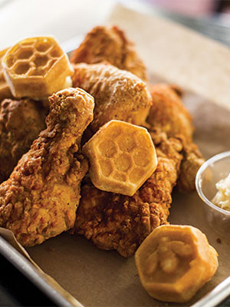
[1] Fried chicken with mini waffles at Chicago’s Honey Buttered Fried Chicken (photo © Honey Butter Fried Chicken).
[2] A gourmet approach at Lazy Bear in San Francisco: Gaufres de Chasse, a Liège-style waffle cut into fingers, with fried game hen, Sauce Chasseur, maple syrup, nameko mushrooms and fines herbes (photo © Lazy Bear).
[3] Chicken & Waffles with a fried egg at Hearthstone Kitchen in Las Vegas. A chic layout of the chicken, waffle and egg is made possible by a wood plank (although we use our rectangular ceramic sushi dishes—photo © Hearthstone Kitchen).
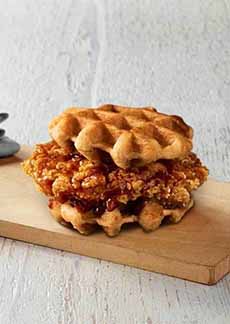
[4] Does having your fried chicken on two waffles instead of two donuts cut the calories (photo © Kentucky Fried Chicken)?
|
|
|
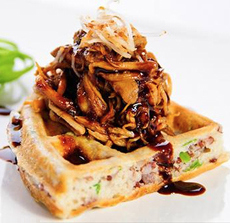
[4] A nod to Pennsylvania Dutch-style Chicken & Waffles: a stuffed waffle topped with adobo pulled chicken. Here’s the recipe from InHarvest.com (photo © InHarvest).
[5] Chicken & Waffles with a side of peaches and cream (photo Arnold Inuyaki | Wikipedia).
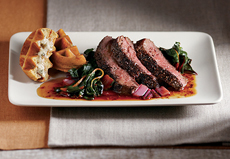
[6] A break from chicken and waffles: How about Steak & Waffles (photo © The Beef Board).
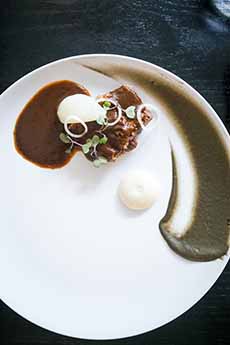
[7] An example of demiglace, the brown sauce at the upper left of the plate. It’s gracing Wagyu brisket; the swath is made from corn and dried chiles (photo © The Beef Board).
[8] Ribeye cap steaks, also called rib crown steaks (photo © Fogo Charcoal).
|
|
RELATED FOOD HOLIDAYS
We found scant information on an International Chicken & Waffles Day: the first Friday following the first Thursday in October. It seems to have been established for fun in Kalamazoo, Michigan, and not exactly an official holiday.
And, it may have been abandoned: Founded in 2003, the website, ICAWD.org, has been abandoned; and the Facebook page, established in 2011, hasn’t been updated since 2014.
If you have any news about International Chicken & Waffles Day, let us know! You can plan your Chicken & Waffles celebrations around:
International Waffle Day, March 25
Maple Syrup Saturday, the 3rd Saturday in March
National Chicken Month, September
National Fried Chicken Day, July 6
National Maple Syrup Day, December 17
National Waffle Day, August 24
National Waffle Week, the first week in September
RECIPE: STEAK & WAFFLES
Ingredients
This recipe, from The Beef Checkoff, makes enough for a big party (24 servings). The waffles are stuffed with blue cheese. It’s a home run!
For The Batter
6 cups prepared waffle batter
1½ tablespoons dried tarragon
1½ tablespoons kosher salt
2 teaspoons black pepper
2 teaspoons garlic powder
Plus
24 ounces crumbled blue cheese
Top quality blue cheese salad dressing* (see Step 4 under Preparation)
For The Demiglace
¼ cup butter
½ cup shallots, minced
½ cup sherry vinegar
6 cups veal demiglace
6 tablespoons coarse-grain mustard
Salt and black pepper, to taste
For The Steak
24 ribeye cap steaks, a.k.a. rib crowns (8 ounce portions)
Salt and pepper, to taste
Grapeseed oil, as needed
24 cups Swiss chard, wilted
Preparation
1. COMBINE all batter ingredients. Mix together and refrigerate, covered.
2. PREPARE the demiglace: In a saucepan, melt the butter, add the shallots and sauté until translucent. Add the vinegar and simmer for 4 minutes. Add the demiglace and bring to a boil. Whisk in the mustard, reduce the heat and simmer 3 minutes. Taste and season with salt and pepper as desired.
3. COOK the steaks: Season with salt and pepper. You can then sauté or grill them. To sauté, heat 1 teaspoon of oil in a sauté pan until hot. Add the steak; sear on both sides until well browned. Place in a 500°F oven and cook to medium rare or desired done-ness. Carve across the grain into thick slices.
4. MAKE the waffles: Using a waffle iron outfitted with the mini waffle plate (4 waffles per plate), ladle ¼ cup waffle batter into 2 sections of the waffle iron and cook according to manufacturer’s directions. Remove the waffles and immediately push in the center of each waffle with a spoon, to create a small well. Fill with 1 ounce of blue cheese and sandwich the waffles together, making sure the waffle depressions line up so it fits back into the iron. Place the waffle sandwich in the waffle iron and cook 1 minute or until cheese is melted.
|
Editor’s note: We took a much easier route with Step 4, making a waffle sandwich from two regular-size waffles. We filled the sandwich with our favorite blue cheese salad dressing*, topped with crumbled blue cheese. We cut the sandwich in half diagonally, set one half on the plate and propped the other perpendicular to the first.
5. PLACE 1 cup of Swiss chard in the center of a plate; fan the sliced steak on top. Place a stuffed waffle on top of the steak; ladle the demiglace on and around it.
_____________________
*Our all-time favorite is the amazing blue cheese dressing from Kathryn’s Cottage Kitchen. But it’s hard to find (here’s the store locator) and expensive to ship. We buy a year’s supply at a time! If you don’t want to make your own (here’s a recipe), look for specialty brands like Marie’s Chunky Blue Cheese Salad Dressing. Among the supermarket brands, Wishbone Blue Cheese is the best.
|
|