THE NIBBLE BLOG: Products, Recipes & Trends In Specialty Foods


Also visit our main website, TheNibble.com.

Celebrate International Waffle Day With These Recipes & More

International Waffle Day, which originated in Sweden, is celebrated in the U.S. on March 25th. It’s one of six annual waffle holidays.

That means you can celebrate a waffle holiday six times year! Prepared sweet or savory, they can be served at breakfast, lunch or dinner. (Check out these recipes).

In different parts of the world, waffles as well as pancakes are topped with confectioners’ sugar, honey, jam, even peanut butter.

In an episode of “Call the Midwife,” which takes place in London, a character just returning from a long visit to the U.S. says something along the lines of, “Thank goodness I can have waffles with sugar and lemon again.”

It turns out the U.K. garnish is a sprinkle of sugar and lemon juice. It’s not surprising: pancakes and waffles existed before America and its maple trees were discovered.

But in the U.S., what are waffles without maple syrup?

And what’s with the different types of maple syrup?

Below:

> A brief history of waffles.

> A recipe with a twist: waffles with maple sugar.

> What is maple sugar?

> The different grades of maple syrup

> Crown Estate premium maple syrup.

Elsewhere on The Nibble:

> The different types of pancakes and waffles: a photo glossary.

> Different and delicious: sweet and savory waffle recipes.

> Fun: sushi waffles recipe.

> How to make better waffles.

> A detailed history of waffles.

> The history of maple syrup.

> The year’s 8 waffle and French toast holidays.
 
 
A BRIEF HISTORY OF WAFFLES
 
The Ur-Waffle. Before there were modern waffles, there were the rustic hotcakes of the Neolithic Age (ca. 6000 B.C.E. to ca. 2000 B.C.E.). Made of cereal pulps, they were cooked on heated stones. Honey is as old as written history, dating back to 2100 B.C.E., where it was mentioned in Sumerian and Babylonian cuneiform writings, the Hittite code and the sacred writings of India and Egypt. We don’t know when man first decided to unite honey and hotcakes, but here’s the history of honey.

The Waffle Iron. The waffle iron—enabling pancake-type foods to be turned into textured waffles—was created in the 1200s, when a [presumably] pancake-loving craftsman combined cooking plates that reproduced a pattern of honeycombs.

The Electric Waffle Iron. The electric waffle iron was introduced in 1911 by General Electric.

Types Of Waffles. There are at least 11 varieties of waffles: American, Belgian/Brussels, Liège, Hong Kong Waffle, Krumcake, Malt, Pizzelle, Potato, Soft, Stroopwafel and, yes, Toaster. Take a look at the types of waffles.

Here’s a comprehensive history of waffles.
 
 
RECIPE: HOMEMADE WAFFLES WITH A TWIST

Here’s a recipe from Crown that uses maple sugar instead of table sugar for even more maple flavor.

Ingredients For 6 Large Waffles

  • 2 cups all-purpose flour
  • 1 teaspoon salt
  • 4 teaspoons baking powder
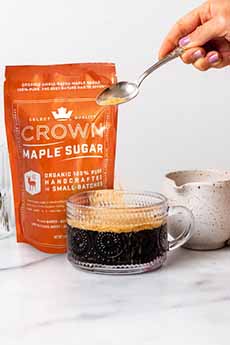
  • 2 tablespoons maple sugar (photo #6)
  • 2 eggs
  • 1½ cups warm milk
  • 1/3 cup melted butter
  • 1 teaspoon white sugar
  •  
    Preparation

    1. PREHEAT waffle iron to desired temperature.

    2. COMBINE all dry ingredients in large mixing bowl and set aside.

    3. BEAT eggs in a separate bowl; stir in milk, butter and vanilla. Pour milk mixture into the flour mixture; beat until blended.

    4. LADLE batter into heated waffle iron and cook until golden brown; serve immediately with maple syrup.
     
     
    WHAT IS MAPLE SUGAR

    Maple sugar is made from the sap from the maple tree, as opposed to the juice of sugar cane, from which table sugar is made. It has the same strong maple flavor and aroma as maple syrup.

    The sap is boiled until almost all of the water has been evaporated; the remaining product has crystallized. The sugar can be sold in large blocks, molded into small shapes or simply ground into a granulated version that can be used like regular sugar.

    Maple sugar can be used in the same way as cane sugar: in coffee, tea, baked goods and cocktails. It adds more complexity and richness than cane sugar.

    However, is almost twice as sweet as regular sugar, so when replacing cane sugar, you need to reduce the amount. Try using one-third less, and adjust to taste.


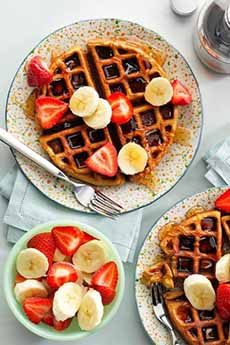
    Fruit-Topped Protein Waffles
    [1] These may look like classic waffles, but they add protein powder to the batter for a hidden nutrition boost. Here’s the recipe (all waffle photos © Taste of Home).

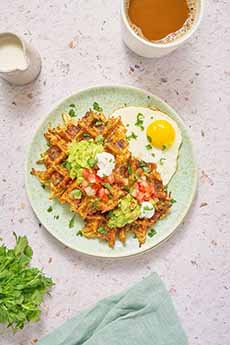
    Savory Waffles With Mexican Flavors & Fried Egg
    [2] This recipe adds a fried egg for protein, plus Mexican touches like guacamole, shredded cheese, green chiles, chili powder, and cilantro. Here’s the recipe.

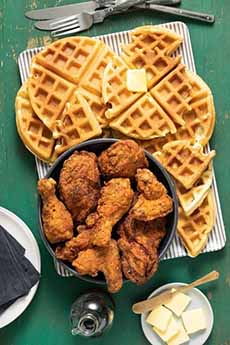
    A Platter Of Chicken & Waffles
    [3] A hearty brunch or dinner: chicken and waffles. Here’s the recipe.

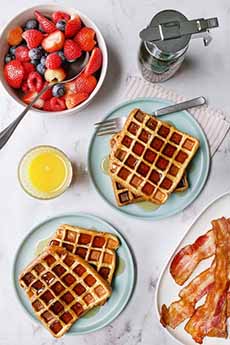
    A Plate Of French Toast Waffles
    [4] These creative waffles are actually a mashup of waffles and French toast. Here’s the recipe.

    Crown Maple Sugar & Coffee
    [5] Maple sugar can be sprinkled on waffles, used in baking, and of course, in coffee (photos #6 and #7 © Crown Maple Estate).

     
    A Platter Of Cornbread Waffles
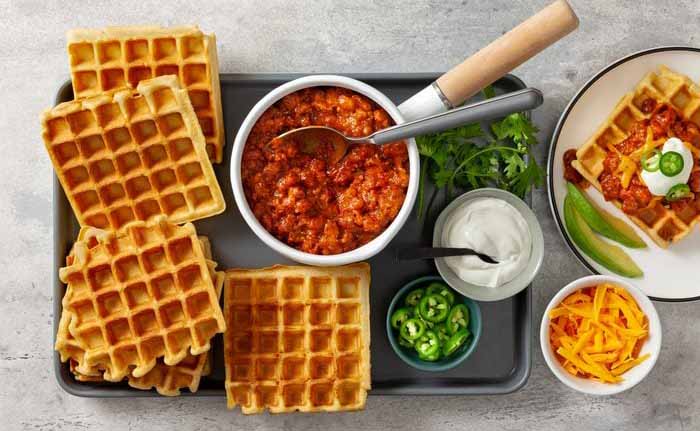
    [6] Something different: cornbread waffles and all the fixings. Here’s the recipe.
     
     
    GRADES (TYPES) OF MAPLE SYRUP

    Because maple syrup is tapped in the winter, it has traditionally been seen as a winter flavor. But just like honey and sugar, it can be enjoyed year-round in recipes from cocktails to salad dressings and marinades to desserts.

    If you’re confused by the four grades of maple syrup (A Light Amber, A Medium Amber, A Dark Amber and B) here’s an explanation of the different types.
     
    In brief, at the beginning of the season, the syrup runs light in both color and flavor, and is called Grade A Light Amber. By mid-season it’s Grade A Medium Amber, followed by Grade A Dark Amber and Grade B. At the end of the season, it’s the strongest in flavor and color, commercial grade syrup.

    The Center Of Syrup. Canada produces more than 80% of the world’s maple syrup, the vast majority in Quebec. Vermont is the biggest U.S. producer, followed by New York and Maine.

  • Canada: about 14–19 million gallons per year, depending on the season.
  • Vermont: about 2–3+ million gallons per year.
  • New York: about 0.8–1.0+ million gallons per year.
  •  
    But no matter how much is produced in the U.S., we need to import the majority of our syrup from Canada. (We have the trees to produce more syrup, but not the people who want to tap them.)
     
     
    CROWN PREMIUM MAPLE SYRUP

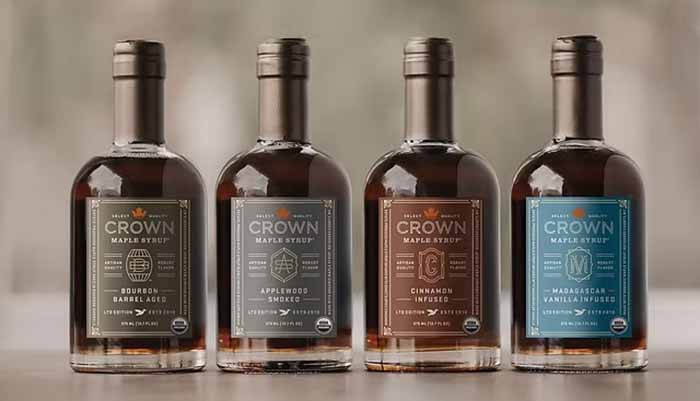
    We recently received a bottle of Crown Maple syrup, certified organic. It is produced by Madava Farms, a family business in the historic Hudson River Valley of New York (Dutchess County).

    There, 800 acres of century-old, sustainably managed groves of sugar and red maples enjoy perfect soil and ideal seasonal weather conditions to produce a superior sap for maple sugaring.

    But production is a key determinant of quality. Far from the old primitive sugar house, Crown premium maple syrup is made at the most advanced maple syrup production facility in the country. The pristine sap collected from the maples is cooked using the latest in green, organic production techniques to produce syrups of exceptional quality.
     
    CROWN SYRUP VARIETIES

    As you can see from these tasting notes, different grades pair better with specific recipes.

    Light Amber Syrup

  • Tasting Notes: Flavors of popcorn, vanilla bean, roasted nuts, salted caramel and brown butter. Although light in color, the body has a pleasing weight and depth, with a sweetness and finish that lingers.
  • Uses: Pair with salty flavors, for example glazing pork belly or bacon. Try it in cocktails with whiskey as a base: Replace the muddled sugar cubes in an Old Fashioned. Use it as a substitute for palm sugar in Thai recipes.
  •  
    Medium Amber Syrup

  • Tasting Notes: Aromas of gingerbread and roasted chestnut with flavors of rye, butterscotch and spice.
  • Uses: Pair with baked breads, chocolate and ginger cookies and heavier spirits—barrel-aged bourbons or peaty, smoky Scotch. Use as a topping for chocolate or vanilla ice cream.
  • Dark Amber Syrup

  • Tasting Notes: The flavor and aroma are similar to Medium Amber, but the syrup has more weight, depth and concentration. Aromas of coffee and cocoa beans are present, along with flavors of brown sugar and toasted almond.
  • Uses: Use instead of other sweeteners in coffee, and as an alternative to honey as a condiment for cheeses.
  •  
    Crown Maple Extra Dark for Cooking

  • Tasting Notes: A robust maple syrup with a great depth of flavor, richness and a bright finish.
  • Uses: For cooking and baking. The richness shines through even the boldest of food pairings.
  •  
    Where To Purchase

    A 12-ounce bottle, gift boxed, is $16.95; a samplers of all three is $59.95; and a “petite trio” of three small bottles (1.7 ounces each) is $15.95. An 12-ounce bottle of Extra Dark Syrup for Cooking is $27.95.

    A 10-ounce bag of maple sugar (see below) is 10.95.

    Buy them online at CrownMaple.com.
    Bottles Of Crown Maple Syrup
    [7] The scrumptious syrups of Crown Maple Estate.
     

    CHECK OUT WHAT’S HAPPENING ON OUR HOME PAGE, THENIBBLE.COM.


    Comments off

    TOP PICK OF THE WEEK: Dear Coco Toffee Chocolate Bars

    Quite a few artisan chocolatiers are also pastry chefs. Rachel Ferneau makes chocolates as Dear Coco, but was previously the proprietor of Eden Cake, a made-to-order kosher pareve bakery serving metro Washington, D.C.

    While we’ve missed the opportunity to try her desserts, she was kind enough to send us some chocolate.

    Everything from this artisan chocolatier is 100% handcrafted in small batches. The chocolates are completely dairy-free, all natural and certified kosher pareve by Star-K.

    In both her baking and her chocolates, flavors of the world are evoked with coffees and teas, exotic salts, fine herbs, flowers, fruits, roasted nuts and spices.

    Recently, Dear Coco launched a creative line of vegan-friendly artisan chocolate bars: Toffee Chocolate Bars. Eight unique bars are embedded with toffee and the spices that evoke each of the eight globally-inspired locations.

    The toffee is made with vegan butter* in order to be pareve† and lactose free. This substitution, so that the bars can be enjoyed anytime by kosher observers, makes them vegan-friendly as well. Yes, it cuts down on the butteriness of the toffee; but there is so much other layering of flavors that no one will notice.


    oaxaca-bar-front-back-230

    The Oaxaca bar invokes the moles of Oaxaca, Mexico with cinnamon toffee and pepitas. Photo by Elvira Kalviste | THE NIBBLE.


    group-tablecloth-230

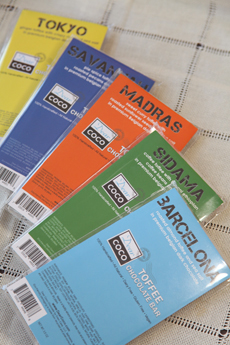
    Five of the eight “destination” toffee
    chocolate bars. Photo by Elvira Kalviste | THE
    NIBBLE.
     

    NEW & SPECIAL: TOFFEE CHOCOLATE BARS

    All of the bars are made with dark chocolate and a touch of sea salt.

  • Barcelona Toffee Chocolate Bar: Influenced by the flavors of Spain—roasted almond toffee and sea salt.
  • Istanbul Toffee Chocolate Bar: Inspired by the flavors of baklava—cinnamon clove toffee with rosewater, roasted walnuts.
  • Madras Toffee Chocolate Bar: A tribute to the curries of Southeast India—sweet curry toffee with roasted sunflower seeds.
  • Oaxaca Toffee Chocolate Bar: A recognition of the mole dishes of Oaxaca—Mexican cinnamon and smoky hot chile toffee with roasted pepitas.
  • Savannah Toffee Chocolate Bar: A tribute to the pecan pie of “The Hostess City of the South”—pie spice toffee with roasted pecans.
  • Shanghai Toffee Chocolate Bar: Honoring a staple spice of Cantonese cooking, Chinese five spice toffee (here a blend of cassia cinnamon, star anise, anise seed, ginger and cloves) with roasted white sesame seeds.
  • Sidama Toffee Chocolate Bar: For the coffee lover, crunchy caramelized coffee toffee infused with Ethiopian coffee beans.
  • Tokyo Toffee Chocolate Bar: Homage to the sushi bar—ginger toffee with crispy rice.
  •  

    The 3.5-ounce bars are $7.50 each. A gift set of eight (all the flavors) is $54.00.

    Get yours at DearCoco.com.

     
    *Products like Earth Balance Vegan Buttery Sticks are made from expeller-pressed oils that have 0g trans fats. More information.

    †Kosher law prohibits the consumption of dairy and meat products together. Pareve is a classification of foods that contain neither dairy nor meat ingredients, and can be eaten with both groups. Pareve foods include eggs, fish and all foods that are grown—cereals, fruits, nuts, vegetables, etc.
      

    Comments off

    TIP OF THE DAY: Popcorn Meat Loaf, A Healthier Meat Loaf Recipe

    Here’s how to add fiber to a meatloaf and have fun with it. The recipe is courtesy Popcorn.org, the website of The Popcorn Board.

    Don’t expect pieces of popcorn popping up in the slices of meatloaf. The popcorn is ground in the food processor and used instead of breadcrumbs, which (unless they’re whole wheat breadcrumbs) contribute zero fiber.

    See if anyone can guess what the “secret ingredient” is. (Food fun: You can tip them off by garnishing the meatloaf with a sprinkle of popcorn.)

    Preparation time is 10 minutes; baking time is 1 hour.
     
     
    RECIPE: POPCORN MEATLOAF

    Ingredients For 6 Servings

  • 5 cups popped popcorn
  • 1-1/4 pounds extra lean ground beef or turkey
  • 1/4 cup chopped celery
  • 1/4 cup chopped onion
  • 1/4 cup 2% milk
  • 1 egg
  • 2 tablespoons chopped parsley
  • 1 clove garlic, minced
  • 1 teaspoon salt
  • 1/2 teaspoon pepper
  • 1/4 cup chili sauce, pasta sauce or ketchup
  • Optional garnish: popcorn
  •   meat-loaf-popcorn.org-230
    Popcorn in a meat loaf adds fiber and fun. Photo courtesy The Popcorn Board.
     
    Preparation

    1. PREHEAT oven to 350°F. Spray an 8 x 4-inch loaf pan with cooking spray; set aside.

    2. PROCESS popcorn in a blender or food processor until finely ground; pour into a large bowl. Add ground beef, celery, onion, milk, egg, parsley, garlic, salt and pepper. Mix until thoroughly blended.

    3. PRESS meat mixture into pan; spread chili sauce over top.

    4. BAKE for 1 hour, or until cooked through. Allow to cool 15 minutes before slicing.
      

    Comments off

    RECIPE: Prosciutto Wrapped Bell Peppers

    Print

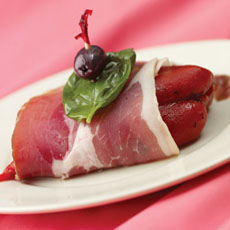
    A tasty first course: a roasted bell pepper wrapped in prosciutto. Photo courtesy Westside Market | NYC.


    This recipe fits right in with a pink food party, Valentine’s Day, Easter or Mother’s Day.

    RECIPE: PROSCIUTTO WRAPPED BELL PEPPERS

    Ingredients For 4 Servings

  • 3 tablespoons olive oil
  • 1 tablespoon balsamic vinegar
  • Salt and pepper
  • 4 red peppers, roasted and peeled*
  • 8 ounces fresh mozzarella, cut into 4 pieces
  • 4 ounces sliced prosciutto
  • 4 basil leaves
  • 4 black olives
  • 4 toothpicks
  •  
    *This is the most laborious part of the recipe. Here’s how to roast peppers. As a substitution, you can purchase whole roasted red peppers in jars (pimento). They have a softer texture and different flavor, but it’s a good flavor.
     
    Preparation

    1. WHISK together olive oil, vinegar, salt and pepper. Add peppers and marinate for 1 hour.

    2. FILL each pepper with a piece of mozzarella. Wrap a slice of prosciutto around each pepper.

    3. TOP each with a basil leaf and olive, held together with a toothpick.
     
    It’s that easy!


    Comments off

    Rainbow Baby Carrots, 20+ Carrot Recipes & 8 Carrot Holidays

    Baby carrots are hot sellers. But how much hotter can they get than these rainbow baby carrots?

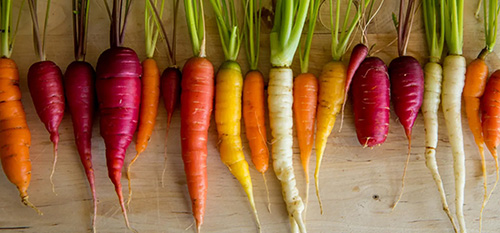
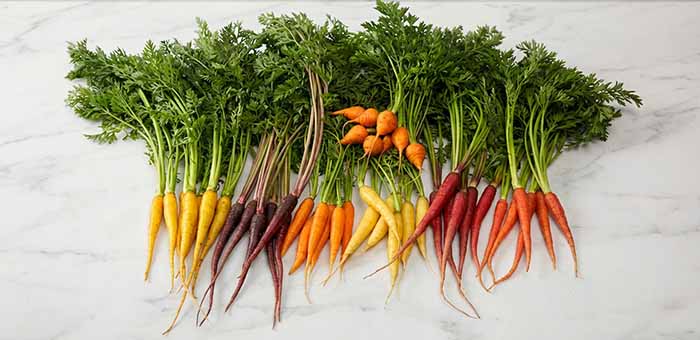
    Carrots—standard size and baby—are available in six different colors: the familiar deep orange plus burgundy red, deep purple, tangerine (light orange), yellow and white.

    Baby carrots, by the way, are not a special breed but standard carrots cut down to the small size.

    They’re a delicious way to add color and crunch to appetizers, salads and entrées. Kids and adults alike love them for their unusual colors—and for helping make family nutrition into fun.

    Deeply colored produce are rich in nutrients, including antioxidants. Different antioxidants produce the different colors or carrots. More about that in a minute. But first…
     
     
    A VERY BRIEF CARROT HISTORY

    The original wild carrots were white, like parsnips. According to Colorful Harvest, marketer of these rainbow carrots, the cultivated purple and yellow carrots—mutations—were eaten more than 1,000 years ago in what is now Afghanistan.

    Other colors are the product of generations of traditional plant breeding. Orange carrots were first successfully bred in Holland from an orange mutation by Dutch farmers.

    > International Carrot Day is April 4th.

    Below:

    > The history of baby carrots.

    > The year’s 8 carrot holidays.

    > 20+ yummy carrot recipes.

    > Where do carrots get their color?

    Elsewhere on The Nibble:

    > Here’s more history of carrots.

    > 25 delicious uses for carrot tops.

    > How to repurpose carrot peelings.
     
     
    WHERE DO CARROTS GET THEIR COLOR?

    From phytonutrients! Studies indicate that these phytonutrients are also more bio-available and easier to absorb from fresh fruits and vegetables than from other sources.

  • Red carrots get their color from lycopene, an antioxidant that may promote healthy eyes and a healthy prostate.
  • Orange and tangerine carrots get their color comes from beta-carotene, an antioxidant and precursor of vitamin A.
  • Purple carrots get their color from anthocyanins, the same potent phytonutrients (antioxidants) that makes blueberries blue,. Anthocyanins are flavonoids that may help increase the antioxidant capacity of the blood and may help maintain good brain function.
  • Yellow and white carrots get their color from lutein, which studies suggest may promote good eye health.
  •  
    Different Carrot Colors
    [6] Today you can find carrots in a rainbow of colors (photo © USDA).
     
     
    THE HISTORY OF BABY-CUT CARROTS VS. TRUE BABY CARROTS

    Baby-cut carrots were “invented” by Mike Yurosek, a California carrot farmer, in 1986.

    He was frustrated that a huge percentage of his carrot crop—up to 70%—was being discarded because the carrots were too twisted, knobby, broken, or misshapen to sell in stores. They were perfectly edible but cosmetically imperfect.

    And it was a significant financial loss for carrot growers.

    He experimented with cutting and shaping the rejected carrots into small, uniform, smooth pieces using an industrial green bean cutter. He then had them peeled into the now-familiar rounded, stubby shape.

    The result was a product that was convenient, visually appealing to kids and adults alike, an easy-to-serve snack, and waste reduction through upcycling—taking something that would have been discarded and transforming it into a higher-value product.

    He sent a bag of his prototype baby carrots to a supermarket buyer, and the response was immediate and enthusiastic. Consumers went wild for them, and stores couldn’t keep them on the shelves.

    Carrot consumption in the United States increased dramatically after their introduction, essentially saving the American carrot industry by turning an overlooked vegetable into a convenient snack. It’s considered one of the most brilliant produce marketing innovations of the 20th century.
     
     
    True Baby Carrots

    Specialty fine produce growers produce true baby carrots, which are actually just immature carrots pulled early. These are prized as ingredients and garnishes by fine chefs.

    The most common term for these immature carrots (photo #7) is “true baby carrots.” Other names include:

  • Baby bunch carrots, frequently used because they’re typically sold in a bunch with their green tops still attached.
  • Gourmet baby carrots.
  • Heirloom baby carrot, used when the carrots are of a heritage variety.
  • Petite carrots, seen on some upscale produce labels.
  •  
    The supermarket variety is referred to as “baby-cut.”


    rainbow-carrots-230
    [1] Rainbow carrots from Colorful Harvest (photo by Elvira Kalviste | © THE NIBBLE).

    Bouquet Of Carrots In A Vase
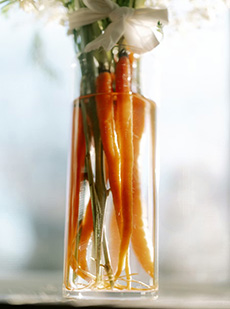
    [2] Turn a beautiful bunch of carrots into a bouquet until you’re ready to eat them (photo © Brooke Balentine | Unsplash).

    Carrot Tartare
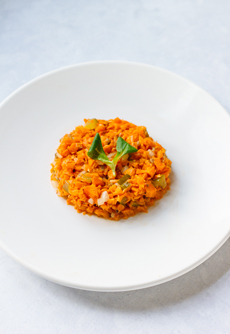
    [3] Carrot tartare, a fun recipe (photo via The Little Things | Pinterest).

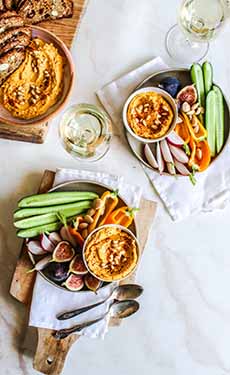
    Carrot Hummus Recipe
    [4] Carrot hummus. Here’s the recipe (photo © Discover California Wine).

    Roasted Carrots With Quinoa
    [5] Moroccan Roasted Carrots & Quinoa. Here’s the recipe (photo © Good Eggs)

     
    True Baby Carrots
    [7] True baby carrots are immature carrots harvested early (Abacus Photo).
     
     
    25 CARROT RECIPES

  • 25 Uses For Carrot Tops
  • Braised Moroccan Chicken With Farro-Carrot Salad
  • Carrot & Sweet Potato Tzimmes
  • Carrot Fries, Baked Or Air-Fried
  • Carrot Hummus
  • Carrot Latkes (Potato Pancakes)
  • Carrot Oil Made From Carrot Peelings
  • Carrot Raisin Slaw
  • Carrot Tartare
  • Carrot Top Pesto
  • Carrot Salad With Global Variations
  • Corned Beef & Cabbage Broth Bowl
  • Curried Carrot Soup
  • Fall Salad
  • More Ways To Enjoy Carrots
  • Moroccan Quinoa & Roasted Carrots
  • Peas & Carrots Canapés
  • Rainbow Mashed Potatoes
  • Roasted Whole Carrots
  • Shredded Salads
  • Spiced Roasted Carrots With Sumac
  • Summer Crudités (A Modern Relish Tray)
  • Vegetable Crudo
  • Veggie Hash Browns
  •  
     
    THE YEAR’S CARROT HOLIDAYS

  • February: National Snack Food Month
  • February 3: National Carrot Cake Day
  • March 10: National Pack Your Lunch Day
  • April 4: International Carrot Day
  • June 17: National Eat Your Vegetables Day
  • October 1: World Vegetarian Day
  • October 2: National Produce Misting Day
  • November is National Roasting Month
  •  
    Plus:

  • April 30: National Bugs Bunny Day
  • September, 4th Saturday: International Rabbit Day
  •  
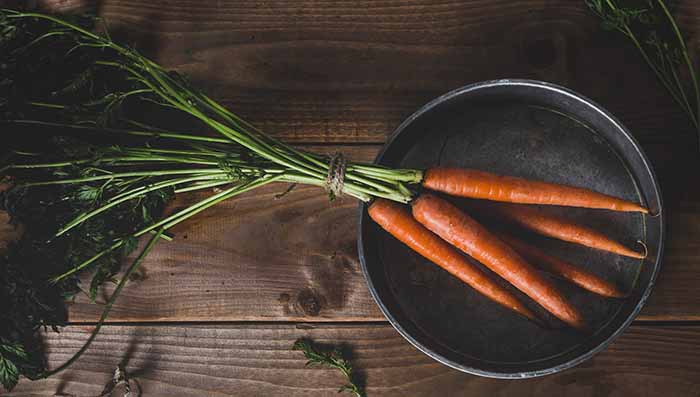
    Bunch Of Carrots With Their Tops
    [8] Don’t toss the tops. Turn them into pesto with this easy recipe (photo © Mae Mu | Unsplash).
     

    CHECK OUT WHAT’S HAPPENING ON OUR HOME PAGE, THENIBBLE.COM.


    Comments off

    The Nibble Webzine Of Food Adventures


    © Copyright 2005-2026 Lifestyle Direct, Inc. All rights reserved. All images are copyrighted to their respective owners.