THE NIBBLE BLOG: Products, Recipes & Trends In Specialty Foods


Also visit our main website, TheNibble.com.

TIP OF THE DAY: Healthy Valentine Gifts

Kiklos Olive Oil

Hot Pickle Slices

Canfield's Diet Chocolate Fudge Soda

Sashimi Deluxe

25 Year Old Balsamic Vinegar

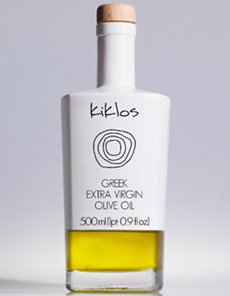
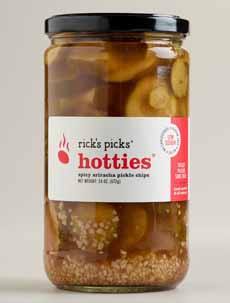
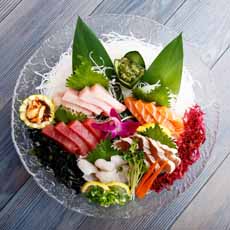
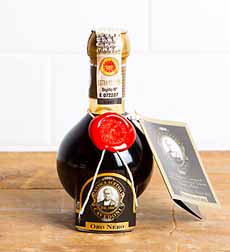
[1] For good health: extra virgin oil (photo courtesy Kiklos). [2] For low calories: artisan pickles, like a gift collection from Rick’s Picks. These Hotties for your hottie are just $6.99 (photo courtesy Rick’s Picks). [3] No calories: Chocolate seltzer or diet chocolate soda. [4] A healthy dinner: sashimi (photo courtesy Kabuki Restaurants). [5] For the gourmet: 25-year-old balsamic vinegar (photo courtesy Gear List)


Not everyone wants chocolate for Valentine’s Day, or cupcakes with red and white sprinkles.

Here are some delicious food ideas for the health enthusiast, the calorie counter, and anyone staying away from the sweets.

KIKLOS OLIVE OIL

Olive oil for Valentine’s Day?

While this is a delicious EVOO for salad lovers, we first thought of this as a gift for health enthusiasts.

The government recommends two tablespoons of olive oil a day as part of a heart-healthy diet—a practice that should start long before we’re at the age to worry about heart health!

They can take the form of salad dressing; but we actually like to drink ours.

The Koroneiki olives in Kiklos olive oil are grown in the Peloponnese peninsula of Greece. The varietal is known for levels of fruitiness, bitterness, and pepperiness.

We found our bottle of Kiklos Greece to have buttery flavor with a bit of peppery kick (i.e., not earthy, green, grassy, or other olive oil flavors that some people might not to drink from the spoon. Everyone will like it.

Plus, the handsome bottle (photo #1) even looks healthy! For your Valentine, add a red ribbon or a few peel-and-stick hearts.

Buy it on the company website for $29; the bottle is 500 ml/16.9 ounces.

Check out this olive oil wheel for an overview of all the flavors and aromas of olive oil.
 
ARTISAN PICKLES

At upwards of of $10 per bottle, even the most avid pickle enthusiasts don’t eat artisan pickles as often as they like.

Look to your local farmers markets, or to online specialists like Rick’s Picks.

Rick’s Picks has a variety of gift boxes, but for a small Valentine gift, how about a bottle of Hotties spicy pickle chips (photo #2) for your own special hottie?

Crunchy, spicy, tangy and low in calories: Help make Hotties a go-to Valentine gift.

 
NON-CALORIC CHOCOLATE SODA OR SELTZER

Canfield’s Diet Chocolate Fudge Soda has long been a staple food for calorie-counting chocolate lovers.

We especially like to add it to nonfat milk for a diet egg cream, or add a small scoop of ice cream for a float.

It’s sold nationwide; but if you can’t find it locally, you can buy a six-pack of Canfield’s Diet Chocolate Fudge Soda on Amazon (photo #3). Tie a bow on it.

For those who don’t like artificial sweeteners, look for chocolate-flavored seltzers. In our neck of the woods, we can find White Chocolate Seltzer from Adirondack Beverages. We buy it by the case.
 
SASHIMI DINNER

There’s no better place to dine than a Japanese restaurant: no bread basket or dessert temptations.

There are different types of salads, the soups are low in calories, you can often get brown rice, and green tea goes better with the food than cocktails.

A deluxe sashimi plate is the best way to load protein with fewer calories (photo #4). Be sure to eat the yummy seaweed. Radish lovers: Enjoy that shredded daikon!

If you aren’t taking the giftee to dinner yourself, put the restaurant gift certificate (or any gift card) in a Valentine card.
 
BALSAMIC VINEGAR

For us, nothing says I love you better than a pricey bottle of super-aged authentic balsamic vinegar (photo #5).

A true gourmet looks forward to these precious drops, so dense they stand up by themselves, which are meted out with an medicine dropper.

This is not the vinegar with which to dress salads; it’s an exquisite accent to anything from filet mignon to the finest Parmigiano-Reggiano cheese.

Other traditional uses are the season’s best tomatoes or strawberries, pound or angel food cake. You place droplets of balsamic on the plate, and dip the food into it. You never cook with it

Once you have your first taste, you may simply decide to drink droplets from the spoon!

 
These precious liquids are sold in 100 ml/3.4-ounce bottles.

  • A 25-year-old balsamic is in the $140-$180 range.
  • A 50 year-old is double that.
  • A 75 year-old is easily double that.
  •  
    Why so pricey?

    Someone has not only been paying the expense to store it under proper conditions, but has not earned a penny from it in 25-50-75 years.

    If you see bargain prices, no matter what the label says (“authentic balsamic from Modena, Italy”), with a a red wax seal and/or a fancy box, pass it by.

    Given the normal prices of super-aged balsamic, there’s a lot of counterfeiting around. Or if not counterfeit, it may contain a drop of 50 year old balsamic mixed in with, say, 12-year-old balsamic.

    The bottom line: Buy from a reputable, knowledgeable retailer.

    Authentic bottles are of the shape shown in photo #4, are numbered, and have the Consorzio seal. Here’s more about balsamic vinegar.
     
    TOMORROW: A MOST LUXURIOUS VALENTINE GIFT.

    And…it’s still a better-for-you gourmet gift.

    Most of it, anyway.
      

    Comments off

    TIP OF THE DAY: 3-D Animal Crackers

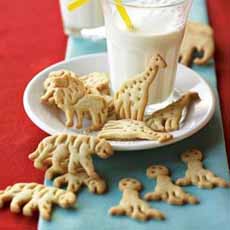
    If you like to bake cookies, try your hand at something different: 3-D cookies.

    They’re sold by a British novelty products company called Suck UK (why ask why?), and available on Amazon.

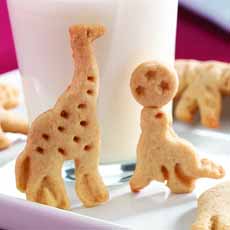
    The zoo animal cookie cutter set contains a mother and baby. Each set has four cutters: two bodies and two pairs of legs, large (mom) and small (baby).

    Cut out the cookie dough, bake, then slot the pieces together. The larger cookie is 7″ tall by 4.5″ wide. Instructions are included.

    For Valentine’s Day, you can affix a candy heart with icing.

  • Elephant
  • Giraffe*
  • Hippo
  • Lion
  •  
    NOTE: For those who pay close attention, we know that these are not 3-D cookies, but 2-D (flat) cookies that stand up. But that’s what the manufacturer calls them, and no one has called them on it.
    ________________

    *We couldn’t find the giraffe on Amazon, but found it on another site, a bit more expensive.

     
    THE HISTORY OF ANIMAL CRACKERS

    Americans grow up on animal crackers. But the concept actually originated in England in the late 1800s, as animal biscuits (the British term for cookies).

    In 1889, when P.T. Barnum toured England with his circus, several manufacturers took advantage of the marketing opportunity and named their animal biscuits “Barnum’s.”

    The animal biscuits were exported to America, inspiring local bakeries to make their own.

    The National Biscuit Co. (today, Nabisco), introduced theirs in 1902 as “Barnum’s Animals” (they added the word “Crackers” in 1948).

    The “circus car” box with the string handle was introduced later in the year, as a Christmas tree ornament for Christmas 1902.

    (Neither P.T. Barnum nor the Barnum & Bailey Circus ever got a cent in licensing fees from any “Barnum’s” crackers or biscuits. Where were their lawyers?)

       
    Giraffe Cookie Cutter

    Elephant Cookie

    Hippo Cookie Cutter
    [1] Giraffe, [2] elephant, [3] and the hippo cookie cutters (photos courtesy Suck UK).


    Homemade Animal Crackers

    Homemade Animal Crackers Recipe

    Homemade Animal Crackers Recipe
    [4] Even if you don’t want to take on 3-D cookies, you can make better-tasting animal crackers with this recipe from Williams-Sonoma Kitchen. [5] and [6] Use a toothpick or other implement to make designs in plain cookies (photos courtesy Chicago Metallic).

      RECIPE: ANIMAL CRACKERS

    If you have an animal cookie cutter hanging around, here’s a recipe for that animal cracker taste, from Williams-Sonoma Kitchen.

    They used a set of plunger animal cookie cutters that create the marks on the cookies. Those cookie cutters are no longer available, but we found something similar on Amazon. Alternatively, you can:

  • Make the grooves with a toothpick, ice pick or other utensil.
  • Leave the cookies plain.
  •  
    Prep time is 45 minutes, cook time is 16 minutes. You can make the dough up to two days in advance.

    Ingredients For 20† Cookies

  • 2-1/2 cups all-purpose flour
  • 1 teaspoon baking powder
  • 1/2 teaspoon salt
  • 1/8 teaspoon freshly grated nutmeg
  • 1/8 teaspoon mace
  • 12 tablespoons (1-1/2 sticks) unsalted butter, at room temperature
  • 1 cup sugar
  • 1 egg
  • 1 teaspoon vanilla extract
  • ________________

    †The number of cookies will vary based on your cookie cutter size.
    ________________

    Preparation

    1. SIFT together the flour, baking powder, salt, nutmeg and mace over a small bowl. Set aside.

    2. FIT an electric mixer fitted with the flat beater and beat the butter on high speed for 2 minutes. Reduce the speed to medium, slowly add the sugar and beat for 2 minutes, stopping the mixer occasionally to scrape down the sides of the bowl. Add the egg and vanilla and beat for 1 minute, stopping the mixer once to scrape down the sides of the bowl.

    3. STOP the mixer and add half of the flour mixture. Beat on low speed until most of the flour has been incorporated. Add the remaining flour and beat until all of the flour has been absorbed and the dough starts to pull away from the sides of the bowl, 2 to 3 minutes.

     
    4. TURN the dough out onto a work surface and divide into 2 equal balls. Shape each into a disk and wrap separately in plastic wrap. Refrigerate for at least 2 hours or up to 2 days. When ready to bake…

    5. PREHEAT the oven to 350°F. Let the dough stand at room temperature for 5 minutes. Place each dough disk between 2 clean, large pieces of plastic wrap. Roll out the dough to 1/8-inch thickness. (If the dough cracks while rolling, let it stand at room temperature for 5 to 10 minutes more.) Remove the plastic wrap and place the dough on a floured work surface. Lightly dust the top of the dough with flour.

    6. LINE several baking sheets with parchment paper. Dip the cookie cutters into flour just before using and cut out the shapes. With plunger cookie cutters: Hold each cutter over a prepared baking sheet and lightly depress the plunger to remove the cutout; the plunger will also imprint the tops of the cookies. With regular cookie cutters: Place the cut-out shapes on the baking sheet one at a time and decorate as desired with a toothpick.

    7. FREEZE the baking sheets for 15 minutes, or refrigerate for 30 minutes. Gather up the scraps, reroll and cut out more cookies.
    8. BAKE the cookies until very light golden brown, 14 to 16 minutes. Transfer the baking sheets to wire racks and let the cookies cool to room temperature.


    Comments off

    Leftover Steak For Breakfast & The History Of The Doggie Bag

    When life gives you leftover steak, make steak and grits. That’s what we did when we happily brought home a doggie bag from a midtown steakhouse Friday night.

    The next morning the leftovers became part of breakfast (or brunch*, if you prefer).

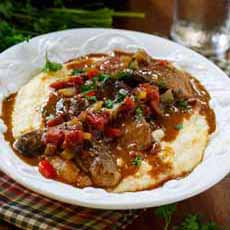
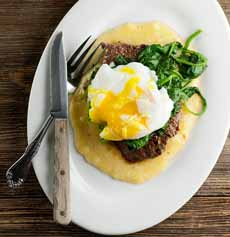
    You can make steak and eggs, of course; but we don’t have grits often enough. And there’s no reason why you can’t combine all three, as in photo #3.

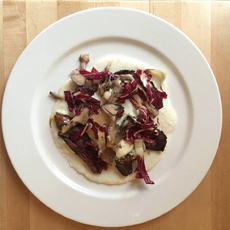
    We were inspired by this photo from Publican Quality Meats of Chicago to recreate a version of their recipe with mushrooms, radicchio and parmesan cheese (photo #1). You can go as plain or fancy as you like.
     
     
    RECIPE: STEAK & GRITS

    The ingredients can be cooked up to two days in advance, then assembled and heated. This is especially great news for those who demand the best, creamiest grits, which can take 90 minutes cooking time.

  • These can be made up to 2 days ahead, cooled to room temperature, then covered and refrigerated. To reheat, break the congealed grits into pieces and whisk in enough boiling water to loosen (up to about 1 cup). Heat over low heat, stirring constantly.
  • If you’re cooking steak from scratch, you can cook it the day before, and slice prior to warming and serving. Undercook it, since it will cook a bit more when you heat it.
  •  
    Ingredients

  • Grits of choice (Anson Mills heirloom grits are the best)
  • Optional: for cheese grits, grated cheese of choice
  • Mushrooms, cleaned (we like a mix of wild mushrooms)
  • Radicchio, julienned
  • Butter or oil for sautéing
  • Steak, cooked
  • Optional garnish: shaved parmesan
  •  
    Preparation

    1. COOK the grits per the package instructions. While the grits are cooking…

    2. SLICE the steak and place it in a microwave-safe dish.

    3. SAUTÉ the radicchio and mushrooms, stirring occasionally, 4 to 5 minutes. When ready, warm the steak in the microwave.

    4. SPOON the grits onto plates and arrange the sliced steak, radicchio and mushrooms. Garnish as desired with freshly-shaved Parmesan cheese. Serve with a pepper mill.
     

    THE HISTORY OF THE DOGGIE BAG

    Since Elizabethan times at least, taverns and public houses provided extra-large napkins—not only because people ate with their hands, but they used them to wrap up and take home any leftovers.

    Long before then, well-to-do ancients were accustomed to bringing napkins when invited to dinner, initially to clean one’s hands and mouth. Hosts provided the food, but not the linens. Around the 6th century B.C.E., they started using their napkins to wrap leftovers to take home (here’s the history of the napkin).

    It was also common practice to distribute leftovers to vassals, slaves and servants; and since there was no refrigeration, remnants went to dogs and pigs.

    In postwar times (that’s post-World War II), customers of steak houses would ask to take home the meaty leftovers, “for the dog.” (For those with no dog, it became a decorous way of taking the food home, for people accustomed to the frugal practices of wartime rationing.) There are different claims to the origin of the doggie bag:

    In 1949, Al Meister, owner of Bagcraft Papercon, a Chicago-based packaging company, developed a coated paper bag that was grease-resistant. He is credited with inventing the “doggie bag”—and the take-out bag, for that matter. See the footnote† below for other references.

    Grease-resistant bags soon evolved into foil-lined bags with drawings of Fido—a way to explain why nice people were leaving the restaurant with paper bags.

    Yet elsewhere, many people were criticized by embarrassed family and friends with whom they dined, who felt it was in poor taste. According to one article, well into the 1970s etiquette columns in newspapers got letters asking if it was O.K. to ask for a doggie bag if they didn’t have a dog.

      Steak & Grits
    [1] Turn leftover steak into steak and grits, here topped with radicchio (photo © Publican Quality Meats| Chicago).

    Steak and Grits
    [2] Stretch leftover steak by adding vegetables, Here’s the recipe from Spicy Southern Kitchen (photo © Spicy Southern Kitchen).

    Steak, Eggs & Grits
    [3] Have it all: steak, grits and eggs, plus some greens. Here’s the recipe from Framed Cooks (photo © Framed Cooks).

    Steak & Grits
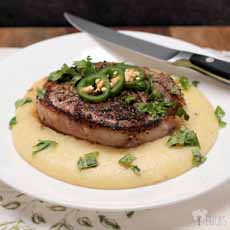
    [4] A peppery approach: bacon-wrapped steak, pepperjack grits and a jalapeño garnish. Here’s the recipe from Erica’s Recipes (photo © Erica’s Recipes.)

    Doggie Bag
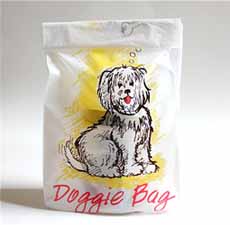
    [5] Turn that leftover steak into steak and grits for breakfast or brunch (photo ©y Disposable Plastic Wear).

     
    With the exception of Elizabeth Post, Emily Post’s granddaughter by marriage, advice columnists invariably approved of doggie bags as “sensible if not downright virtuous.”

    That remains on trend. No one wants to throw out good food, including the restaurants. (Seattle has even enacted laws to create less kitchen food waste.)

    So no matter how large or small the amount of leftover food, don’t hesitate ask for it. If not, you’ll wake up the next day, sorry you didn’t take it home.

    ________________

    *Breakfast is the first meal of the day, lunch is the second meal, after breakfast. “Brunch” evolved as a weekend meal for later risers, who combined the two meals. Brunch is typically eaten during the late morning or early afternoon and can include both conventional breakfast items (eggs, pancakes) and lunch items (frittatas, starts, quiche, soup and salad, panini or other lighter fare). The other benefit of brunch over breakfast: cocktails with juice (Bellini, Bloody Mary, Mimosa, etc.)

    †Sources vary as to the origin of the term:

    >According to the Encyclopedia of American Food and Drink, John F. Mariani [Lebhar Friedman:New York] 1999 (p. 113): “Although leftovers have long been packed up for customers, the term ‘doggie bag’ dates in print to 1963. Two claims have been made for the idea under that name, Lawry’s Prime Rib, a Los Angeles restaurant that dates it usage back to the 1930s, and the Old Homestead Steak House in New York City, whose owner, Harry Sherry, also began to use the term in the 1930s.”

    >According to Oxford Companion to Food, Alan Davidson [Oxford University Press:Oxford] 2nd edition, 2007 (p. 253), notes that the doggy bag (or doggie bag) presumed the dog to be the beneficiary of the contents. A 1943 print reference notes that in San Francisco and Seattle, a bag called the Pet Packit was used to take home leftovers.

    >Restaurants in San Francisco and Seattle started to providing waxed paper bags for customers to take home leftovers “for the dog”; the custom rolled out nationwide.

    >Yet another claim says that the doggie bag was born in 1949 at Dan Stampler’s Steak Joint on Greenwich Avenue in New York City. Their grease-proof doggie bags bore an image of the proprietor’s Scottish terrier. They were manufactured by Bagcraft Corporation of Chicago, which sold them to other restaurants as well. Subsequently, the wife of the co-founder of Bagcraft, Jane Meister, wrote a poem that appeared on the bags: “Oh where, oh where have your leftovers gone? / Oh where, oh where can they be? / If you’ve had all you can possibly eat,/ Please bring the rest home to me!!”

    For more information see the article in Smithsonian Magazine.


    Comments off


    © Copyright 2005-2026 Lifestyle Direct, Inc. All rights reserved. All images are copyrighted to their respective owners.