RECIPE: Inside-Out Homemade Peppermint Patties
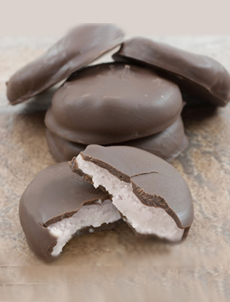
 [1] Hannah Kaminsky’s Inside-Out Peppermint Patties (photo © Bittersweet Blog).
|
It’s National Chocolate Mint Day. You can make a cool chocolate peppermint pie, warm chocolate mint lava cakes, have some mint chocolate ice cream or chocolate peppermint patties. How about your own, homemade peppermint patties—with a reverse approach: creamy chocolate on the inside, white mint coating on the outside? Hannah Kaminsky of Bittersweet Blog who created this recipe, gives us the reason: “The only thing that could be improved [in a peppermint patty] is the ratio of chocolate to peppermint, which is why I decided to flip the classic patty inside-out.” > The history of mint. > The history of the peppermint pattie. > The year’s 9 mint holidays. February 11th is National Peppermint Patty Day and February 19th is National Chocolate Mint Day. > The year’s 69 chocolate holidays. > The year’s 60+ candy holidays. Ingredients For 30-34 Patties *As always, the better the chocolate, the better the result. Look for two quality 3.5-ounce chocolate bars (Green & Blacks, Lindt, etc.) or consider buying a pound of the chocolate disks (wafers) that confectioners use. 1. FORM the centers: Place the chopped chocolate and corn syrup in a microwave-safe bowl and heat for about 60 seconds. Stir vigorously; continue to heat at intervals of 30 seconds, stirring well each time, until the chocolate is completely melted and smooth. Transfer the mixture to a Silpat mat or piece of parchment paper, and refrigerate until set, about 1 hour. 2. ROLL out the chilled chocolate mixture to about 1/4-inch thick and use 1-inch round cookie cutters to punch out the candy pieces. Should the chocolate become too soft or difficult to work with, just toss it back in the fridge for another 15-30 minutes. Once all of the centers are cut, place them in the freezer for at least 30 minutes before getting making the coating. 3. PREPARE the coating: Place the cocoa butter in a microwave-safe bowl and heat for 1-3 minutes until it completely liquefies. Whisk in the sugar and peppermint oil, stirring vigorously to completely dissolve. 4. REMOVE the semi-frozen patties from the freezer and dip each into the mint coating, one at a time. Place them back on the Silpat, allowing the coating to set. This top coat is thinner than the standard pure chocolate shell, so you may wish to double-dip once the first layer has solidified. |
|
|
5. SHARE the result with loved ones and raise a cup of tea (or brandy, liqueur [chocolate, mint, Irish cream), Prosecco, or Zinfandel) to National Chocolate Mint Day. FREEZE THE PATTIES IN SUMMER February 11th is National Peppermint Patty Day, February 19th is National Chocolate Mint Day. How can you celebrate in the summer? “Especially in the heat of summer,” says Hannah Kaminsky, “peppermint patties are one of my favorite treats. Best stashed in the freezer for full cooling effect, I love the way the chocolate shell shatters upon impact, releasing its soft, creamy center with minty-fresh flavor. Whether it’s candy, meat, or veggies, to be perfectly correct, the spelling is patty. Patties is the plural form, so many folks assumed the singular to be pattie. The word first appeared in English around 1700-1710, derived from the French pâté (paste in English), a mix of finely-ground ingredients. Pasta is the Italian word for paste; and in modern French cuisine, pâté refers to a meatloaf as well as the more finely ground goose or duck liver pâté. Perhaps America’s most famous patty is the [incorrectly spelled] York Peppermint Pattie. According to a company history in Wikipedia, the York Peppermint Pattie was first produced by Henry C. Kessler, owner of the York Cone Company, in 1940. The company was named for its location: York, Pennsylvania. Today the company is owned by Hershey and the production is in Monterrey, Mexico. (continue below) Mint has been valued for millennia, as medicine, air freshener, breath freshner, perfume, and in recipes. Mint is believed to have originated in North Africa. By 1500 B.C.E. it was well known to the Egyptians, who used it to treat stomach ailments and to sweeten their breath. Known in Greek mythology as the herb of hospitality, one of mint’s first known uses was as a room deodorizer: The herb was strewn across floors to cover the smell of the hard-packed soil. In fact, the name “mint” comes from a nymph in Greek mythology named Minthe or Menthe, who was Pluto’s girlfriend. Pluto’s wife, Persephone, became jealous and transformed her into a plant that people could step on. Although Pluto was unable to change Minthe back into a nymph, he gave her the ability to sweeten the air when her leaves and stems were crushed. In ancient Greece and Rome, the sweet smell of mint was used in funerary rites and to scent the body. Some ancient Greeks even rubbed it on their arms, believing it would make them stronger. Ancient Jewish temples received tithes of mint. In Matthew 23:23, the scribes and Pharisees (religious leaders and teachers) paid tithes of mint, dill, and cumin as part of their meticulous observance of religious law*. The mint was spread mint on the floors of synagogues to freshen the air with its sweet fragrance. Throughout the Middle Ages, numerous healing properties were attributed to mint. Dietaries from the late 1500s suggest that mint juice was effective against poison, and the mint herb encouraged circulation of good blood if eaten raw. Most likely, mint reached the New World via the Pilgrims. Eventually, farmers began to cultivate it commercially. Mesopotamia: Herbs like cilantro and mint were abundant in Mesopotamian food, where some of the oldest recorded recipes date to around 1730 B.C.E. China: In ancient China, mint was served to welcome guests and used to balance flavors in savory dishes and create refreshing summer drinks. Egypt: Ancient Egyptians used mint to flavor foods and beverages, including a popular drink made from fermented barley. Greece: Ancient Greeks used mint as a flavoring in meat sauces and as a condiment in food and wine. While it may sound stange to us, mint was often used to flavor wine at feasts Rome: Ancient Roman cooks incorporated mint into sauces for roasted meats, believing it aided digestion. India: Mint has been a cornerstone of Indian cuisine for thousands of years. Known as pudina in Hindi, it features prominently in chutneys, raitas, and refreshing beverages like mint lassi. The most popular types of mint are spearmint (Mentha spicata) and peppermint (Mentha x piperita), which dominate culinary, medicinal, and commercial uses. Spearmint is widely used for cooking, cocktails, and toothpaste, while peppermint is known for its strong menthol flavor in teas and candies. Other popular varieties include apple, chocolate, and orange mint. ________________ †The book is believed to have been compiled in the 4th and 5th centuries by various contributors, and the name honors a famed first-century gourmet, Marcus Gavius Apicius, a wealthy Roman gourmet and epicure in the days of Emperor Tiberius. Famous for his extreme culinary extravagance, he is often dubbed the “patron saint of cooks.” His costly banquets ultimately depleted much of his wealth. When he realized he could no longer maintain his lavish culinary lifestyle and would have to economize, he poisoned himself rather eat ordinary food. CHECK OUT WHAT’S HAPPENING ON OUR HOME PAGE, THENIBBLE.COM. |
||