RECIPE: Bhaji, Indian-Style Onion Rings & The History Of Onion Rings
|
|
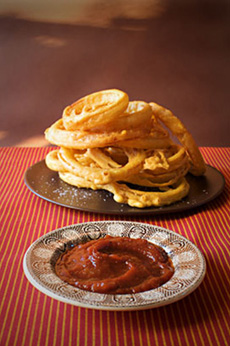
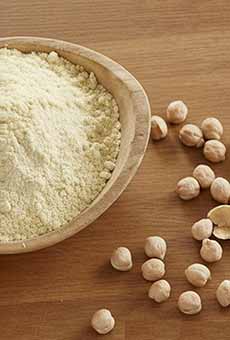
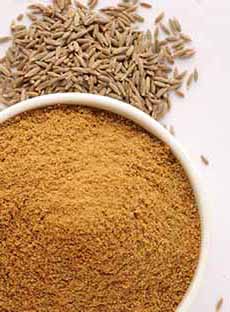
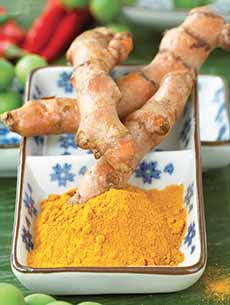
If you’re looking for interesting Super Bowl fare, add a spin to onion rings with this recipe from Indian food doyenne Maya Kaimal (find more of her delicious recipes at MayaKaimal.com). Serve it with spicy ketchup—store bought or home made, by mixing some heat into your regular ketchup. The recipe follows, but first: > The history of onion rings is below. > The different types of onions: a photo glossary. > The year’s 5 Indian food holidays. > The years 24 fried food holidays are below. > The years 6 onion holidays are also below. National Onion Ring Day is June 22nd. > Below: More special onion ring recipes. > Below: Cooking frozen onion rings in an air fryer. Ingredients For 2 Servings 1. HEAT the oil in a wok or 4-quart pot over medium heat, to 350°F. 2. MIX the chickpea flour, cumin, cayenne, turmeric and salt in a medium bowl. Add the water and stir until batter is formed. It should be just thick enough to coat an onion ring without sliding off too quickly. Adjust with more water if necessary. 3. DIP the onion rings into batter and coat each thoroughly. Deep-fry the rings, in 3 or 4 batches, in the oil until golden brown on both sides. Drain on paper towels. 4. SERVE with spicy ketchup. Fried onion rings have a surprisingly murky history for such a popular dish. The exact origins are debated, but here’s what we know: The earliest known recipe for something resembling onion rings appears in an 1802 English cookbook called “The Art of Cookery Made Easy and Refined,” by John Mollard. It describes cutting onions into rings, dipping them into a batter, and frying them. These were meant as a garnish than eating onion rings as a standalone dish, such as evolved in the U.S. American-style onion rings seem to have emerged in the early 20th century. A recipe appeared in Women’s Home Companion in 1905, which means that they were known earlier. There are records that fried onion rings were served at the Grove Park Inn in Asheville North Carolina, shortly after it opened in 1913. A few years later politician William Jennings Bryan’s recipe for them appeared in a Boston newspaper, in which he said that he first encountered them at the Inn. [source]. Bryan’s recollection as well as the 1905 recipe settle the question of whether french fried onion rings were the 1920s invention of a Pig Stand in Texas, as frequently claimed on the internet. They were not. Helping the popularity was a 1933 Crisco advertisement in the New York Times Magazine, featuring a recipe for “French Fried Onion Rings.” |
|
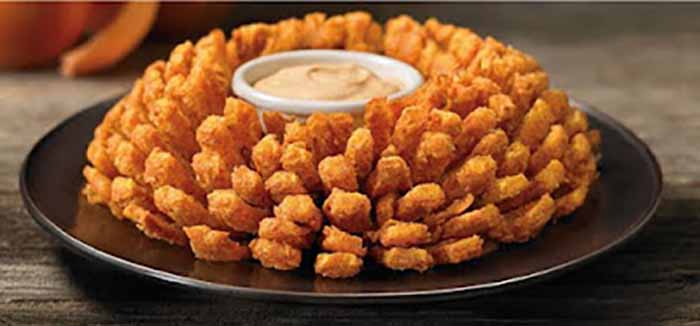
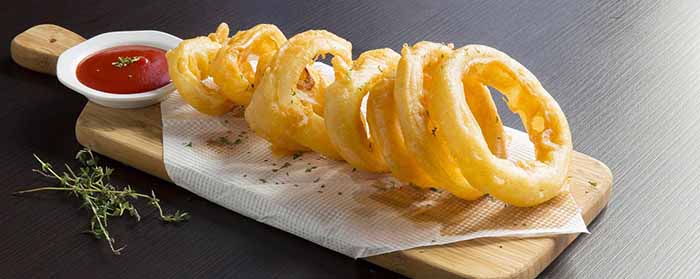 [5] One of our favorite sides…with a beer (photo Pixabay). In the 1930s onion rings became more common in restaurants, likely aided by improvements in cooking oil and deep fryers. Then, and for several decades to follow, they were usually featured as an accompaniment to a steak. In the heart of the Depression, Schrafft’s restaurants advertised its Sizzling Steak Combination: “With it you get generous helpings of French fried potatoes, onion rings or a fresh vegetable, a green salad, and a pot of Schrafft’s coffee, $1.50.” It ended with the tagline, “A Man’s Meal.” Onion rings were often specifically marketed to men. Whether women shied away from them because of possible “breath contamination” or the high price of a steak meal is unclear. At the time, onions in general carried a stigma. At various times in 20th century, they were characterized as “ordinary and even common,” as breath contaminators, and as food that restaurant kitchen workers did not like to handle (because of burning eyes?). Yet, by 1969, according to a search by Claude A.I., one writer acknowledged that, after French fries, onion rings “must be the all time favorite accompaniment to hamburgers.” According to one source, the debut of the frozen onion ring egan in 1955. A Nebraskan named Sam Quigley started a company to create products for the food service industry that would eliminate work in the kitchen. He supplied restaurants with frozen, fry-n-serve hand-breaded onion rings. In the beginning, he sold them out locally from his storefront in Nebraska but the business quickly took off and by 1959, the demand was so great that a factory he built a factory to make them faster. Another big break came in the 1960s, when the A & W chain restaurant added onion rings to its menus [source]. Beer batter onion rings became a “thing” in the 1980s, as a menu item at casual dining chains like Houlihan’s. Beer batter itself wasn’t a new cooking—it had been used for fish and for much longer. But it gave a “happening” cachet to everyone else’s onion rings. Though not ring-shaped, Outback Steakhouse’s “Bloomin’ Onion” may have propelled deep fried onions to their historic pinnacle both in terms of fat and calorie load as well as price. It was introduced by Outback Steakhouse in 1988, the year the restaurant chain was founded. It quickly became their signature appetizer and remains one of the most iconic menu items in casual dining‡‡. The Bloomin’ Onion inspired quite a few variations (Texas Roadhouse’s Cactus Blossom, Lone Star Steakhouse’s Texas Rose, state fair fare). The basic concept involves cutting a large onion to create a “flower” appearance, battering and deep-frying it, then serving it with a creamy dipping sauce (Outback’s signature sauce is a spicy, mayo-based blend).
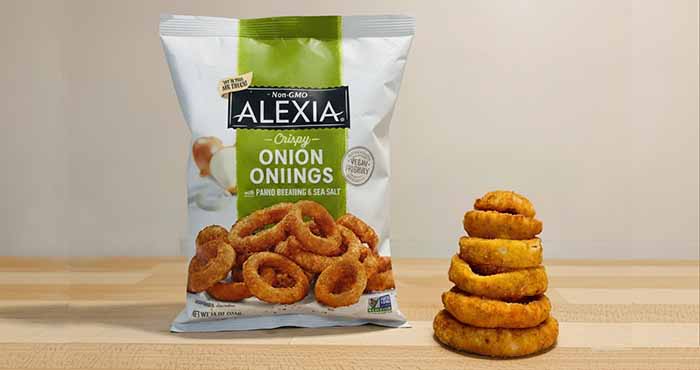
Per a search with Claude A.I., we learned that more than 200,000 U.S. restaurants currently offer onion rings on their menus. As with everything else on menus, the category is getting creative using different types of onions, coatings, and seasonings to excite the consumer palate. Some examples: The consumer market for frozen onion rings is also growing. So if you want to use your air fryer: †Sofrito is a flavorful aromatic base sauce made from a blend of sautéed onions, peppers, and garlic. It is the baser of many dishes in Spanish, Latin American, and Caribbean cuisines. ‡Onions joined lamb kidneys, pig’s knuckles, parsnips, turnips, and rutabagas, as foods that refined people should avoid. Why, we know not. ‡‡Before you rush to order a Bloomin’ Onion: According to Outback Steakhouse’s nutritional information, a full Bloomin’ Onion and dipping sauce contains approximately 1,950 calories. Not to mention the beer, which is a must-have companion. The dish is also quite high in fat, sodium, and carbohydrates due to the deep-frying process and breading. For context, that’s roughly equivalent to an entire day’s worth of calories for many people. But it is an American culinary experience, so bring a group of friends to share it with you. CHECK OUT WHAT’S HAPPENING ON OUR HOME PAGE, THENIBBLE.COM. |
||