The History Of Spinach & Ways To Use Spinach For National Spinach Day - The Nibble Webzine Of Food Adventures History Of Spinach-Ways To Use Spinach-National Spinach Day


THE NIBBLE BLOG: Products, Recipes & Trends In Specialty Foods


Also visit our main website, TheNibble.com.

The History Of Spinach & Ways To Use Spinach For National Spinach Day

March 26th is National Spinach Day.

Popeye may have enjoyed his spinach straight from the can, but for today, we can come up with 20 better suggestions.

Below:

> 20 ways to enjoy spinach.

> The history of spinach.

Elsewhere on The Nibble:

> The year’s 7 spinach holidays.

> The year’s 60+ vegetable holidays.
 
 
LOVE YOUR SPINACH AT EVERY MEAL OF THE DAY
 
BREAKFAST

  • Spinach omelet or frittata (recipe)
  • Eggs Benedict With Spinach (recipe)
  •  
    DIPS & SPREADS

  • Green Mayonnaise (Julia Child’s recipe)
  • Spinach Dip With Walnuts (recipe)
  • Spinach Pesto (substitute spinach for the basil in this recipe)
  • Warm Crab & Spinach Dip (recipe)
  • Warm Spinach & Mascarpone Dip (recipe)
  • 13 Ways To Use Spinach Dip Or Spread
  •  
    LUNCH & FIRST COURSES

  • Curried Spinach Tart (recipe)
  • Grilled Cheese With Spinach (recipes)
  • Mac & Cheese With Spinach (recipe)
  • Spanakopita (Greek spinach pie—recipe)
  •  
    MAINS

  • Pasta With Spinach: penne pasta with a garnish of fresh spinach leaves and cherry tomatoes (recipe), bow tie pasta with chicken and spinach (recipe) or cheese tortellini with spinach (recipe)
  • Spinach Stuffed Pork Roast (recipe)
  •  
    PIZZA

  • Feta & Spinach Pizza (recipe)
  • Spinach & Grilled Shrimp Pizza (recipe)
  •  
    SIDES

  • Wilted Spinach With Tzatziki (Greek yogurt dip—recipe)
  •  
    SALADS

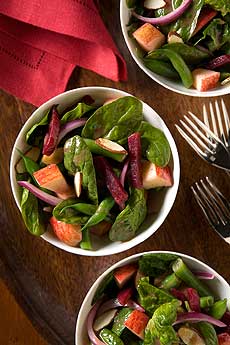
  • Beet, Spinach & Apple Salad (recipe)
  • Spinach & Grapefruit Salad (recipe)
  •  
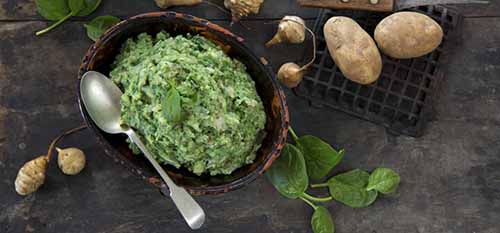
    A Dish Of Spinach Mashed Potatoes
    [4] We love this mashup of spinach and mashed potatoes. Here’s the recipe (photo © Idaho Potato Commission).

       
    spinach-mascarpone-dip-vermontcreamery-230
    [1] A warm spinach dip, creamy with mascarpone cheese (photo © Vermont Creamery).

    beet-spinach-apple-salad-butterball230
    [2] Beet, spinach and apple salad (photo © Butterball).


    [3] Spinach frittata (photo © Sun Basket).


    THE HISTORY OF SPINACH

    Spinach is believed to have originated in ancient Persia (today’s Iran), likely cultivated there by around the first millennium C.E. The first known reference to spinach dates to between 226 and 640 C.E.

    The plant, which does not like heat, was successfully cultivated in the hot and arid Mediterranean climate by Arab agronomists through the use of sophisticated irrigation techniques.

    Over trade routes, spinach was introduced to India and then to ancient China in 647 C.E., where it was (and still is) called “Persian vegetable.”

    The first written reference to spinach in the Mediterranean are in three 10th-century texts. It became popular vegetable in Provence, and by the 15th century it was common in Provençal gardens.

    It traveled north, and Europe became a spinach-loving continent.

    Spinach spread east and west via trade and conquest. It:

  • Reached India and China by the 7th century, where the Chinese called it “the Persian vegetable.”
  • Became popular across the Arab world, where it was valued both as food and medicine.
  • Entered Europe through Islamic Spain. Around the 10th–12th centuries, it was established in Al-Andalus (Andalusia).
  • Spread north into Italy and France by the late Middle Ages.
  •  
    Like Popeye, people loved their spinach (although did Popeye love the flavor, or just that the veggie packed a punch?).

  • In medieval Europe, spinach gained a reputation as a refined vegetable—sometimes called the “prince of vegetables.”
  • By the 15th–16th centuries, spinach was widely cultivated in Renaissance Europe.
  • Real or legend: Catherine de’ Medici, the Florentine noblewoman who married France’s King Henry II and became Queen of France in 1547, supposedly loved spinach so much that dishes served on a bed of spinach became known as “à la Florentine.”
  •  
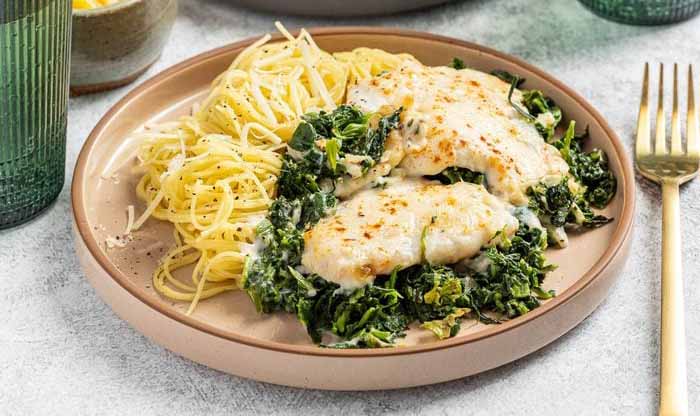
    A Plate Of Flounder Florentine
    [5] Thanks to Catherine de’ Medici, we have “Florentine” dishes for every meal of the day. Here’s the recipe for this Flounder Florentine (photo © Taste Of Home).
     
     
    Etymology
     
    The plant’s Persian name was along the order of aspanākh / esfenāj / esfanākh, the root of many modern words for spinacha.

  • Arabic isfānākh, Catalan espinac, Old French espinache (evolved to modern épinard, Portuguese espinafre, Spanish espinaca.
  • Dutch spinazie, German Spinat, Italian spinaci.
  • The English word comes from the French: Persian aspanākh → Arabic isfānākh → Old Spanish espinaca → Old French espinache → English spinach (late Middle Ages).

    If you line them up, you can hear the evolution: aspanākh → isfānākh → espinaca → espinache → spinach.
     
     
    The Two Main Forms Of Spinach

    Over time, two main forms emerged:

  • Savoy spinach: crinkled leaves, traditional European type).
  • Flat-leaf spinach: smoother, easier to clean—more common today, with many sub-varieties.
  •  
     
    Spinach Arrives In The Americas

    Spinach was brought to the Americas by European colonists in the 17th century and became a staple garden crop. It wasn’t a standout crop at first, but more of a seasonal garden green alongside things like chard and beet leaves.

    By the 1800s, it had settled into American kitchen gardens, especially in the Northeast. It was valued because it:

  • Grows fast in cool weather (early spring, late fall)
  • Was one of the first fresh greens ready after winter, and became a market vegetable.
  •  
    As cities grew, spinach became a market garden crop—farmers near cities (like New York and Philadelphia) grew it for urban markets. It was often sold loose, muddy, and highly perishable, which was a pain.

    Cookbooks from the 1800s treated spinach plainly: Boil it, chop it, serve it with butter or cream.

    In the early 20th century, spinach started to gain status.

  • Nutrition science was booming, and spinach got labeled a “health food.” It became associated with strength, recovery, and “building blood.”
  • Canning and later freezing made it easier to distribute nationwide
  • Because of its healthy association, it also became institutional food, served schools, hospitals, and military kitchens.
  •  
    In the 1930s, Popeye The Sailor changed the game*. As a result of “his” newspaper strip and subsequent cartoons, spinach demand spiked dramatically.

  • Crystal City, Texas—in a major spinach-growing region—erected a statue of Popeye in 1937 and branded itself as the “Spinach Capital of the World.”
     
    Through both World Wars, spinach maintained its reputation as a “strength food.” It was promoted as nutritious, patriotic, and
    even processed into spinach-enriched foods for soldiers. It fit perfectly into wartime messaging: cheap, domestic, healthy.

    In the mid-1950s, things changed. Mushy canned spinach in grocery stores and cafeterias engendered an anti-spinach backlash, especially among kids.

    On the other hand, the quality of frozen spinach improved the experience, and fresh spinach slowly gained ground. In the 1960s, eating raw spinach in salads became popular. The spinach, bacon, and mushroom salad became as popular as any other luncheon salad.

    In the 1980s, with a revival of health culture, spinach made a comeback in different forms: baby spinach (tender, mild, salad-friendly), pre-washed bagged spinach, and incorporation into smoothies.

    We love it in just about any form!

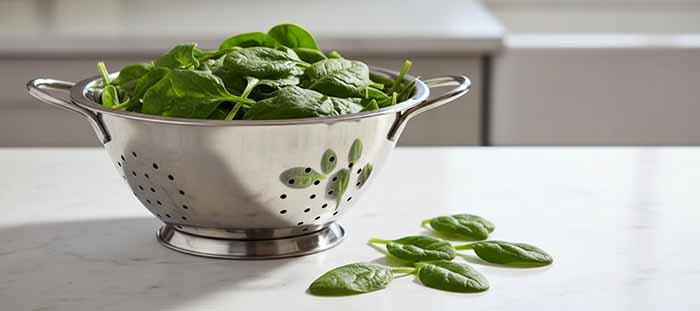
    Raw Spinach In A Colander
    [6] Think of all the things you can make with it. We started with Eggs Florentine for breakfast, a Spinach, Bacon, and Mushroom salad for lunch, and Chicken Florentine for dinner. (Abacus Photo).
     
    ________________
     
    *Popeye the Sailor was created by American cartoonist Elzie Crisler Segar (E.C. Segar). Popeye first appeared on January 17, 1929, in Segar’s daily comic strip Thimble Theatre. Although originally introduced as a minor character for a specific storyline, Popeye quickly became the popular lead character of the strip. The character is believed to be based on Frank “Rocky” Fiegel, a resident of Segar’s hometown, Chester, Illinois, who was a pipe-smoking, one-eyed laborer known for fighting.

    Initially, he didn’t eat spinach at all, but derived his superhuman strength and near-invulnerability by rubbing the feathers on the head of Bernice the Whiffle Hen. Spinach was introduced by Segar a few years later as a more permanent explanation for Popeye’s strength. On June 26, 1931, when asked how he performed his feats of strength, Popeye replied, “Tha’s easy. I eats Spinach.” In the strip of February 28, 1932, Popeye was shown eating a heaping bowl of spinach in order to knock out a braggart, stating, “They’s nothin’ like Spinach to give a man strengt’.”

    While Segar created the comic character, Max Fleischer of Fleischer Studios, who adapted Popeye into the animated cartoon series, turned the spinach into a formulaic plot device. Starting in 1933. in almost every cartoon, Popeye would be beaten down by Bluto, only to eat a can of spinach at the last second to save the day.

    The irony you didn’t see coming: There is no historical or scientific reason to continue the claim that Popeye ate spinach for its iron content, which is a double-layered myth (i.e., there was a decimal point error, i.e., that someone had misplaced a decimal point, making spinach appear ten times more iron-rich than it actually was. But Segar explicitly stated he chose spinach for a completely different nutrient.

    Segar was a health enthusiast who followed the nutritional trends of the late 1920s and early 1930s. At that time, vitamin A (specifically beta-carotene, which the body converts to Vitamin A) was the “super-nutrient” of the day. In a 1932 comic strip, Popeye explicitly explains his strength by saying spinach is “full of Vitamin A and tha’s what makes hoomans strong and helthy.” Iron was never mentioned as the benefit of spinach. However, Americans leaned into the spinach myth, and the spinach industry actually credited Popeye with a 33% increase in spinach consumption in the U.S. between 1931 and 1936.
     
    Popeye & Spinach Cartoon
    [7] One thing still bugs us: Popeye squeezed the spinach into his mouth and threw the can on the ground. Certainly, he would have been a good enough shot to throw it into the nearest trash can (photo © Mel Magazine).
     

    CHECK OUT WHAT’S HAPPENING ON OUR HOME PAGE, THENIBBLE.COM.


  • Comments are closed.

    The Nibble Webzine Of Food Adventures


    © Copyright 2005-2026 Lifestyle Direct, Inc. All rights reserved. All images are copyrighted to their respective owners.