THE NIBBLE BLOG: Products, Recipes & Trends In Specialty Foods


Also visit our main website, TheNibble.com.

TIP OF THE DAY: Buckwheat Crepe (Galette) Filled With Ham & Eggs

A crêpe is a type of very thin pancake, that can be served unfilled, with only a sprinkling of confectioners sugar, or with sweet or savory filling.

  • They can be simple or elaborate—like Crêpes Suzette, flambéed with orange liqueur.
  • They can be folded (photos #1 and #2) or rolled into a tube shape.
  •  
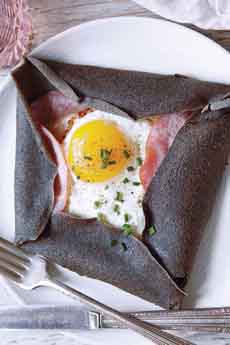
    In their native region of Brittany, France, crêpes are made with wheat flour. Those made with buckwheat flour (photo #2) are called galettes*. In the U.S., you can use either term.

    Buckwheat crêpes are a gluten-free alternative to a traditional crêpe. A common galette filling in France is ham and cheese with a sunny-side-up egg on top.

    Play with the ingredients and make yourself a breakfast galette filled with the types of eggs, cheese and breakfast meat you prefer. You can also use combinations of:

  • Other meat, fish or seafood
  • Vegetables
  •  
    Galettes are just one type of buckwheat pancake. Blini are smaller and thicker, buckwheat pancakes, often served with caviar and sour cream. Here’s a photo.

    > December is National Buckwheat Month.

    Below:

    > The buckwheat galette recipe.

    > What is buckwheat and the history of buckwheat.

    Elsewhere on The Nibble:

    > Soba noodles and soba salad recipe.

    > The year’s 7 pancake holidays.

    > The year’s 35+ grain holidays.
     
     
    RECIPE: BUCKWHEAT CRÊPES (GALETTES)

    This recipe for galettes is from King Arthur Flour. Prep time is 20-35 minutes, cook time is 20-25 minutes.

    You can halve the recipe if you need five or fewer servings.

    Ingredients For 10-12 Crêpes

  • 1 cup buckwheat flour
  • 3/4 teaspoon salt
  • 2 large eggs
  • 1 cup milk (whole, 1% or 2%)
  • 1 tablespoon melted unsalted butter
  • 1/4 to 1/2 cup water
  •  
    For The Filling

  • Eggs
  • Cheese of choice
  • Ham or bacon (we used prosciutto)
  • Optional herbs
  •  
    Preparation

    1. MAKE the crêpe batter: Combine all the ingredients except water in a blender, and blend until smooth.

    2. COVER the batter and let it rest in the refrigerator for at least 2 hours or overnight. When you’re ready to make the crêpes…

    3. THIN the batter with water, using less water for thicker crêpes and more water for thinner ones.

    4. PREHEAT a crêpe pan or non-stick skillet over medium-high heat. Lightly grease the pan with butter, oil, or pan spray. Pour in enough batter to thinly coat the bottom of the pan. Swirling the pan as you pour the batter will help ensure an even coating.

    5. COOK the crêpe for 1 to 2 minutes on the first side, until it’s golden and lifts from the pan easily. Flip it over and cook for another 1 to 2 minutes on the other side.

    6. TOP with 2 tablespoons of grated Swiss cheese and a thin slice of ham. Cook until the cheese is melted and the underside is browned. In a separate pan, fry an egg to desired doneness. Place the egg in the center of the crêpe, sprinkle with herbs, then fold the edges towards the center to make a square.

    7. TRANSFER the cooked crêpes to a plate, keeping a towel over them to hold in the warmth. Fill as desired; serve immediately.

    NOTE: While the crepês won’t keep—a stack of unfilled crêpes will start to adhere to each other—you can follow up the ham-and-egg crepes dessert crepes, filled with jam, fruit, ice cream, etc.
     
     
    Buckwheat Pancakes
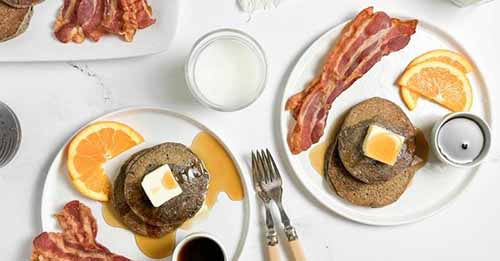
    [6] American-style buckwheat pancakes. Here’s the recipe (photo © Taste Of Home).
     
     
    WHAT IS BUCKWHEAT

    Buckwheat (Fagopyrum esculentum) is not wheat, but a highly nutritious, gluten-free pseudo-cereal, derived from the seeds of a flowering plant related to rhubarb and sorrel.

    A pseudocereal is a seed used like a grain, and its used like wheat: in grain salads, pancakes, and as a porridge, soba noodles. Toasted, it’s known as kasha.


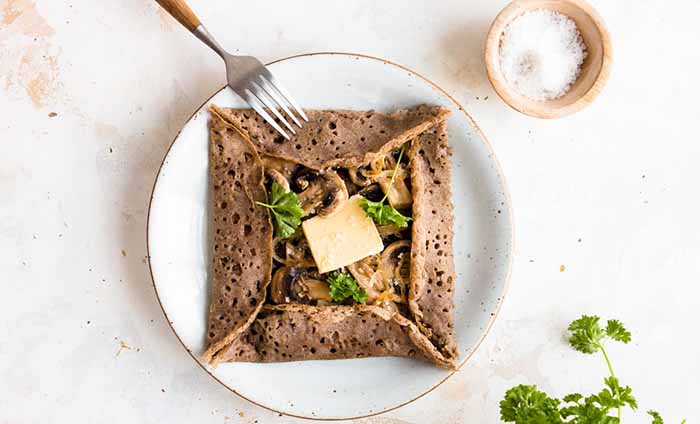
    Buckwheat Crepe
    [1] A buckwheat breakfast crêpe, also called a galette in Brittany*. The buckwheat crêpes are famously folded into a square—often called a “complete” fold—leaving the center open to show off the fillings. are slightly crispier and more “structural.” (photos #1, #4, and recipe © King Arthur Baking).

    Crepes Suzette
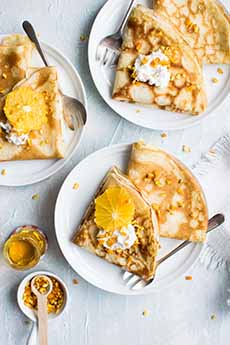
    [2] White flour triangular crêpes contain sweet fillings or garnishes, like these Crêpes Suzette. Here’s the recipe. White flour crêpes are softer, more elastic, and delicate, which makes the triangle fold easy (photo © Monika Grabkowska | Unsplash).

    Nutella Crepe
    [3] A rolled crêpe. Here’s the recipe from Let The Baking Begin.

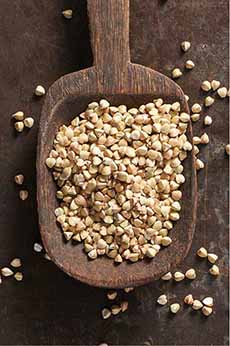
    A Measuring Spoon Of Buckwheat Groats
    [4] Buckwheat groats.

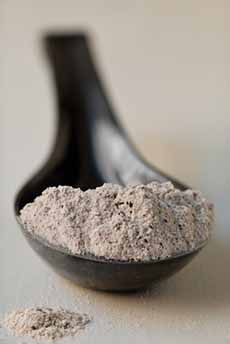
    A Measuring Spoon Of Buckwheat Flour
    [5] Buckwheat flour (photo © Anson Mills).

     
    Like quinoa, another pseudocereal, it contains all essential amino acids, making it a complete protein. It’s a good source of fiber and protein, manganese, magnesium, copper, and iron. It’s a heart-healthy superfood.

    Plus, it’s sustainable: a fast-growing, hardy crop that often requires fewer resources and is great for sustainable, organic farming. Its hulls (outer shells) are used for making pillows and as organic garden mulch.

    Pseudocereal seeds’ high starch content enables them to be cooked and consumed like a cereal.

    Today, buckwheat, renowned for its nutty flavor and gluten-free, is used worldwide in savory and sweet dishes, nutritious profile. Eastern European kasha, French galettes (savory crêpes), Italian pizzoccheri pasta, Japanese soba noodles, and Russian blini are just some well-known international dishes.

    It’s also a staple in Indian cuisine, for breads, dosas, dumplings, fritters, puddings, stews, and more.

    Buckwheat is also made into tea and whiskey, and the flowers of the plant provide buckwheat honey.
     
    Buckwheat Galette (Crepe)
    [7] This buckwheat galette uses just three ingredients to make the crêpe. Here’s the recipe (photo © Cooking With Elo).
     
    ________________

    *Two pastry types are also called galette. First is a crusty flat cake (an inch or two high), such as an Epiphany Cake (galette des rois). The term is also given to a French pastry similar to a tart or a pie. Created in the days when most people lacked pie pans, the pie filling is placed atop the pastry dough on a work surface, and the dough edges are turned up to create an edge. Here’s a photo.
     

    CHECK OUT WHAT’S HAPPENING ON OUR HOME PAGE, THENIBBLE.COM.


    Comments off

    RECIPE: Cream Cheese Pound Cake For National Pound Cake Day

    Cream Cheese Pound Cake
    [1] Cream cheese pound cake bundt from The Baker Chick.

    Vanilla Beans
    [2] Vanilla beans (photo by Claire Freierman | The Nibble).


    March 4th is National Pound Cake Day. The original cake was created in England in the 1700s. Here’s the history of pound cake.

    Dense, buttery pound cake is one of our favorite cakes. This recipe is even richer, thanks to the added cream cheese.

    The recipe was sent to us by one of our favorite bakers, The Baker Chick. Easily made in a bundt pan, the recipe has a glaze for drizzling.

    We left off the glaze and enjoyed ours with ice cream, mascarpone and whipped cream (not all together!).
     
    RECIPE: CREAM CHEESE POUND CAKE BUNDT

    Ingredients

  • 1½ cups butter (3 sticks), softened
  • 1 package (8 ounces) cream cheese, softened
  • 2½ cups white sugar
  • 1 tablespoon vanilla extract
  • Optional: 1 teaspoon lemon or almond extract -or- 1 tablespoon lemon or orange zest
  • 6 eggs, room temperature
  • 3 cups cake flour, sifted *
  • 1 vanilla bean, split open
  • 3 tablespoons whole milk (or a mixture of lowfat milk and heavy cream)
  • 1-2 cups powdered sugar
  • Cooking/baking spray
  •  
    Preparation

    1. PREHEAT the oven to 325°F. Spray well or grease a 10-inch bundt cake pan.

    2. CREAM together the butter, cream cheese and sugar for about 5 minutes or until very light and fluffy. Stir in the extract orr zest.

    3. ADD the eggs, one at a time, scraping down the bowl as needed. With the mixer on low speed, add the flour slowly and gradually. Do not over-mix—you’ll get a tough cake.

    4. POUR the batter into the prepared pan. Bake for 65-75 minutes or until a toothpick inserted in the center comes out clean. Let cool. Meanwhile…

    5. MAKE the glaze. If you start the glaze when the cake goes into the oven, it will be ready when the cake is cooled. Pour the milk into a glass measuring cup and scrape in the vanilla bean.

    6. STEEP for an hour to give the milk mixture a strong vanilla flavor. Then add the powdered sugar and whisk with a fork until it’s thick and the right consistency for drizzling. Drizzle over the cooled cake.


    Comments off

    Healthy Snacks For National Snack Day & National Healthy Eating Day

    March 4th is National Snack Day. Quick: Name your favorite snacks!

    > The year’s 90 snack holidays.

    Now, take a look at these better-for-you snacks, and see how you measure up. (Note: November 6th is National Healthy Eating Day.)

    Most are easily portable. To sweeten the snacks, consider a Splenda/cinnamon mix: a packet of Splenda with a dash of cinnamon.

    In alphabetical order, we suggest:

  • Apple chips. Dried fruit can be high in calories. But unsweetened apple chips are a caloric bargain. Try them with plain yogurt, too,
  • Cheerios. It may sound strange, but think of them as you would a handful of nuts. Whole grain, crunchy comfort food, you can enjoy them plain, seasoned with a Splenda/cinnamon mix, with tea or coffee, or with a glass of nonfat milk.
  • Cottage cheese. This diet staple can be flavored with fresh herbs or a Splenda/cinnamon mix or Sugar-Free Jell-O.
  • Dark chocolate. Have a large square of chocolate, 70% cacao or more. The higher the percentage of cacao, the lower the sugar. Great with a cup of coffee or tea.
  • Diet egg cream. One of our favorite sweet treats: Mix diet chocolate soda with nonfat milk. Just 80 calories.
  • Fresh fruit. Another diet staple: Berries and melon cubes are the best caloric value; but apples, bananas, and oranges are easier to pick up at delis and other grab-and-go locales.
  • Hard-boiled eggs. These days, it’s easy to buy them cooked and peeled (photo #2). Then, sprinkle with a pinch of salt and pepper (we like to spread them with Dijon mustard).
  • Hummus and crudités. Hummus is very nutritious but high in calories; so eat it with lots of crudités. Bell peppers, carrots, celery, cherry tomatoes, cucumbers, and radishes pair well.
  • Jerky and beef sticks. Look for a brand that isn’t loaded with sugar and salt (photo #1). Because beef jerky is so chewy, a little goes a long way in satisfying snack cravings.
  • Nori strips. You don’t have to be a sushi lover to enjoy crisp nori snacks (photo #4). If you don’t like it plain, there are so many flavors, from barbecue to wasabi.
  • Nut butter with crudités. Carrots, celery, and cucumbers bulk up the snack. Another pairing option: Triscuit Baked Whole Grain crackers.
  • Nuts. The USDA recommends one ounce of heart-healthy nuts daily. That equals 23 almonds, easy to carry around. Here are the other heart-healthy nuts.
  • Oatmeal. We keep unflavored packets in our desk drawer and cook them in the microwave, to enjoy plain or with our Splenda/cinnamon mix.
  • Olives. A staple of the Mediterranean diet, you can find them in snack pack sizes, or wrap up your own.
  • Popcorn. A big, fluffy cup can be enjoyed plain, with salt and pepper, or garnished in sweet or savory ways. Try chile flakes, flavored olive oil, grated parmesan, or a Splenda-cinnamon mix. Bonus: Popcorn is a whole-grain snack.
  • Rice cakes. Whole-grain brown rice cakes are filling, and while they aren’t high in nutrition, they’re only 35 calories apiece. Combine them with hummus, nut butter, or yogurt.
  • Roasted chickpea snacks. A great source of protein, and a good choice of flavors.
  • Sardines. We drizzle a can of sardines with balsamic vinegar and sprinkle whatever fresh herbs are in the crisper.
  • String cheese. Always popular. Or, have an ounce of cheddar with some Triscuits.
  • Sugar-Free Jell-O. There are numerous flavor choices, all at 10 calories per serving. Have all you want by itself, or with cottage cheese or yogurt.
  • Tuna or salmon pouches. Protein-packed, these are seasoned and ready to it, with or without crudites (photo #33).
  • Veggie chips. We dehydrate our own in the microwave with Mastrad trays.
  •  

    Chomps Grass Fed Beef Sticks
    [1] Grass-fed, non-GMO beef sticks from Chomps.

    Pete & Gerry's Organic Hard Boiled Eggs
    [2] Lots of protein: a real hunger quencher (photo © Pete & Gerry’s).

    StarKist Jalapeno Pouch
    [3] Seasoned tuna pouches: protein and omega-3s (photo © StarKist).

    GimMe Teriyaki Seaweed Chips
    [4] Flavored seaweed strips in a variety of flavors (photo © GimMe Health).

  • Yogurt. Plain greek yogurt or sugar-free yogurt is best. We’re not keen on the sugar-free varieties, but we do like to add 25 calories’ worth of topping to Greek yogurt: apple chips, diced strawberries, Cheerios, mini chocolate chips, pumpkin seeds, etc. We also like the yogurt plain with a packet of Splenda and a dash of cinnamon. Another option: Mix in a spoonful of jam or sugar-free jam.
  •  
    Your next step: Decide which of these to substitute for your less-than-good-for-you snacks.


    CHECK OUT WHAT’S HAPPENING ON OUR HOME PAGE, THENIBBLE.COM.


    Comments off


    © Copyright 2005-2026 Lifestyle Direct, Inc. All rights reserved. All images are copyrighted to their respective owners.