THE NIBBLE BLOG: Products, Recipes & Trends In Specialty Foods


Also visit our main website, TheNibble.com.

TOP PICK OF THE WEEK: Stuffed Puffs Chocolate-Filled Marshmallows

Stuffed Puffs
[1] A bag of Stuffed Puffs, marshmallows with real chocolate centers, is tons of fun (all photos © Stuffed Puffs).

Stuffed Puffs
[2] Melt a graham cracker sandwich—s’mores—or enjoy Stuffed Puffs “open face.”

Stuffed Puffs
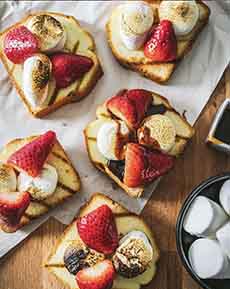
[3] Top a slice of pound cake with toasted Stuffed Puffs and berries.

Stuffed Puffs
[4] Here’s what a toasted Stuffed Puffs marshmallow looks like up close.


We don’t know who invented S’mores, but the Girl Scouts certainly popularized them. The first published recipe is in their 1927 handbook.

(Here’s the history of s’mores.)

S’mores around the campfire has been a yummy tradition: a stick, a fire, two toasted marshmallows, a square of chocolate and two graham crackers turn into a delicious chocolate marshmallow sandwich.

While there have been numerous creative uses of s’mores (see our recipe list), as well as flavored marshmallows and chocolate-covered marshmallows, there’s now a true innovation:

This summer, Stuffed Puffs, marshmallows filled with chocolate, debuted at WalMart.

Stuffed Puffs were created by Michael Tierney (who also created the Mikey’s line of paleo baked goods).

What seems like an obvious idea, he says, was actually born around a campfire. It’s a simple idea, but very hard to execute—which is why it hasn’t been done before.

It took Tierney seven years to work out the details. Now that chocolate-filled marshmallows are a reality, S’mores lovers no longer have to juggle marshmallows, chocolate bars and graham crackers over heat—be it campfire, fireplace, grill or gas stove.

It also solves the problem that the marshmallow does not get hot enough to melt the chocolate. With the chocolate inside the marshmallow, Stuffed Puffs has ingeniously solved the problem:

The chocolate melts while the marshmallow toasts. It’s fail-safe.

NATIONAL S’MORES DAY IS AUGUST 10TH. Plan ahead!
 
 
BEYOND S’MORES

While Tierney created Stuffed Puffs specifically for S’mores, we also enjoy them for snacking, right out of the bag.

We’ve also used them for:

  • Dessert garnishes
  • Dessert skewers, with cake cubes and fruit
  • Hot chocolate
  • Snack plates, with cookies, peanut butter cups and other favorites
  • Sundaes
  • Toasted on skewers (skip the graham crackers)
  •  
    For Summer 2019, you can find Stuffed Puffs at WalMart.

    In the fall, they will be available at stores nationwide.

    Different flavors and coatings are in the works. We can’t wait!

    For more information visit StuffedPuffs.com.
     
     
    THE HISTORY OF MARSHMALLOWS

    Marshmallows take their name from the marsh mallow plant (Althea officinalis)—a large herb that grows in marshes.

    The root of the plant produces a sticky, white, almost jelly-like (or sap-like) substance called mucilage. (Sound familiar? Mucilage is also a term used for glue, because it’s sticky like the sap.)

    Mallow was an edible vegetable in Roman cuisine. A a dish of marsh mallow was one of their delicacies [source].

    The Egyptians may have used it as early as 2000 B.C.E., combining it with honey to make a candy.

    The Greeks (and later, the Arabs and Indians), used marsh mallow for medicinal purposes, often as an ingredient in preparations to quiet coughs.

    Today, we have better cough remedies: Bring on the candy!

    Here’s more history of marshmallows.


    Comments off

    COCKTAIL RECIPE: Blueberry Frosé For National Blueberry Month

    For the past several summers, the frosé—a frozen rosé cocktail (or wine slush, if you prefer) has been served as a winetail (wine cocktail) or an after-dinner drink (liquid dessert).

    Here’s our first set of frosé recipes, from two summers ago.

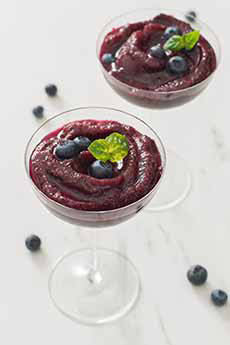
    This recipe (photo #1), from the U.S. Highbush Blueberry Council, adds blueberries that turn a frosé into a thick, toothsome slushie.

    The Blueberry Frosé is a high-antioxidant cocktail (now there’s an excuse!).

    Blueberries have one of the highest antioxidant levels of all fruits and vegetables. Their chief antioxidants are family of polyphenols called flavonoids.

    Among the many benefits attributed to flavonoids are reduced risk of asthma, cancer, heart disease and stroke. They may play a special role in protecting the brain. Here’s more about flavonoids.

    Check our Antioxidant Glossarys, and these details on the specific benefit of blueberries.

    If the antioxidants don’t convince you, make a Blueberry Frosé to celebrate National Blueberry Month: July.
     
     
    RECIPE: BLUEBERRY FROSÉ FROZEN COCKTAIL

    Ingredients For 4 Servings

  • 1 750 ml bottle (25 ounces) rosé wine
  • 2-1/3 cups frozen blueberries, divided
  • 1/3 cup granulated sugar
  • 1/4 cup fresh lemon juice (1 lemon)
  • 1/4 cup fresh basil leaves, divided
  • Optional garnish: fresh blueberries on a pick
  •  
    For virgin drinks, substitute lemon sparkling water for the wine.

    Preparation

    1. POUR the wine into ice cube trays; freeze for 6 to 8 hours until almost frozen solid. (Wine will not freeze completely because of the alcohol content. The higher the A.B.V. or proof of an alcohol beverage*, the less solid it will freeze.)

    2. PULSE in a blender until smooth: the wine ice cubes, 2 cups of the frozen blueberries, the sugar, lemon juice and 2 tablespoons of basil leaves.


    Blueberry Basil Frose
    [1] Blueberry frosé, a frozen drink or blueberries and rose wine (photo © U.S. Highbush Blueberry Council).

    Bosman Rose Wine
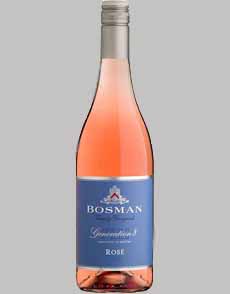
    [2] Bosman Family Vineyards, a Fair Trade Certified winery in South Africa. The salmon-colored wine is made in the dry Provence style, and has notes of strawberry and peach.

     
    3. DIVIDE among 4 glasses. Garnish with remaining blueberries and basil leaves. While the frozen blueberries are a nice garnish, we like fresh blueberries on a pick even more.
     
     
    THE TWO TYPES OF BLUEBERRIES

  • Highbush blueberries (Vaccinium corymbosum) grow on tall bushes; some cultivars reach a height of 6 to 8 feet. The berries are larger and more abundant than lowbush blueberries, although their flavor may be somewhat less intense and sweet.
  • Lowbush blueberries (Vaccinium angustifolium), also referred to as wild blueberries, grow in Maine and the colder regions of eastern North America. The shrubs grow no taller than two feet and may be smaller, depending on soil and climate, and produce small, exceptionally sweet bluish-black berries. If you want to plant a bush or two, these are hardy plants that do well in all soils, even poor, rocky types, providing the drainage is good.
  •  
     
    CHECK OUT THE HISTORY OF BLUEBERRIES

    Plus, more blueberry recipes.
     
     
    ABOUT BOSMAN FAMILY WINERY

    We made our Blueberry Frosé with a bottle of Bosman Generation 8 Rosé, from South Africa.

    The first Bosman emigrated to South Africa eight generations ago, in 1798. He grew grapes on his land to make wines for his own consumption.

    The practice continued through six generations until the seventh decided to join the South African wine renaissance and make wine for sale. Hence: Bosman Family Vineyards.

    There’s a ninth generation, far too young to help with production. You can see the generations here, and guess how long it will take the youngsters to join the family business.

    If you’d like to “visit” the vineyard, head to BosmanWines.com.

    ________________

    *A.B.V., alcohol-by-volume, the number of milliliters of ethanol expressed as a percentage. Here’s more about it. Another way to specify the amount of alcohol is the alcohol proof, which in the U.S. is twice the alcohol-by-volume A.B.V. Systems of expressing proof can vary in other countries.


    Comments off

    FOOD FUN: Let Me Out! Says The Crayfish

    Seafood Soup
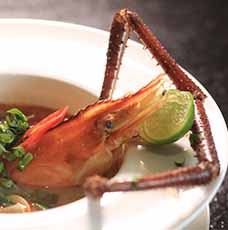
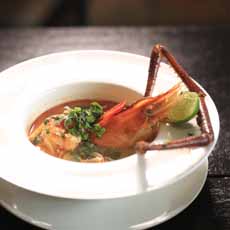
    [1] Ready for his close-up: Our crustacean friend is holding a piece of lime, to be squeezed into the soup at the HM Grand Central Hotel in Phnom Penh, Cambodia (photo courtesy Pexels).

    Shrimp Soup With Crayfish
    [2] You can serve a larger bowl or a smaller bowl. We recommend a larger service plate under the bowlm so the crayfish tail can be pulled apart and eaten.


    Pièce de résistance, a French term, originally referred to the principal dish of a grand meal, or a dessert, created to be a showpiece.

    While the term literally translates as “piece of resistance,” the reference is to the most important or remarkable feature.

    You don’t have to work too hard to create a pièce de résistance.

    Here, a simple bowl of seafood soup is turned into a memorable dish by the simple addition of a crayfish*.

    The crayfish looks like he’s ready to start a conversation (e.g., “Let me out of here!).

    His tail is a tasty addition to the other seafood in the soup, and his claws are utilitarian: They hold a piece of lime to squeeze into the soup.

    The take-away: Keep your eye out for a “piece of resistance” element for whatever you’re serving.

    The book Play With Your Food is just one tome with lots of ideas.
     
     
    THE HISTORY OF SOUP
     
     
    TYPES OF SOUP
     
     
    ________________

    *A crayfish is also known as a crawdad, crawfish, freshwater lobster, mountain lobster, mudbug, or yabbie. It is a freshwater crustacean resembling a small lobster to which it is related.


    Comments off


    © Copyright 2005-2026 Lifestyle Direct, Inc. All rights reserved. All images are copyrighted to their respective owners.