THE NIBBLE BLOG: Products, Recipes & Trends In Specialty Foods


Also visit our main website, TheNibble.com.

GIFT: Turmeric Tea For Health-Conscious Friends

A tea-of-the-moment, which happens to be thousands of years old, is turmeric tea, a highly antioxidant, anti-inflammatory herbal tea.

Revered as a ‘golden spice’ in Ayurvedic medicine for more than 5000 years, it has long been drunk as a tea.

When brewing black tea, you can add ¼ teaspoon ground turmeric to the cup before pouring in the hot water. For a simple tisane, ground turmeric or fresh root slices with hot water is popular.

But for a most impressive healthful gift, Vahdam’s Turmeric Tea Tales (photos #1 and #2) is the way to gift it in style.

An elegant golden gift box contains vials of six turmeric teas that, the company notes, are not only healthful year-round, but are ideal to combat holiday stress and travel.

And, we say, a fine way to usher in all those “healthier lifestyle” resolutions for the new year.

Vahdam’s turmeric teas are flavored to add variety:

  • Turmeric Ashwagandha Tea
  • Turmeric Fennel Tea
  • Turmeric Ginger Tea
  • Turmeric Moringa Tea
  • Turmeric Saffron Tea
  • Turmeric Spiced Tea
  •  
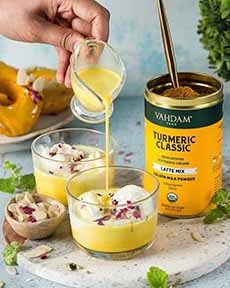
    There are also individual tins of Turmeric Lattes (photo #3). Just add hot water or milk.

    Varieties include:
    li>Turmeric Ashwagandha Tea

  • Turmeric Classic Tea
  • Turmeric Ginger Tea
  • Turmeric Moringa Tea
  • Turmeric Mushroom Latte
  •  
    And there are even more options for everyday: tea bags and pouches of loose tea.

    Head To VahdamTeas.com to see all the options.
     
     
    WHAT IS TURMERIC

    Turmeric (TER-muh-ric) is a rhizome, an edible root of a flowering plant.

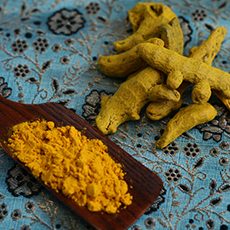
    A relative of ginger, turmeric may look like ginger root from the outside (photo #4). But inside is a vivid yellow-orange flesh, that is dried and ground into a spice (you can find it in just about any grocery store).

    Common in Indian, Southeast Asian, and Middle Eastern cuisines, turmeric has a sharp, slightly bitter flavor that adds interest to foods.

    Because of recent focus of turmeric as a superfood, fresh turmeric root is now available in health food and other food stores in the U.S. We have friends who brew tea from the fresh root daily.

    There’s more about the potential health benefits of turmeric below.
     
     
    TURMERIC IN THE KITCHEN

    In addition to brewed tea, turmeric is an ingredient in curry powder and garam masala spice mixes. It also has a place in American cuisine:

  • In scrambled eggs, frittatas, quiche, even deviled eggs.
  • To season greens, roasted vegetables, sautéed onions, beans and lentils.
  • Added to soups and smoothies.
  • Added to rice, yogurt and other pale foods (even pancakes!) for great color.
  • Blended into hummus and yogurt, marinades and salad dressings.
  •  
    Use the freshly-grated root in:

  • Marinades
  • Pumpkin: pies, muffins, cookies
  • Smoothies and fresh-pressed juices
  • Stir-frys
  • Vinaigrettes and other salad dressings
  •  
    Here’s more on how to cook with turmeric.

     
    TURMERIC & HEALTH

    Turmeric has been touted as a superfood that can fight cancer and diabetes, ease depression, and more.

    Several compounds in turmeric may contribute to better health. The most well-known of these is curcumin.

    We turned to Web MD for advice on what turmeric can, and can’t do.

    While there has been much lab testing, the Web MD notes that scientific testing on humans is limited, and more is needed.

    Research is ongoing.


    [1] Deck the halls with this healthful gift: Turmeric Tea Tales (photos #1, #2 and #3 © Vahdam Teas).

    [2] The inside of the gift box. And surprise: It’s one of Oprah’s favorite things!


    [3] Turmeric latte.


    [4] Turmeric root (photo © Malaysian Kitchen).


    [5] Turmeric root and ground spice (photo © Silk Road Spices).

     
    We’ve abridged their information here. Check out the entire article and discuss options with your healthcare provider.

  • Alzheimer’s. People with Alzheimer’s have chronic inflammation, and turmeric seems to have natural anti-inflammatory effects. But so far, there’s no strong scientific evidence of turmeric’s efficacy.
  • Arthritis. For its anti-inflammatory properties, there is hope that turmeric may help with joint pain, stiffness and other inflammation. If you decide to try it,note that black pepper is needed to help your body absorb the natural curcumin.
  • Cancer. In lab and animal studies, turmeric has stopped the growth of tumor cells and helped detoxifying enzymes work better.
  • Depression. Scientists are excited about curcumin’s potential to ease depression and help antidepressants work better. But so far, research results have been mixed.
  • Diabetes: Because curcumin can keep blood sugar levels steady, it could be a useful tool to prevent or treat type 2 diabetes.
  • Flu. If you sip turmeric tea, the curcumin might help you to fight off a variety of viruses, including herpes and the flu. But since turmeric is only about 3% curcumin, the occasional cup of tea isn’t be a cure-all.
  • Headache. Since ginger is a well-known natural headache remedy, turmeric has also been embraced anecdotally, especially for migraines. More research is needed.
  • Heart Health. Some studies have found that turmeric can lower LDL “bad” cholesterol, while others concluded that the spice has no effect. Scientists continue to look into the heart-protective possibilities of turmeric.
  • IBS. Early research indicates that turmeric could help improve IBS symptoms such as abdominal pain.Turmeric is also being studied as a treatment for diseases like Crohn’s and ulcerative colitis.
  • PMS. Curcumin supplements have been found helped ease PMS symptoms.
  •   

    Comments off

    RECIPE: Pumpkin Spice Hummus


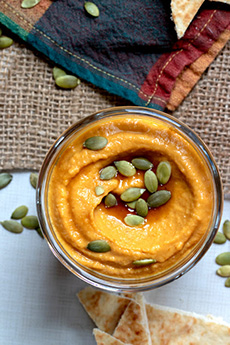
    [1] Pumpkin spice hummus (both photos © Hatherleigh Press).


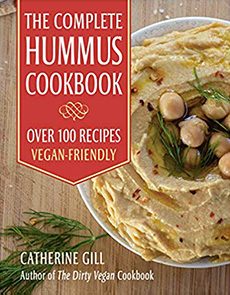
    [2] Love hummus? Beyond a dip and spread, there are many recipes in this hummus cookbook. Get your copy here.


    As a frequent purchaser or flavored hummus, we often look at the eight-ounce containers as one serving, possibly 1.5.

    In terms of the “serving size” of two tablespoons—well, sure, if you’re five years old.

    While our friend Jerry uses a mortar and pestle to grind his chickpeas and tahini into an authentic, rustic, consistency, we prefer the smooth-as-silk textures of commercial brands.

    It’s so easy to make silky hummus. Just throw everything into a food processor.

    Make this batch of Pumpkin Spice Hummus for Thanksgiving Week.

  • Slice those crudités and snack away!
  • Bring some to work.
  • Bring some to your Thanksgiving hosts.
  • Spread it onto your leftover turkey sandwiches.
  •  
    Thanks to Catherine Gill and her hot-off-the-presses The Complete Hummus Cookbook for this recipe.
     
     
    RECIPE: PUMPKIN SPICE HUMMUS

    Ingredients For 8 Servings

  • ½ cup canned pumpkin purée
  • ½ cup canned chickpeas, drained or equivalent cooked chickpeas
  • 2 tablespoons tahini
  • 2 tablespoons pure maple syrup
  • ⅛ cup lemon juice or juice from half large lemon
  • 2 tablespoons olive oil
  • ½ teaspoon ground cinnamon
  • ⅛ teaspoon ground nutmeg
  • ⅛ teaspoon ground ginger
  • ⅛ teaspoon ground clove
  • ¼ teaspoon sea salt
  • 1–2 tablespoons water
  • Garnish: a sprinkle of cinnamon and some pepitas (raw pumpkin seeds)
  •  
    Preparation

    1. ADD all ingredients to a food processor, and blend until the desired consistency is reached.

    2. TASTE and add more water if a thinner hummus is desired. Add more salt to taste.

    3. GARNISH and refrigerate until ready to serve.
     
     
    RELATED RECIPE: SWEET POTATO DIP
     
     
    CHECK OUT THE HISTORY OF HUMMUS


    Comments off

    STOCKING STUFFER: Zoku Pocket Straw & The History Of Straws

    Americans use millions of plastic straws each day. Plastic drinking straws are among the top 10 contributors to marine debris pollution [source].

    They are one of the top five contributors to plastic marine waste, with millions of plastic straws being used every day in the U.S. alone. During a five year cleanup project around American shorelines, nearly 7.5 million straws were found [source].

    > The history of drinking straws is below, including the chronology of countries and municipalities that have banned plastic straws.

    These non-biodegradable straws litter our streets, lands, shorelines, and oceans. They do not biodegrade but break down into smaller microplastics that have made their way into our food chain and the deepest trenches of our oceans.

    Coalitions of restaurants, bars, cafes, hotels, event venues and other organizations are committing to eliminate single-use plastic straws; but it will take time to trickle down.

    Environmentally-conscious consumers are aware of the problem, and strive to eliminate single-use plastics straws, sending them back in food venues and drinking straight from the glass.

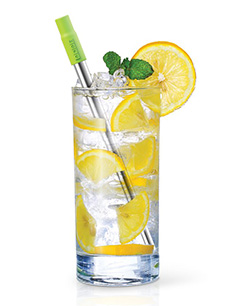
    Numerous reusable straws have come onto the market to meet the demand. The one we like best is Zoku’s reusable stainless steel Pocket Straw.

  • Use it for hot or cold drinks.
  • It telescopes up to 9 inches and fits any glass size.
  • The silicone mouthpiece mimics the feel of plastic, so sipping is just like (or better than) a plastic straw.
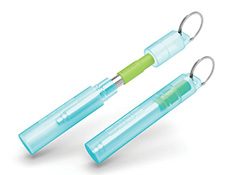
  • Small and lightweight, just 4.4″ when closed, you can carry it in a small pocket. A loop on the case lets you attach it to your keyring.
  • The hygenic carrying case and includes a cleaning brush.
  • It’s dishwasher-safe, BPA- and phthalate-free.
  •  
    We think it’s a great gift for eco-conscious friends and family.

    The right person will love it!

    And at $9.99, it doesn’b break the bank.

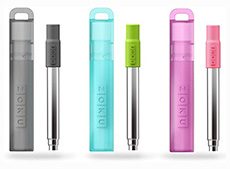
    You can buy it in Berry, Charcoal or Teal on the company website, or on Amazon, and at other retailers and e-tailers.
     
     
    THE HISTORY OF THE DRINKING STRAW

    From ancient times, man has had the need to sip from a straw.

    The first known straws were made by the Sumerians, living along the valleys of the Tigris and Euphrates rivers in the Fertile Crescent—the “birthplace of civilization”.

    It’s located in the historical region of southern Mesopotamia, modern-day southern Iraq*, dating to the 4th millennium B.C.E. [source].

    Back in during the Chalcolithic (Copper Age) and Early Bronze Ages, necessity was the mother of invention. The straw was invented to drink ancient man’s favorite drink: beer.

    It is believed that the straws were needed to avoid the solid byproducts of fermentation that sank to the bottom of the vessel.


    [1] The Zoku Pocket Straw telescopes to accomodate any size glass (all photos © Zoku Home).


    [2] The straw telescopes into a 4.4″ carrying case and can hang on a key ring.


    [3] Pick your color!

    Old newspaper ad for paper straws
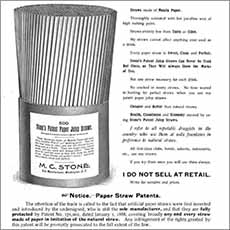
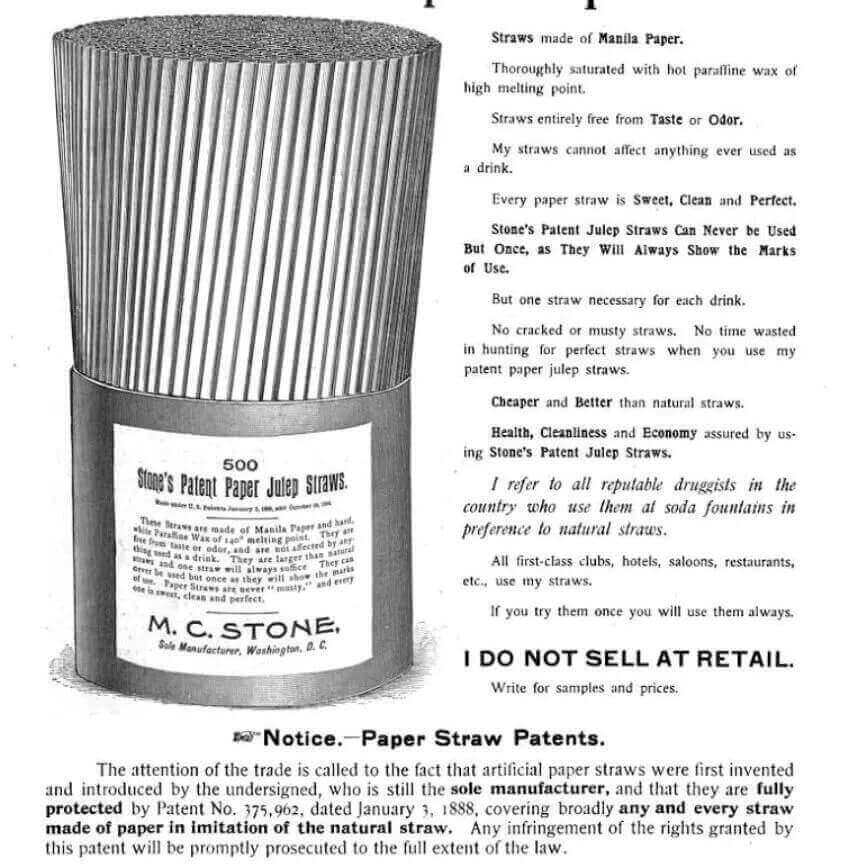
    [4] An ad for the paper drinking straw, invented in 1888. See the end of the article for a readable version.


    The oldest drinking straw in existence, found in a Sumerian tomb dating to 3000 B.C.E., belonged to someone who could afford all the food and drink he liked. It’s a gold tube inlaid with lapis lazuli.

    These early straws weren’t the simple, practical straws we might imagine; they were elaborate, ceremonial objects that demonstrated wealth and status, ornate drinking tubes made from precious metals and decorated with semi-precious stones.

    These straws were likely used for drinking beer from communal vessels. Beer was a staple beverage in Sumerian society and the straws helped to filter out grain and other sediments at the bottom of the vessel.

    The idea caught on and natural grass straws were devised by and for ordinary people. Rye grass was particularly popular: hollow, naturally waterproof, and readily available. The did have the major drawbacks of affecting the taste of beverages and deteriorating quickly.

    Over the centuries, people created metal drinking straws from common metals, but metal was always expensive.
     
     
    The Modern Paper Drinking Straw Arrives

    American Marvin C. Stone patented the modern drinking straw, made of paper, in 1888. He did not enjoy sipping his Mint Julep through the rye grass straw, which not only became mushy, but imparted a grassy taste.

    One day, he wound paper around a pencil to make a long paper tube. Sliding the pencil from the paper, he applied glue to hold it together.

    The glue, too, would ultimately dissolve during slow sipping, so he later built a machine that coated the outside of the paper with wax to hold it together. Voilà: an improvement in sipping beverages that everyone could enjoy and afford.

    He mass-producing the paper straws, making them the first affordable and accessible to the general public.

    In 1937, Joseph Friedman invented the bendable straw after watching his young daughter struggle to drink a milkshake through a straight paper straw, too tall for her to reach easily.

    Friedman inserted a screw into a paper straw and wrapped dental floss around the grooves. When he removed the screw, it left accordion-like ridges that allowed the straw to bend. He patented his “Articulable Straw” that year. Manufacturers were not initially interested, but the straw eventually became widely popular, especially in hospitals where patients could drink while lying down.

    In 1969, his Flex-Straw Company was sold to the Maryland Cup Corporation.
     
     
    Plastic Straws Move Into The Mainstream

    The 1950s saw the rise of the automobile and subsequently, the rise of Fast Food. These restaurants replaced washable plates, utensils, and glassware with low cost and portable paper for meals and drinks on the go.

    The transition to plastic straws happened gradually during the 1960s as the manufacturing infrastructure to mass produce plastic straws was put into place. While plastic was more costly than paper, it was cheap enough; and the straws didn’t lose their shape when saturated in liquid, as paper straws could.

    Existing straw manufacturers like Maryland Cup Corporation began producing them, and there was a bonus to both manufacturers and consumers:

    With the growth of fast food and to-go drinks, plastic straws could easily be pushed between the “X” crosshairs of a to-go lid without tearing.

    Better venues opted for plastic straws as a customer convenience.

    The consumer boom and the baby boom after World War II also gave rise to children-pleasing novelty straws:

  • Straws with plastic animals looped around the top of the straw (see photo).
  • Straws filled partially with chocolate or strawberry flavor, creating chocolate milk or strawberry milk by merely sipping plain milk.
  • Straws were made with a bend toward the top, to better angle into the mouth.
  •  
    For adults and kids alike, fashion came to straws:

  • Colors, stripes, polka dots.
  • Prints
  •  
    Today, you can treat guests to fancy-print straws: leopard-print straws, metallic stars, and too many others to enumerate.

    Good news going forward: Since the drinking straw issue has arisen, some paper straw manufacturers have created a thicker version of the paper straw. It holds up like plastic; and when it’s outlived its single-purpose use, it biodegrades.

    And cornstarch-based straws are on the rise, compostable and biodegradable.

    In 2024, plastic straws make up about 99% of the $3 billion global drinking-straw market. Some sources indicate that the category is growing at a CAGR of 20.27%.

    That’s a long way to go, but you can start now.

    ________________

    *Other almost-as-old civilizations include Ancient Egypt, Norte Chico in Peru, and the Indus Valley in modern-day northwest India and Pakistan.

    The history of plastic straw bans [source]:
    >August 2016: France becomes the first country to impose a total ban on plastic cups, plastic plates and plastic cutlery.
    >August 2017: Lonely Whale kicks off a digital campaign for A Strawless Ocean to educate the public and push for regulations on single-use plastic.
    >February 2018: Queen Elizabeth bans plastic straws and bottles from all royal estates, cafes, and gift shops.
    >May 2018: Vancouver becomes first major Canadian city to ban single-use plastic.
    >May 2018: Alaska Airlines eliminate plastic straws and stirrers, substituting white birch and bamboo for the 22 million plastic stir straws and citrus picks used each year.
    >July 2018: Seattle is first in the U.S. to have a plastic straw ban go into effect.
    >July 2018: Starbucks announces it plans to eliminate plastic straws from all global locations by 2020.
    >September 2018: McDonald’s announces it will replace single-use plastic straws with paper-based alternatives in all stores across UK and Ireland. The chain uses 1.8M straws per day in the UK.
    >January 2019: California enacts a “straw upon request” policy. Most cities within the state phased out plastic straws with compostable, paper-based alternatives.
    >2019: Washington D.C. also bans single-use plastic straws.
    >2020: England bans all single-use plastic straws China.
    >2021: Canada and Mexico City ban all single-use plastics.
    >2022: New Jersey rolls out single-use plastic ban, starting with plastic straws, with single-use plastic carryout bags and Styrofoam cups, plates and containers also banned that year.
    >2022: France bans single-use plastic packaging for most fruits and vegetables, which could eliminate 1 billion pieces of plastic waste.
    >2022: Three out of four people in a 28-country survey support the elimination of single-use plastics [source].


    Old Newspaper Ad
    [5] [Source.]


    CHECK OUT WHAT’S HAPPENING ON OUR HOME PAGE, THENIBBLE.COM.


    Comments off


    © Copyright 2005-2026 Lifestyle Direct, Inc. All rights reserved. All images are copyrighted to their respective owners.