|

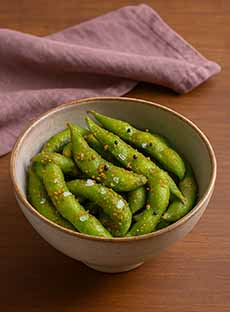
[1] These edamame are better than the ones at Japanese restaurants! Deft spicing makes the super-delish (recipe and photo © Hannah Kamkinsky | Bittersweet Blog).
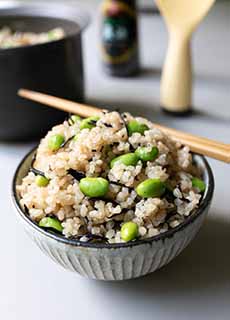
[2] We came across this side and it’s become a favorite. Here’s the recipe. You can make it with white rice, but brown rice delivers a better symphony of flavors. For a main course, top with chirashi or grilled fish (photo © Onolicious Hawaii).
[3] Edamame has become so popular, you can find it in most frozen food aisles (photos #3, #9, and #11 © Seapoint Farms).
[4] We’re a big fan of La Tourangelle oils, but you can find a less expensive bottle from Whole Foods’ 365 Brand. Be sure you get toasted* sesame oil (photo © ChefShop).
[5] While the exact ingredients can vary, shichimi togarashi, Japanese Seven Spice, typically includes red chile pepper, sansho pepper (Japanese chile pepper), sesame seeds, orange peel, ginger, nori (dried seaweed), and poppy seeds. You can blend your own with this recipe (photo © Oaktown Spice Shop).
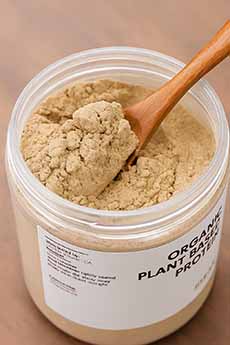
[6] You can find shiitake powder at health food stores or online (photo © Orgfun | Amazon).
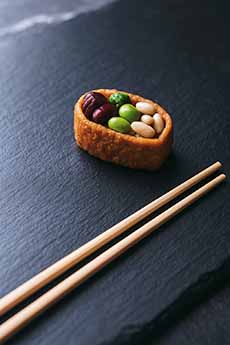
[7] You’ve heard of three-bean salad; this is three-bean inari sushi. The deep-fried tofu pouches (abura-age) are simmered in a sweet and savory broth, then stuffed with kidney beans, edamame, and great northern beans (photo © Eiliv Aceron | Pexels).
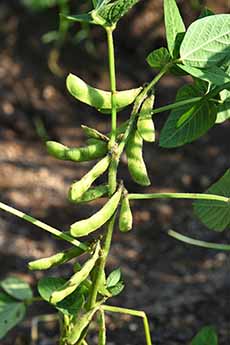
[8] Edamame (soybeans) growing on the bush (photo © Dipak Shelare |YAYMicro | Panther Media).
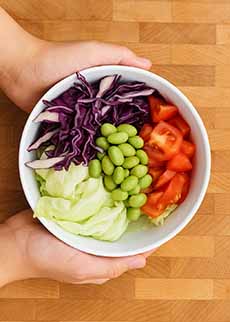
[9] Add edamame to your daily salad, be it green or tuna (photo © Vo Thuy Tien | Pexels).
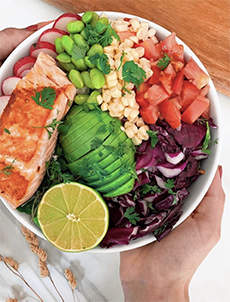
[10] Top a bowl of greens with salmon, chicken, and the colors of the rainbow.
|
|
Edamame (ay-dah-MOM-may)—young, green soybeans harvested before they fully mature (photo #7)—has a long history rooted in East Asian agriculture and cuisine, particularly in Japan, China, and Korea.
In addition to their appearance in Asian restaurants in the U.S., they have become a fusion food.
Enjoy them in a mixed salad, stirred into grains (photo #2), as a snack with a cold beer (photo #1).
Add them to casseroles, soups, and pasta dishes.
Substitute them any place you’d normally use a pop of color from green peas—from potato salad to sautéed mushrooms.
The recipe follows. Below you’ll find:
> The history of edamame.
> Why soybeans are a nutritional powerhouse.
> The year’s bean holidays.
> Head to the different types of beans: a photo glossary.
> Here’s how to eat edamame (YouTube).
RECIPE: SPICED EDAMAME
Thanks to Hannah Kaminsky of Bittersweet Blog, whose recipe inspired this article.
If you’re purchasing the Japanese ingredients for the first time, you’ll find many uses for them.
Ingredients
1 pound frozen edamame in pods (photo #3)
2 teaspoons toasted sesame oil (photo #4)
1-2 teaspoons shichimi togarashi (Japanese 7-spice, photo #5)
1 teaspoon shiitake mushroom powder (photo #6)
1/2-1 teaspoon coarse or flaky Salt
Preparation
1. BOIL the edamame in plenty of water for 4-5 minutes until tender. Drain thoroughly.
2. TOSS with the sesame oil, shichimi togararshi, shiitake powder, and salt.
3. ADJUST the seasonings to taste. We’ve enjoyed them at all temperatures: hot, room temperature, and chilled.
Variation:
4. TOSS the edamame into the air fryer for 8 minutes at 400°F until lightly charred around the edges. This extra step really takes the edamame to the next level!
THE HISTORY OF EDAMAME
Soybeans have been cultivated in China for more than 5,000 years. While they were and are primarily for their fully mature, dried form to make products like tofu and soy sauce, edamame, the immature green soyeans, likely originated as a seasonal, fresh preparation.
And likely in Japan: References to eating green soybeans are sparse in ancient Chinese texts.
The word edamame is Japanese. It translates to “stem beans”—the pods were traditionally boiled while still attached to the stem for easier handling and storage. (In English usage, the word is both singular and plural [like sushi]).
Soybean cultivation in Japan is believed to have begun around the early Yayoi period, approximately 300 B.C.E. to 300 C.E. Yet, many centuries pass by before we hear of edamame.
Edamame Appears In The Food Record
13th Century: The earliest written reference to edamame in Japan dates to 1275 C.E., when the Buddhist monk NichiRen thanked a parishioner in a letter for offering edamame at a temple.
17th Century: In Japan’s Edo-period (1603–1868), edamame became a common street food, sold on skewers. At home, it was boiled and served warm.
Late 19th/Early 20th Century: Edamame became a standard Japanese pub (izakaya) snack, enjoyed with a chilled beer.
Late 20th Century: As health food movements grew in the West, edamame spread beyond Asia. In the U.S.† it was valued for its nutritional value—high in protein, fiber, and essential amino acids.
Japanese restaurants gained popularity in the U.S. starting in the 1960s, with sushi gaining traction in the 1970s, and full integration into mainstream American dining by the 1980s–1990s.
Late 20th/Early 20th Century: By the 1990s and 2000s, frozen edamame became a supermarket staple in North America.
Crunchy freeze-dried shelf-stable versions appeared, marketed as a plant-based, low-carb snack. (They’re a great general garnish, and you can re-hydrate them for soups and salads.)
There are also vacuum pouches of pre-cooked, ready-to-eat soft, moist, beans to steamed edamame.
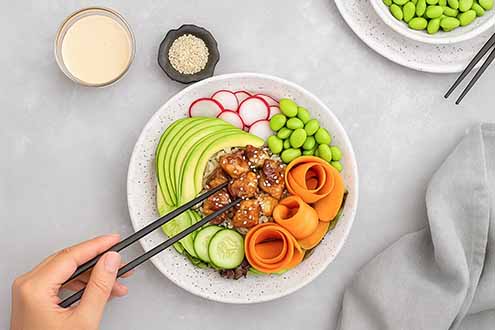
[11] Whether a green salad, grain bowl, or poke bowl, edamame adds lots of nutrition and bright color.
NUTRITION: EDAMAME ARE GOOD FOR YOU!
Edamame (young, green soybeans) are not only delicious and versatile—they’re also highly nutritious. They’re:
Nutrient dense: The food is highly nutritious relative to the number of calories in a given food.
High-quality plant protein and a complete protein, containing all nine essential amino acids. A cup of cooked edamame contains 18 grams of protein and 190 to 200 calories per cup of cooked, shelled beans.
Fiber-rich: 1 cup provides 8 grams of fiber—more than many other legumes—and helps promote digestion, regulate blood sugar, and support heart health.
Heart healthy: They’re packed with omega-3 fatty acids and isoflavones that may help lower LDL (“bad”) cholesterol, improve artery function, and reduce inflammation.
A good source of isoflavones (phytoestrogens), plant compounds that mimic estrogen in the body. They may alleviate hot flashes, support bone health, and reduce risk of hormone-related cancers.
Loaded with micronutrients: folate for cell division and fetal development, vitamin K for bone and heart health, iron for red blood cell production, magnesium and potassium for muscle and nerve function.
Supportive of brain health: Choline and omega-3 fatscontribute to memory and cognitive function, and even…
Aids in weight management: The high levels of protein and fiber increase satiety.
A YEAR OF BEAN HOLIDAYS
January: National Bean Month
January 6: Dry Bean Day
January 9: National Cassoulet Day
April: National Soy Foods Month
April 20: Lima Bean Respect Day
July: National Baked Bean Month
July 3: National Eat Beans Day (or National Eat Your Beans Day)
July 13: Beans ‘n’ Franks Day
July 26: World Tofu Day
October: National Chili Month
October, 1st Week: National Chili Week
October 21: Garbanzo Bean (Chickpea) Day
December 3: National Green Bean Casserole Day
Plus:
April 22: National Jelly Bean Day
April 26: National Bean Counter Day
July 31: National Jump For Jelly Beans Day
August 22: Never Bean Better Day‡
October 1: World Vegetarian Day
November 1: World Vegan Day
________________
*Toasted sesame oil is made from roasted seeds, and has a richer, nutty flavor and a darker color than regular sesame oil, made from raw seeds. Toasted sesame oil has a lovely aroma and is used primarily as a finishing oil or for adding flavor to sauces and dressings (we like to use 2/3 EVOO and 1/3 toasted sesame oil in a vinaigrette). Regular sesame oil has a neutral flavor and a higher smoke point, making it useful for general cooking and frying.
†The history of Japanese cuisine in the U.S. moved outside of Japanese-American enclaves and into the mainstream in the 1950s, with interest from returning American servicemen who had been stationed in Japan. Teppanyaki, exemplified by Benihana, founded in 1964 in New York City, introduced theatrical cooking to Americans. Other restaurants opened introducing sukiyaki and tempura.
In the 1960s and 1970s, sushi bars began to appear in major U.S. cities. Sushi gained popularity among foodies, and the rise of health-conscious eating of more fish attracted others.
In 1971 Nissin Foods introduced packaged ramen to the U.S. market, and by the late 1970s, the inexpensive and filling instant ramen had become a staple food among students.
In the 1980s–1990s, sushi restaurants and Japanese fast-casual dining grew rapidly, expanding beyond cities to suburbs, shopping malls, and airports. Dishes like teriyaki, miso soup, and udon noodles became mainstream.
In the 2000s, grab-and-go sushi began to appear in supermarkets, and authentic ramen shops began opening in major U.S. cities. Poke bowls, sashimi-inspired but created in Hawaii, appeared, as did ice cream mochi, invented in California as an Americanization of the Japanese rice dough sweet.
Social media brought us sushi burritos and ramen burgers)Japanese fare is now a staple in America, at prices from fast food to high-end omakase sushi experiences costing several hundred dollars.
‡This has nothing to do with beans. The holiday was named for a hospital therapy dog named Bean, and celebrates all canine colleagues who give us a lift.
CHECK OUT WHAT’S HAPPENING ON OUR HOME PAGE, THENIBBLE.COM.
|