THE NIBBLE BLOG: Products, Recipes & Trends In Specialty Foods


Also visit our main website, TheNibble.com.

FOOD FUN: Green Beer For St. Patrick’s Day

Green beer has a reputation as cheap stuff, served in pitchers.

After all, why color a good beer green?

Well: Green food color is flavorless and odorless.

So you can color any beer—even fine craft brews—if you want to.

For some St. Patrick’s Day fun, that’s just what we’re going to have with, with our “corned beef and cabbage” lunch:

A corned beef sandwich and a side of coleslaw.
 
 
HOW TO COLOR BEER

You’ll get the brightest green color with the palest (lightest color) beer:

Pale Ale, Pilsner or other Pale Lager, and especially, Wheat Beer (photo #2).

  • For 12 ounces of beer, use 5 to 6 drops green food color.
  • Place the food color in a glass. Then add the beer and stir very gently until evenly tinted.
  •  
    How about chips and dip to go with the beer?

    Here’s a green ranch dip recipe.

    Serve it with potato chips, pretzels, even fries.
     
     
    > THE DIFFERENT TYPES OF BEER & THE HISTORY OF BEER


    [1] Pale beer + green food color = green beer (photo © Jill Wellington | Pixabay).


    [2] How light can beer get? This is Belgian White from Allagash (made deliberately hazy—photo © Burg | NJ).


    Comments off

    TOP PICK OF THE WEEK: Partake Brewing IPA – Non-Alcoholic & Delicious


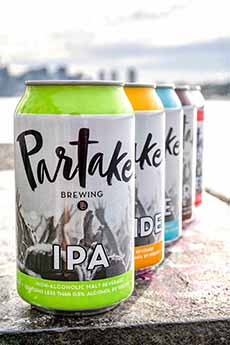
    [1] IPA, the original Partake brew (all photos © Partake Brewing).


    [2] Partake brews five styles: Blond, IPA, Pale, Red and Stout. Gose is forthcoming.


    [3] IPA, Blonde and Stout.


    [4] Our idea of a great party is when nobody gets inebriated.


    We made a beer discovery recently that has made us very happy.

    We have a pretty narrow palate in beer: We want hops. The hoppier and more citrusy, the better.

    That means IPA (India Pale Ale).

    When we were offered samples of a non-alcoholic IPA from Partake Brewing, we paused.

    Non-alcoholic?

    The few brands we’ve tasted over the years have told us to steer clear of N/A beer.

    But we love IPA. So why not taste it?

    We struck gold. Partake Brewing IPA is a delicious beer with negligible calories and no alcohol*.

    There’s plenty of IPA flavor to please us, and it doesn’t taste like a non-alcoholic beer.

    In fact, we like it more than some standard IPAs we’ve tasted.

    Made with citrusy, zingy and bold, Amarillo, Cascade and Citra hops, Partake Brewing IPA has aroma and palate notes of grapefruit, that we love from these Pacific Northwest hops.

    All this aroma and flavor is delivered with just four ingredients: water, barley, hops and yeast.
     
     
    A BIG BONUS

    To those who aren’t inclined to try a non-alcoholic beer, consider these benefits:

    Because there is no alcohol, there are:

  • Only 10 calories per 12-ounce can.
  • Just 2 g carbohydrate.
  •  
    You can drink an entire six-pack—if that’s your thing—for 60 calories.

    Plus, you get no elevated blood alcohol level and no hangover.

    Let us twist your arm to have a can with your next burger, pizza, sandwich, sushi, steak, whatever.
     
     
    GET YOUR PARTAKE BREWS

    Head to DrinkPartake.com.

    You can get a sampler—one of each style—for just $18.

    Or, order a 24-pack of your favorite style.

    Here’s a store locator.
     
     
    PARTAKE BREWER

    Partake Brewing was founded by Ted Fleming, a Canadian beer lover who could no longer drink alcohol.

    His quest was to make craft beer great for non-alcoholic drinkers, creating the taste and authentic experience of craft beer.

    Except that no alcohol means it can be enjoyed by all. If you had serve it to me blind, I would not have known it was
    alcohol free.

    The brewery makes five styles of non-alcoholic beer: Blond, IPA, Pale, Red and Stout. Gose is forthcoming.

    “Alcohol Free, Beer Lover Approved” says Partake Brewery. We agree.
     
     
    > THE DIFFERENT TYPES OF BEER & THE HISTORY OF BEER
     
    ________________

    *Federal regulations allow .5% A.B.V., which equates to 1 proof.


    Comments off

    RECIPE: Irish Brown Bread For St. Patrick’s Day

    If you’re one of the many who bake bread—and many more have gotten into bread-baking during the pandemic—here’s one for your repertoire.

    And just in time for St. Patrick’s Day.

    It’s a recipe for Irish brown bread: an “everyday” Irish brown bread recipe by Fred B. Dugan for King Arthur Flour.

    Traditional Irish brown bread is a blend of whole wheat and white flours, baking soda, salt and buttermilk.

    This version adds a bit of enrichment in the form of sugar and butter (or oil).

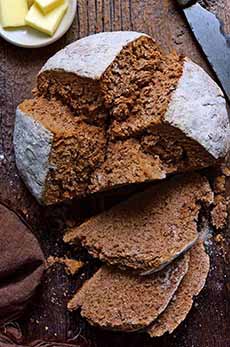
    Slightly sweet with a craggy crumb, the recipe uses Irish-style wholemeal flour (photos #2 and #3), a soft flour coarsely ground from red whole wheat.

    It’s King Arthur’s version of the whole grain flours used to bake traditional Irish breads.

    It is key, says King Arthur, to use flour that imparts the right flavor and texture.

    You can use the Irish-style flour for scones, tea brack (barmbrack) and other Irish baking; as well as in any non-yeast bread recipe calling for wholemeal flour.
     
     
    RECIPE: IRISH BROWN BREAD

    This recipe produces a dense, complex-tasting loaf of brown bread.

    Slather on plenty of rich salted butter (we personally prefer unsalted) and optional marmalade.

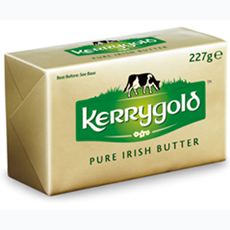
    Buy some Kerrygold butter, imported from Ireland.

    It’s one of the best grass-fed butter brands, made from milk produced by cows that graze on Irish fields and primarily eat grass.

    Irish butter is often more flavorful thanks to the grass the cows eat, so it can deliver even more buttery flavor in recipes.
     
    Ingredients

  • 4 cups (439g) Irish-Style Flour
  • 2 to 3 tablespoons (25g to 35g) sugar
  • 1 teaspoon salt
  • 1 teaspoon baking soda
  • 2 teaspoons baking powder
  • 1-1/2 cups (340g) buttermilk
  • 2 tablespoons (25g) vegetable oil or 2 tablespoons (28g) melted butter
  •  
    Preparation

    1. PREHEAT the oven to 400°F. Lightly grease a baking sheet, or line it with parchment.

    2. STIR together in a large bowl, the flour, sugar, salt, baking soda and baking powder.

    3. MAKE a well in the dry ingredients and pour in the buttermilk and the oil or butter. Stir together until blended; some lumps will remain.

    4. TURN the dough out onto a floured board and knead about 10 times, or until it all holds together. Form the dough into a large ball and place it on the prepared baking sheet. Cut a deep cross in the top.

    5. BAKE the bread for approximately 40 minutes, or until it tests done (a cake tester or toothpick inserted into the center will come out clean).

    6. REMOVE the bread from the oven and cool it on a rack. Enjoy it warm or at room temperature. Serve with sweet butter and a dollop of marmalade, if desired.

    7. STORE, well-wrapped, for a couple of days at room temperature; freeze for longer storage.
     
     
    > THE HISTORY OF BREAD
     
     
    MORE IRISH BREAD RECIPES

  • Chocolate Peanut Butter Irish Soda Bread
  • Irish Soda Bread Muffins With Beer
  • Irish Soda Bread French Toast & Bread Pudding
  • Sweet Or Savory Irish Soda Bread
  • Tea Brack (Barmbrack), An Irish Sweet Bread
  • Traditional Irish Soda Bread (photo #5)
  •  
     
     
    ________________

    *Whole wheat pastry flour will make a moist loaf with fine crumb; Irish-Style Flour, a more traditional open-textured, drier loaf.


    [1] Slather traditional Irish brown bread with salted butter: a treat for breakfast, tea time, anytime (photos #1. #2 and #3 © King Arthur Flour).


    [2] You’ll need Irish-style wholemeal flour. You can get it from King Arthur Flour.


    [3] Irish-style wholemeal flour is used for a number of Irish favorites.


    [4] Treat yourself to some Kerrygold Irish butter (photo © Kerrygold).

    Irish Soda Bread Recipe
    [5] Keep baking! Bake a traditional Irish soda bread recipe (photo © Hot Bread Kitchen).


    Comments off


    © Copyright 2005-2026 Lifestyle Direct, Inc. All rights reserved. All images are copyrighted to their respective owners.