|

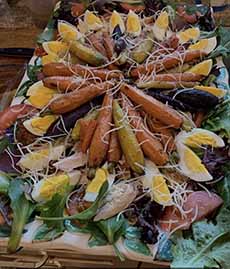
[1] Start a Salmagundi salad tradition. Here’s the recipe for this one (photo © Virtual History Westport.com).
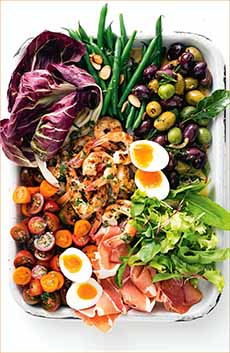
[2] A Salmagundi recipe from down under (photo © Taste.com.au).
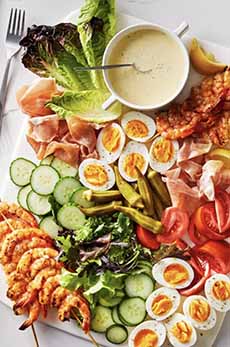
[3] Surf and Turf Salmagundi: prosciutto, shrimp, olives, and more. Here’s the recipe (photo © Southern Living).
|
|
Looking for something different in a dinner salad? How about a salmagundi?
“Salmagundi“ means a heterogeneous mixture or a mixed salad of various ingredients in addition to the greens. A Cobb Salad—avocado, bacon, blue cheese and chicken—is an example of salmagundi.
The word derives from the French salmigondis, meaning a hodgepodge or mixture.
Why not invite friends to a fête de salmagundi brunch, lunch, or dinner:
You provide a large platter and salad greens, plus dressing(s) on the side, artisan bread, butter and anything else you’d like to round out the menu (beverages, soup, dessert).
Either you provide, or each guest brings, potluck-style, a non-greens item to put into a huge salad: anchovies, avocado, baby corn or corn kernels, beets, boiled potatoes, eggs, carrots, cheese, Chinese noodles, croutons, dried fruit/fresh fruit, grilled meats, ham/bacon/prosciutto, marinated or roasted vegetables, nuts, olives, onions, seafood, tomatoes/sundried tomatoes, seeds, water chestnuts and so forth. You can assign ingredients, but it could be more fun if what they bring is a surprise.
If a potluck, as guests arrive, they arrange their ingredients atop the greens, to add to the artistry of the evening.
Red, white and rosé wines, plus beer and artisan soft drinks will pair well with the salmagundi.
> The history of salad.
> The history of salmagundi salad follows.
THE HISTORY OF SALMAGUNDI SALAD
Salmagundi first made an appearance in 17th-century England as a main dish summer salad (and thence to the Colonies).
According to Claude.ai, it was originally a seafaring dish popular sailors and pirates (!) in the 1600s.
It began as a way to use up leftover salted meat (usually fish or chicken) at sea, and evolved into an elegant display dish in British and colonial American cuisine, often arranged in decorative patterns on plates
It’s the ancestor of Cobb salad, layered salad, antipasto salad, and even chef salad. It is made as composed salad (salade composée), the ingredients are arranged on a platter rather than tossed together in a bowl.
The ingredients are carefully placed to create a visual presentation and highlight each component. The salad dressing (oil and vinegar or a citrus or other vinaigrette) can be drizzled on top or served on the side.
Easy to put together, it unites salad greens and vegetables; cold meat, poultry, or seafood (including anchovies); hard-cooked eggs; and condiments—gherkins or other pickles (including pickled vegetables), olives, spicy onions, nuts and fruits, etc.
Modern recipes touches can include cheese and fancier salad greens such as arugula, endive, fennel, radicchio, and watercress, plus standards like cherry tomatoes and radishes.
The dish was popular in England and its colonies for more than a century before the 1824 publication of The Virginia House-Wife by Mary Randolph of Richmond, Virginia—the South’s premier food writer.
It was the first cookbook published in America and the most influential cookbook in the 19th-century U.S. Her way to prepare salmagundi:
|
“Turn a bowl on the dish, and put on it, in regular rings, beginning at the bottom, the following ingredients, all minced: anchovies with the bones taken out, the white meat of fowls, without the skin, hard boiled eggs, the yolks and whites chopped separately, parsley, the lean of old ham scraped, the inner stalks of celery; put a row of capers round the bottom of the bowl, and dispose the others in a fanciful manner; put a little pyramid of butter on the top, and have a small glass with egg mixed as for sallad to eat with the salmagundi.” [source]
Her recipe differs from most historical recipes:
It was composed on an inverted bowl instead of a bed of leafy greens—in fact, it contained no greens other than the herb parsley.
In most older recipes the components were arranged over or under) finely cut salad greens.
Her recipe uses a dressing thickened with hard-cooked egg yolks (“a small glass with egg mixed as for sallad”). Older recipes used a simple dressing of oil and lemon juice or vinegar.
Here are two classic Salmagundi recipes:
Hannah Glasse’s “The Art of Cookery,” an 18th century English cookbook that was popular in America
Twentieth Century Salmagundi, as it used to be served at Christiana Campbell’s Tavern in Colonial Williamsburg,
This handsome salad remained popular in the U.S. until late in the 19th century.
Thanks to Damon Lee Fowler and the Savannah Morning News for a portion of this history.
CHECK OUT WHAT’S HAPPENING ON OUR HOME PAGE, THENIBBLE.COM.
|