|
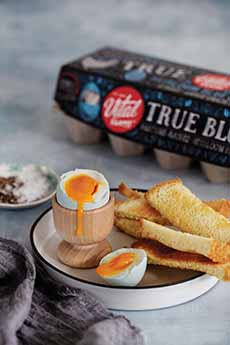
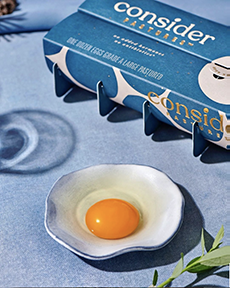
[1] Look at that golden yolk! You can tell it’s a pasture-raised egg (photos #1, #2, and #3 © Vital Farms | Facebook).

[2] The yolks before cooking. They have seven times the beta carotene of conventional eggs.
[3] Pasture-raised hens eat the bounty of the land, all year long.
[4] A modern egg carton, with snazzy design from Consider Pastures (photo © Consider Pastures).
[5] The first attempt at a protective carton for eggs, in 1906. A wood box contained a cross-hatch of cardboard pieces to separate the eggs (photo © The Antique Kitchen).
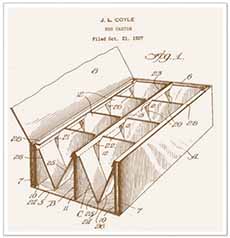
[6] Next came this invention in 1911, which created V-shaped cardboard “slings” to cradle the eggs (photo © Bulkley Valley Museum | British Columbia).
[7] The modern egg carton, of molded paper pulp, has individual cups to cradle the eggs (photo courtesy Geek Philosopher [now closed]).
|
|
June 3rd is National Egg Day, and our tip is: If you love breakfast eggs, no matter what style, try pastured-raised eggs. You’ll be amazed at how much more intensely delicious they are. As one of our colleagues, who buys eggs at her local farmers’ market, said, “They’re like a different species.”
They work equal magic in baking and other recipes, particularly egg-focused ones like carbonara, crème brûlée, deviled eggs, custard, hollandaise and béarnaise sauces, mayonnaise, and quiche—for starters.
Pasture-raised eggs are the best you can buy: better than free range, cage free, organic, and other types. Treat yourself to a carton and discover superior egg flavor.
WHAT ARE PASTURE-RAISED EGGS?
They are eggs are by hens that spend their days outdoors, roaming the pastures and pecking food from the earth. They have much more individual space than both free range and cage-free hens*. They have access to fresh air and sunshine year-round (yes, they peck through the snow to find worms and other tasty morsels.
The hens spent their lives — or portions of them — on a pasture, or with access to a pasture and have grazed naturally.
Egg farmers like Consider Pastures are raising the bar for excellence in the egg category, with focus on environmental stewardship and holistic farming practices. There is also commitment to humane animal treatment, via Certified Humane® certification.
Crack a pasture-raised egg and you’ll notice:
A stronger, thicker shell.
Intensely hued, deep yellow yolks.
Substantial whites and thick, strong shells.
And then, there’s the taste. Just try it!
THE BENEFITS OF PASTURE-RAISED EGGS?
In addition to great flavor, pasture-raised eggs have:
1/3 less cholesterol
1/4 less saturated fat
2/3 more vitamin A
2 times more omega-3 fatty acids
3 times more vitamin E
7 times more beta carotene
3-6 times more vitamin D
Most Americans are deficient in vitamin D. Eating just two pasture-raised eggs will give you from 63%-126% of the recommended daily intake of D [source].
WHERE TO FIND PASTURE-RAISED EGGS
Check:
Farmers’ markets.
Natural food stores,
The internet for farms in your area and where they retail their products.
THE HISTORY OF THE EGG CARTON
It seems simple enough. But prior to 1911, eggs were transported and sold in baskets or wooden crates—like you’ve seen in many of images of the good old days. While a basket was fine for carrying eggs from the coop to the house, transporting them elsewhere was a challenge.
Whether via horse and wagon on bumpy roads or even bumpy railroad cards, many eggs were broken in this unprotected state, no matter how much straw cradled baskets and crates.
So one day, rather late in the history of selling eggs, one person sat down and invented the world’s first egg carton.
In 1906, Thomas Peter Bethell of Liverpool invented a predecessor to the modern egg box, which he called the Raylite Egg Box. Made from wood with frames of interlocking strips of cardboard that created compartments for each egg, it was the first egg transporter of its kind (photo #5).
In 1911, Joseph Coyle, a newspaper editor in Smithers, British Columbia invented the first iteration of the egg carton as we know it. As the story goes, he was dining at a local hotel when an argument erupted between the hotel owner and the hotel’s egg supplier over the broken eggs in the latest shipment. Curious, he set to problem-solving and in a few weeks, invented the Coyle Egg Safety Carton.
His early version didn’t have cups for each egg, like today’s cartons. Rather, he created individual compartments with V-shaped cardboard “slings” to cradle each egg (photo #6). But it was the same long, narrow shape we know today. Demand was so high that he later designed a machine to automate most of the carton production [source].
In 1921, Morris Koppelman of Brooklyn, New York patented an improved version of the egg carton made from cut, folded, and glued cardboard. The patent emphasized the ability for it to fold flat after use for storage and reuse, a feature no longer important in our disposable lifestyles [source].
In 1931, Francis H. Sherman of Palmer, Massachusetts patented an egg carton formed with pressed paper pulp that is recognizable as one of the modern egg cartons used today. The pulp, or fiberboard, was pressed into the still-familiar gray, cardboard-like containers.
In 1966, polystyrene foam made its debut, molded into cushiony egg cartons (styrofoam is a form of polystyrene). They were white and pastels: blue, pink, and yellow.
In 1969, the United Industrial Syndicate in Maine patented an egg carton developed by Walter H. Howarth, Gerald A. Snow, and Harold A. Doughty. It’s similar to Sherman’s pressed paper pulp carton, with improvements.
It has special “feet,” small pedestals molded into the carton to provide support for the weight of stacks of egg cartons, and other strength-related features.
It also had an improved clasping closure feature.
In the last few years, clear plastic cartons have appeared in grocer’s cases, making the task of opening the carton to look for broken eggs obsolete (almost—we still check). That customers can see through the carton is appealing, although the see-through egg cartons cost double† that of the polystyrene and pulp cartons [source].
So today’s egg packers can choose from cartons made from polystyrene, clear hard PET plastic, or (environmentally preferred) the good old molded pulp paper carton using recycled paper and a mechanized papier-mâché process (photo #7).
And while some cartons are plain, some brands pull out all the stops for shelf appeal (photo #4)—Consider Pastures’ modern take on what an egg carton could look like. Why be a plain Jane, when for a few cents more per carton, you can dazzle customers who are checking out the eggs on the shelf.
MORE TO DISCOVER
> The different types of eggs.
> What egg color means (and doesn’t): From the shell to the yolk, debunking egg color myths.
> How to create jammy eggs.
|