|
Foodies who like lusciousness—not to mention fitness fans looking for a natural source of post-workout muscle recovery—may want to reach for one of the world’s oldest-cultivated fruits: Medjool dates.
Dates are one of the first cultivated foods, and so naturally sweet that they’ve earned the nicknames “nature’s candy” and “the world’s first candy.”
Sure, they’re delicious. But dates and other foods rich in potassium are linked to reduced exercise-induced muscle soreness and connective tissue damage, and enhanced athletic performance going forward. Nutritionists are touting the health and muscle-recovery capabilities of dates as a natural replacement for sports drinks and energy bars that are loaded with processed sugar.
According to Elizabeth Somer, registered dietitian and author of Eat Your Way to Happiness and Eat Your Way to Sexy, dates are one of nature’s best recovery foods.
“A serving of dates speeds recovery after exercise, replacing needed potassium and other electrolytes, and helping to restock glycogen stores,” explains Somer. “In addition, the potassium and manganese help balance blood-sodium levels that support muscle contraction, reduce fatigue, and stimulate recovery.”
Who knew? We’ve been eating them plain and with cheese simply because we love them. But now, we’ll look at them as a guilt-free sweet snack! For those watching their sugar intake, Medjools rate low to low/medium on the Glycemic Index (GI).
> February 4th is Medjool Date Day.
> December 22nd is National Date Nut Bread Day.
Below:
> The history of dates.
> How to buy dates.
> How to enjoy dates, no cooking required.
Elsewhere on The Nibble:
> The year’s 80 fruit holidays.
> The year’s 90 snack holidays.
THE HISTORY OF DATES
Among the sweetest fruits in the world, with a concentration of natural sugar that has earned them the sobriquet “nature’s candy,” dates are one of the earliest crops to be cultivated, in the Fertile Crescent between Egypt and Mesopotamia as early as 4000 B.C.
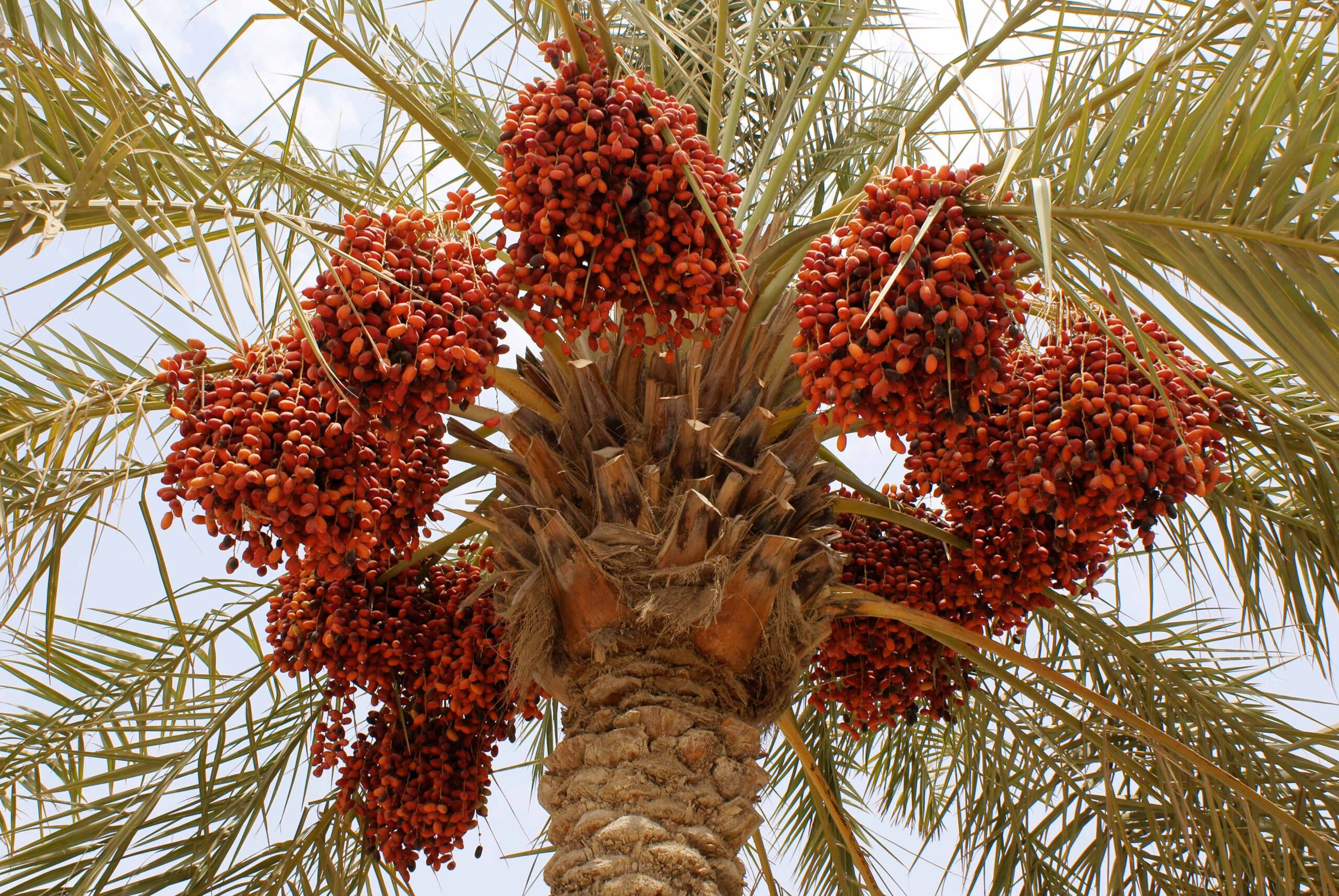
Dates are the fruit of the date palm (photo below), a tree that thrives in desert conditions—including the Bard Valley of Southern California, which produces premium Medjools.
Dates are prominent in the Abrahamic religions of Christianity, Islam, and Judaism, with date palms thought to be the original “apple tree” in the Biblical story of Adam and Eve.
In Judaism, dates are considered one of the seven holy fruits, or seven species, and remain an important ingredient in Israeli cuisine.
Silan, a syrup extract taken from dates, is thought to be the sweet component of the promised “land of milk and honey.” In Islam, the end of Ramadan may be celebrated by indulging in ma’amoul (buttery cookies with date stuffing).
They continue to be an important crop for Iraq, Iran, the Arabian peninsula, and North Africa west to Morocco.
Dates In The New World
Since the early 20th century, dates also have been cultivated in southern California, Arizona, and Florida [source].
Several varieties are easy to find in the U.S., but the best are Medjools, larger, plumper, moister, and more tender, with caramel notes. They are considered the best-tasting, most luscious dates in the world, and have long been called the “Fruit of the Kings.”
You may also come across Deglet Noor, Halawy, and Khadrawy, all chewier varieties. We like them all but prefer the larger, softer Medjool.
In addition to sweet recipes—cakes, compotes, cookies, fruit breads, ice cream, puddings, smoothies, etc.—dates add a sweet accent to braises and roasts and can be substituted for prunes. (Unless otherwise specified, date varieties are interchangeable in recipes.)
One serving of Medjool dates (two whole dates) provides 8% of the daily recommended value (DRV) for potassium, 12% for dietary fiber, and 4% for magnesium, as well as important vitamins and minerals including calcium, copper, iron, magnesium, niacin, potassium, and vitamin B6.
|
|

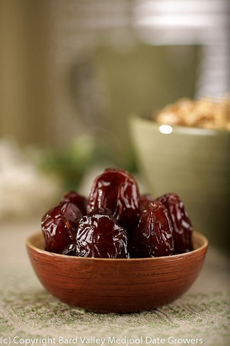
[1] A great anytime snack (photos © Bard Valley Medjool Date Growers Association).
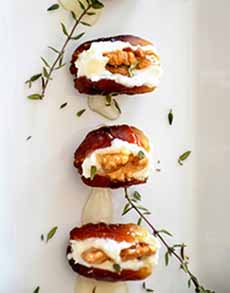
[2] Stuff dates with your favorite soft cheese, a nut, and a garnish of thyme leaf. Drizzle with honey for a dessert plate (photo © Boba Jaglicic | Unsplash).
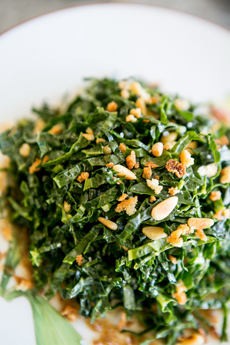
[3] Kale salad with date vinaigrette: Mix pureed dates into vinaigrette, to taste (photo © Art De Fete)
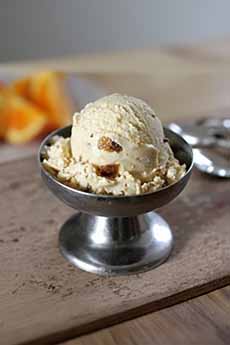
[4] Soften a pint of ice cream and mix in chopped dates and other ingredients from nuts to chocolate chips. Here’s the original from-scratch recipe by David Lebovitz (photo © Spice Islands).
|
Here’s how the fruits grow on theMedjool date palm tree (photo Nepenthes | License CC-BY-SA-3.0).
10 WAYS TO ENJOY DATES WITHOUT BAKING OR COOKING
We’re content to eat them straight from the bag or box. But with just a bit more effort, you can have:
Blended: as a natural sweetener in a smoothie, or in energy bites (pulse pitted dates in a food processor with nuts, seeds, and a pinch of cocoa powder or shredded coconut until the mixture sticks together; roll into small balls).
Cheese & Dates: Pair with your favorite cheese(s). We personally like dates with goat cheese and blue cheese.
Charcuterie Boards: Add with dried apricots, walnuts, and pecans.
Chocolate Dipped: Dip them into melted chocolate as a quick “fondue,” or place on wax paper to cool.
Cocktail & Snack Bites: Wrap a pitted date in a thin slice of prosciutto or Serrano ham.
Garnish: Chop dates into pieces and toss them atop your cereal, yogurt, or salad. With cereal, there’s no need to add sugar. With salad, our favorite pairing is arugula, toasted walnuts, and a balsamic vinaigrette.
Ice Cream: Soften a pint of ice cream and mix in chopped dates, nuts, chocolate chips, orange zest, crystallized ginger, mochi bits…whatever you have on hand.
Stuffed Dates: Slice a date lengthwise, remove the pit, and fill the cavity with any soft cheese or nut butter. You can top it with a single almond, walnut half, or a sprinkle of sea salt.
Spread: Blend pitted dates into a paste with a splash of water, a touch of vanilla extract, and a pinch of salt until smooth. Spread on apple slices, celery sticks, or crackers.
HOW TO BUY DATES
Harvesting dates from the palm tree is a labor-intensive process.
Wind pollinates date palms naturally, but to ensure an adequate yield, the growers must pollinate each palm by hand.
A worker may climb the same full-grown tree multiple times a day to trim sharp thorns, monitor air circulation, and ensure proper sunlight exposure so the dates can reach optimal size.
The ripening dates are then covered with burlap bags or nylon netting for protection from birds and insects.
Since dates don’t ripen simultaneously, this process is done repeatedly, picking fruits one by one until the harvest is exhausted. Think of all this the next time you bite into a delectable date!
Dates are harvested according to stages of ripeness. Once fully ripened, they need to be picked: The longer they stay on the tree, the drier they become.
Delicate, just-ripe dates are sold fresh at some farmers markets and Middle Eastern grocers, but they’re most commonly sold partially dried, often with the pit removed.
Choose dates that are plump and glossy. They can look wrinkled, but shouldn’t feel hard. A thin coating of sugar on the outside is okay, provided it’s not crystallized. If the dates smell sour, pass them by.
Like dried fruits, dates have a long shelf life and will keep at room temperature for about two months if sealed in plastic.
Thanks to the Bard Valley Medjool Date Growers Association (BVMDGA), a consortium of family growers in the southwest, is responsible for more than 60% of the Medjool dates grown in the U.S. For more information, visit NaturalDelights.com.
CHECK OUT WHAT’S HAPPENING ON OUR HOME PAGE, THENIBBLE.COM.
|