|
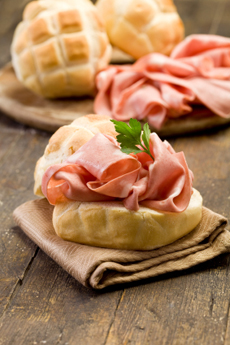
[1] A bologna sandwich, long a cold-cut standard. American bologna evolved from Italian mortadella. See the *footnote below (photo © Francesdo Di Bartolo | iStock).
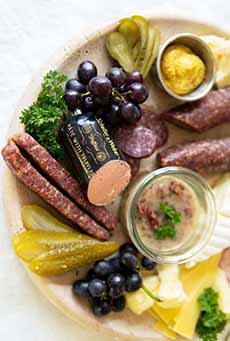
[2] Precooked, smoked, or cured sausages are considered cold cuts. Here’s how to put together a Vesperplatte, a German charcuterie board. This one contains Landjäger (left); Dauerwurst, a type of salami (right); truffled pâté (left) and Griebenschmalz, rendered pork fat mixed with cracklings (center) (photo © Dirndl Kitchen).
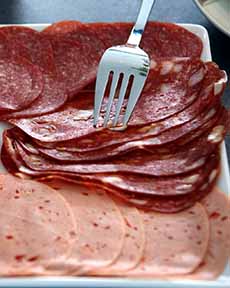
[3] Building a sandwich. Cold cuts are an American favorite—but not a nutritionist’s (Pixabay Photo CC0).
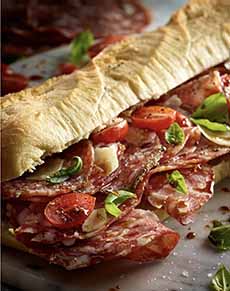
[4] Possibly America’s favorite use of cold cuts: the hero (a.k.a. grinder, submarine, torpedo sandwich (photo ).
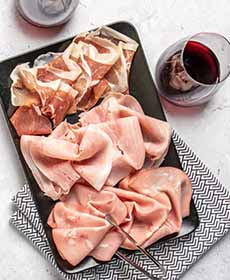
[5] A tasting of prosciutto crudo (dry-cured ham, prosciutto cotto (cooked ham), and mortadella (pork sausage containing cubes of pork fat).
|
|
March 3rd is National Cold Cuts Day, an American holiday.
Why American? The word is an Americanism dating back to 1940-45 according to the Random House Dictionary.
The term refers specifically to precooked or cured meat, often in loaf or sausage form, that are sliced and served cold on sandwiches or on party trays.
They are cooked, cured, smoked, or otherwise preserved meats that are served cold or at room temperature, typically thin-sliced for sandwiches and platters.
These include salami, bologna, ham, liverwurst, Italian salume, mortadella, turkey roll, roast beef, salami, and other cured and processed meats.
Cold cuts are also known as deli meats, lunch meats, luncheon meats, sandwich meats and in the U.K., as cold meats, cooked meats and sliced meats.
Below:
> The history of cold cuts.
> Cold cuts by country.
Elsewhere on The Nibble:
> The year’s 28+ sandwich holidays.
> The year’s 24 pork holidays.
> Pork cuts: a photo glossary of pork cuts and terms.
> Types of charcuterie: a photo glossary of classic charcuterie.
THE HISTORY OF COLD CUTS
Ancient times. For most of human history, millennia before the concept of “cold cuts” emerged, preserving meat before refrigeration was essential. While roasts could be eaten over several days, longer-term options were needed. Cultures developed:
Salting and curing: dry salt and brines to reduce spoilage (later with nitrates/nitrites).
Smoking: to add antimicrobial compounds and dry the surface to prevent bacterial growth.
Drying/fermentation to lower water activity and pH (especially for salami-type sausages).
Cured hams and sausages, smoked meats, and dried meats like jerky were the result.
Now, fast-forward to…
Medieval to early modern Europe: From the Middle Ages onward, France developed the technique of charcuterie, a specialized craft of preparing pork products made by specialized pork butchers called charcutiers.
The result: cooked, cured, or smoked meat products from bacon and hams to pâtés, sausages, and terrines. Many of which were meant to be eaten cold, a convenience food. See the different cold cuts by country, below.
Cold cuts have long been a workman’s lunch: A man went off for the day with sliced bread, sliced meat and cheese. But it didn’t stay a working-class food.
18th–19th centuries: With urbanization came the rise of delicatessens, to provide ready-to-eat food for city dwellers. The modern concept of “cold cuts”—sliced meats sold to order—grew with city life. Delicatessens also sold prepared foods, including cured/smoked meats, cheeses, and breads.
19th-20th centuries: In the U.S., waves of European immigrants helped to popularize deli-style meats, particularly German sausages (wurst) and ham, Italian salami and mortadella, and Jewish/Eastern European pastrami and corned beef. German bologna became a mainstream sandwich filling.
Late 19th century: In the U.K., tea rooms began to serve cold cut tea sandwiches in addition to butter and cucumber of watercress, cream cheese, egg salad and ham salad [source].
Late 19th–20th centuries: In the U.S. and elsewhere, mechanical refrigeration and mass production made cold cuts a mainstream staple: Refrigeration enabled safer storage and wider distribution.
Industrial meat processing scaled the production of the category called “luncheon meats.” Uniform loaves like bologna and later, prepackaged sliced meats, made cold cuts affordable and convenient.
Mid–20th century: By mid-20th century, cold-cut sandwiches had become a standard lunch food. Cold were ubiquitous in groceries, in vacuum packs everywhere and sliced to order (as in the old days) at supermarket meat and deli counters.
The down side is that highly processed sliced meats (reformed, emulsified, or injected products designed for consistent texture and shelf life) turned out to be unhealthy—not just from high sodium levels, but links to cancer and heart disease. Most cold cuts are higher in fat, nitrates, sodium, and preservatives. In fact, the prepackaged/presliced kind can have even more sodium and preservatives, as the larger exposed surface of the slice requires stronger preservatives.
21st century: To produce better-for-you products, the modern artisan salume movement began to take shape in the U.S. in the late 1990s and accelerated rapidly throughout the 2000s, with a significant renaissance occurring in the last 10 to 15 years.
Depending on one’s palate and pocketbook, both mass-produced and artisan meats are enjoyed by many Americans, in a sandwich or on a party platter. They’re easy lunch and party fare.
Alas, even with the artisan foods, cold cuts are not a nutritionist’s dream. Cold cuts and cured meats have too much, i.e. unhealthy, sodium [sodium].
|
COLD CUTS BY COUNTRY
Cold cuts are essentially the American, everyday term for the meats that form the foundation of charcuterie, although modern American charcuterie boards often replace artisanal cured meats with deli-style cold cuts. But let’s return to the foundation of the original “cold cuts,” made long before America existed.
Eastern Europe, including Russia, served up a wide array of zakuski—cold appetizers, often featuring cured meats and fish. Smoked fish and pâtés were joined by kabanos (dried sausage) and salo (cured pork fatback).
France, as noted above, originated a vast practice in charcuterie. See them all here.
Germany’s Wurstplatte was known for heartier, often smoked products, typically served on a Vesperbrett (snack board). The fare included Landjäger (smoked and dried sausage), Liverwurst (spreadable liver sausage), Speck (smoked ham), and various salami (photo #2).
In Italy, salumi (the most direct equivalent to charcuterie) brought forth cured and dried meats, among them prosciutto (dry-cured ham), ‘nduja (a spicy, spreadable sausage filling), mortadella, pancetta, and salami (more than 600 types). Beef bresaola is dried like preparation (photos #3, #4, and #5).
Spain’s tapas culture, famous for its tabla de embutidos, served embutidos (sausages) and jamón (cured ham). Popular examples include chorizo (paprika-spiced pork), jamón ibérico, jamón serrano, and lomo (cured pork loin).
Other regions had (and have) less extensive, but equally tasty, offerings. Some examples:
Argentina: picada—a, popular, shared platter of cheeses, cured meats (like salame), and olives.
China: A cured meat platter featuring bakkwa (savory and sweet sweet beef, mutton, or pork jerky), lap cheong (sweet pork sausage), and lap yuk (cured pork belly/bacon).
Greece/Middle East: mezze such as pastirma (highly seasoned, air-dried beef) and sujuk (spiced sausage).
South Africa: Bbiltong and droëwors (cured, air-dried sausages).
Switzerland: plättli—hearty, alpine-style boards featuring dried meats like Bündnerfleisch (air-dried beef).
Home-cooked “cold cuts”: At home, it was common to roast a large cut of meat, then slice and eat the leftovers cold for later meals. This practice is an ancestor of the “cold cuts” concept.
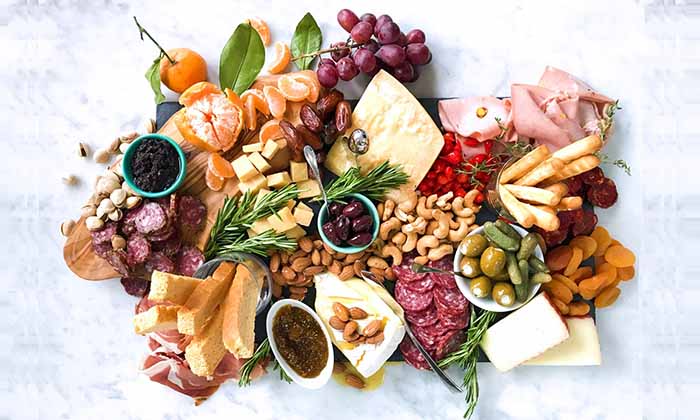
[6] Cold cuts platter, waiting for the wine and beer (photo © DeLallo).
_____________________________
*What Americans call bologna traces back to Italian mortadella, made since at least the 14th century in Bologna, Italy. Italian immigrants brought mortadella to America, where it was eventually simplified and mass-produced in the late 19th century. The differences between traditional Italian mortadella and American supermarket bologna are significant in terms of texture, ingredients, and flavor:
Visible Fat and Additions: Mortadella contains large, visible cubes of high-quality pork neck fat (called lardons) and often whole green pistachios or black peppercorns. Bologna is a completely smooth, uniform “emulsified” meat. All fat and meat are ground together into a fine paste (batter) so that no individual chunks are visible.
Meat Composition: In Italy, Mortadella Bologna PGI (Protected Geographical Indication, a legal EU designation) must be made of 100% pork by law (there is also generic mortadella in Italy, without the PGI). It uses finely ground lean pork mixed with the cubes of fat. Bologna has no standards. It can be a blend of pork, beef, chicken, or turkey.
Spicing and Flavor: Mortadella has a complex yet delicate, aromatic floral and spice profile that usually includes myrtle berries, nutmeg, coriander, and cloves. Bologna is typically seasoned with salt, pepper, celery seed, and often coriander and garlic. The flavor is simpler and more “savory-sweet.” Bologna can have a distinct tang or smokiness that is not present in mortadella.
Production Method: The meat for mortadella is ground into a very fine paste using large industrial mortars (hence the name) and then slow-cooked in large ovens for hours, sometimes days, to reach a specific internal temperature. Bologna, while also cooked, it is often produced much faster and frequently includes liquid smoke (or is smoked during the cooking process) to give it a characteristic “American deli” flavor.
Why isn’t American bologna called mortadella? By the early 20th century, the bologna mass-produced in America was no longer the same product as Italian mortadella, which was made by smaller American-based producers of Italian foods, as well as imported. At some point, some producer sought a different name to differentiate the American product, and the hometown of mortadella—Bologna, Italy—provided an answer. Ironically, the mortadella from Bologna, Italy is a protected, premium regional product with PGI status, while American bologna named after that town is an inexpensive sandwich meat.
Over time, bologna (pronounced buh-LOW-nya) became pronounced “baloney.” For word nerds: When a foreign word is brought into English and the original spelling is kept, the pronunciation often changes to fit English mouth-movements or phonetics. This is how buh-low-nya became buh-low-nee. Another example is colonel, pronounced “kernel” due to historical influence from the Spanish “coronel.” When the spelling doesn’t clearly match the sound, linguists refer to it as orthographic opacity.
CHECK OUT WHAT’S HAPPENING ON OUR HOME PAGE, THENIBBLE.COM.
|