|
This week we attended a trade event called Riesling & Co. World Tour 2011, sponsored by GermanWineUSA.com, a trade association that aims to heighten awareness of the quality and special nature of German wines. A revelation: the best wine for sushi may be Riesling.
At most wine tastings, there’s a selection of cheeses, breads, and other foods to go with the wine. At this Riesling tasting, the only food served was sushi—plus dumplings and spring rolls targeted at those who don’t eat sushi.
It was a perfect pairing. Those who don’t drink beer or saké have a winner in a Riesling, part of a quintet of other white wines that includes crisp, high-acid Riesling and Pinot Blanc, spicy and aromatic Gewürztraminer and Viognier. Champagne and other sparklers go well, too.
Riesling, Gewürztraminer, and Pinot Blanc are grown in both the Alsace region of France and in Germany. Viognier is largely Alsatian, but Germany has been amping up its production. All four varieties are grown in California, where they are known as “the Rhone clones.”
While wines from the same grape variety taste different based on where they were grown, each region produces delicious wines. It’s a question of finding which producers you prefer.
Below:
> The new Riesling style.
> Classic food pairings with Riesling.
> The history of Riesling.
Elsewhere on The Nibble:
> A brief history of wine.
> The year’s 22+ white wine holidays.
> The year’s 25+ red wine holidays.
THE NEW RIESLING
Rieslings have changed substantially over the last 20 years. In an effort to gain more fans worldwide, vintners have moved away from the traditional style of Riesling with its notes of petrol and flowery, sometimes heady aromas. Today, the wines are made to be food-friendly across a rainbow of cuisines. The crispness and acidity are just right for sushi.
|
|
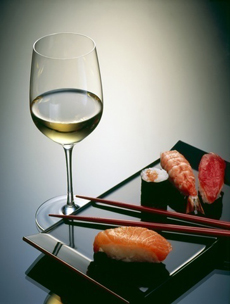
[1] Riesling is the wine to pair with sushi (photo © Lognetic | Dreamstime).
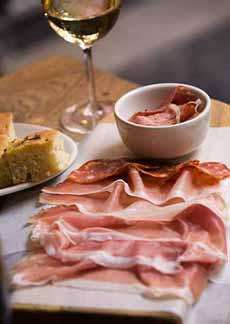
[2] Pair salty foods like prosciutto and other cured meats with Riesling (photo © Lupa Restaurant | NYC).
|
Riesling is vinified into six categories, in order of increasing sugar levels based on the ripeness of the grapes when picked. Don’t let the word “sugar” scare you away: The slight sweetness in Kabinett and Spätlase wines goes very well with sushi.
Kabinett Rieslings, with the lowest sugar levels, are the best place to start.
Kabinett Riesling is a light wine, typically semi-sweet with crisp acidity. It can be vinified to be dry (you’ll see the word Trocken, dry, on the label).
Spätlese Riesling, typically semi-sweet or sweet, is made from late harvest (Spätlese) grapes.
Auslese Riesling is made from selected very ripe grapes. Auslese means “select harvest.”
Beerenauslese Riesling is made from overripe grapes vinified into a rich, sweet dessert wine. Beerenauslese means “select berry harvest.”
Eiswein (ice wine) is made from grapes that have been naturally frozen on the vine, resulting in a very concentrated flavor.
Trockenbeerenauslese Riesling, nicknamed TBA, is made from overripe, shriveled grapes often affected by noble rot—an extremely rich sweet dessert wine that is a glass of heaven. The name means “select dry berry harvest” or “dry berry selection.”
Our favorite producers: Dr. Loosen, Müller Cattoir and Weingut Robert Weil. But you can start your Riesling voyage with any German—or California—Riesling.
Now for the bad news: Just try to find Riesling (or a Pinot Blanc, Gewürtztraminer or Viognier) at a Japanese restaurant. You may have to do some lobbying with management. At a minimum, ask if you can bring your own wine for a corkage fee, a charge by the restaurant for every bottle of wine or spirits served that was not bought on the premises. It is usually equal to the price of the most affordable wine that the restaurant carries.
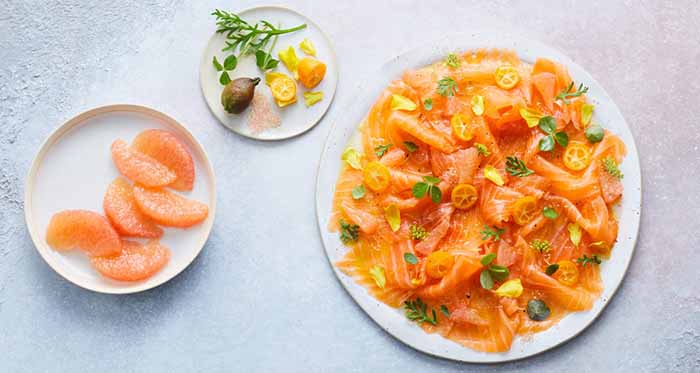
[3] Serve Riesling with smoked fish (photo © Petrossian).
CLASSIC FOOD PAIRINGS WITH RIESLING
Riesling, Germany’s principal wine grape, is considered one of the most food-friendly wines due to its high acidity and range of sweetness. This crisp white wine can partner everything from delicate seafood to heavy, spicy dishes.
Riesling is vinified in four levels of sweetness: dry, off-dry, semi-sweet, and sweet. Each one pairs with a specific range of foods.
Dry Riesling (Trocken)
Dry styles are lean and refreshing, excellent for cutting through fat and highlighting fresh, mineral flavors. Pair them with:
Seafood: Raw, cured, or smoked fish like salmon and trout are classic choices. As noted above, these Rieslings also pair exceptionally well with sushi.
White Meats: Pour a Trocken with simply prepared poultry, veal scaloppine, or pork. Cured pork and German charcuterie like leberwurst (liverwurst) on rye are traditional rustic pairings.
Vegetables: Vegetable-driven dishes and salads with lemon-based dressings benefit from Trocken’s dryness and acidity.
Off-Dry and Semi-Sweet Riesling (Kabinett, Spätlese)
These wines are great pairings for dishes that are difficult to pair with other wines, particularly those with heat or fruit elements.
Spicy Foods: The residual sugar tames the heat in Thai curries, Szechuan pork, and Indian dishes like tandoori or vindaloo.
Sweet & Savory: Dishes that incorporate fruit—such as pork with applesauce, duck with plum sauce, or Hawaiian pineapple relish—harmonize perfectly with the wine’s fruit notes.
Salty Foods: The sweet-and-salty contrast makes off-dry Riesling a ready partner for Parmesan-topped dishes like risotto and aged hard cheeses such as aged Gouda, Manchego, and Pecorino Romano plus lightly-aged feta; cured Meats like prosciutto di Parma and Serrano ham. The salt crystals in these changes make the fruit notes in an off-dry Riesling “pop”; dishes seasoned with soy sauce or miso; dishes with capers and olives.
Fried & Smoked Foods: The acidity of Riesling cuts through the grease and salt—of foods like fried chicken, smoked salmon, and other smoked fish.
Other raw fish: crudo, oysters, tartare, tiradito.
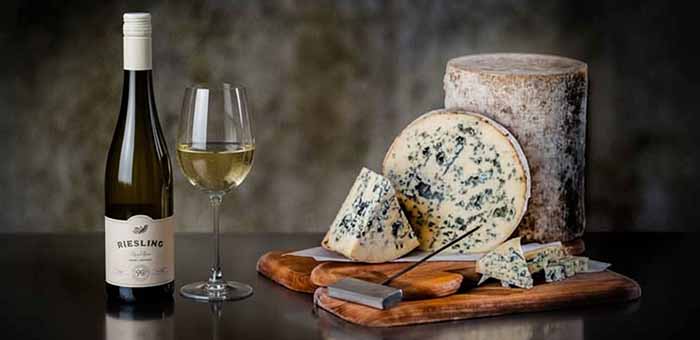
[4] Pair strong, salty cheeses with Riesling (photo © Jasper Hill Farm).
Sweet Dessert Styles (Auslese, Beerenauslese [BA], Trockenbeerenausle [TBA], Eiswein [Ice Wine])
These rich and concentrated wines pair with foods that match their intensity.
Fruit Desserts: Tarts or compotes made with stone fruits (peach, apricot, nectarine) or tropical fruits like mango and pineapple are naturals with a dessert Riesling’s sugar and acidity.
Strong Cheeses: Ditto with very salty blue cheeses like Roquefort or Stilton.
Avoid Serving Riesling With These Foods
Heavy red meats (beef, lamb), very peppery dishes, and coffee or chocolate-based desserts, which can overwhelm Riesling’s subtle aromatics.
The “Sweetness Rule”: When pairing with dessert, ensure the wine is sweeter than the food; otherwise, the wine will taste thin and tart.
What desserts are “too sweet?”
Baklava or honey-soaked pastries (with the emphasis on “soaked”).
Coffee and Mmocha Desserts: The bitter, roasted notes of coffee and mocha (including tiramisu) overwhelm the subtlety of Riesling.
Heavy caramel or butterscotch desserts, e.g. sticky toffee pudding or a very caramelly crème caramel.
Meringues and pavlovas, because the base meringue is essentially pure sugar. A TBA or ice wine could work.
Milk chocolate and fudge desserts: The sugar and fat in the chocolate will make even a sweet Riesling taste sour. This goes for chocolate- and other glazed donuts.
]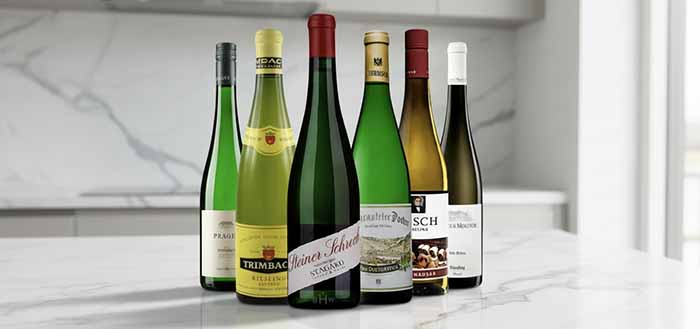
[5] For a Riesling party, you can order the Iconic Riesling Collection from Big Hammer Wines.
THE HISTORY OF RIESLING
Riesling is a white grape that originated in the Rhine region of Germany. The first known written mention is March 13, 1435: a cellar record from Count John IV of Katzenelnbogen in Rüsselsheim, whose cellarmaster noted the purchase of “Riesslingen” vine cuttings.
(As with all foods, the wine was around for some time prior to the first known documentation.)
The spelling evolved over time. Early forms like Rießlingen or Rissling appear in 15th‑century documents. The modern “Riesling” spelling was recorded in 1552 by botanist Hieronymus Bock.
Historically used for everything from bone‑dry table wine to some of the world’s most long‑lived dessert wines (BA, TBA, Eiswein), top Rieslings—especially sweet ones—can age for decades. Some 19th‑century bottles have shown well over 100 years later!
(Editor’s note: When we vacillated over buying a second case of 1989 TBA years ago, the wine merchant said, “These wines will outlive you!” So we purchased one case of Egon Müller and another of Prüm. We had a bottle of each at a wine dinner recently, and both showed beautifully, although at 37 years old, they have a long way to go.)
15th–18th Centuries. Riesling was nurtured primarily by Benedictine and Carthusian monasteries and noble estates along the Rhine and Mosel Rivers. It was mentioned in Alsace as early as 1477, showing its early spread beyond Germany.
After the devastation of the Thirty Years’ War in Central Europe (1618 to 1648, one of the most destructive conflicts in European history), many ruined vineyards in the Rhine and Alsace were replanted with Riesling. It became a prestige wine.
In 1720, Schloss Johannisberg in the Rheingau famously replanted all its vineyards to Riesling, signaling rising prestige Wine Spectator, and was regarded as the world’s first Riesling wine estates, producing wines characterized by exceptional minerality due to its unique quartzite soil. (The estate is also famous for inventing late-harvest wine.)
Another innovation at Schloss Johannisberg: A delayed harvest in the late 1700s allowed noble rot (Botrytis cinera) to develop on the Riesling grapes. The mold was an accidental boon: It concentrated the flavors, resulting in a rich, concentrated wine that launched the tradition of late-harvest Spätlese, Auslese, Beerenauslese and Trockenbeerenauslese Rieslings.
In 1787, the Elector (Archbishop) of Trier ordered that the “bad vines” in his territories be ripped out and replaced with Riesling.
19th Century: The Golden Age Of Riesling. By the mid‑1800s, Riesling had become one of Europe’s most fashionable and expensive wines, often fetching prices comparable to or higher than top Bordeaux and Champagnes.
The Mosel, Rheingau, and Rhine regions built a global reputation for age-worthy, often sweet Rieslings, shipped throughout Europe and to the U.K.
20th Century: World Wars I and II destroyed many vineyards and disrupted trade. Post‑war, German production often prioritized quantity over quality, favoring easier, high‑yielding varieties like Müller‑Thurgau. Mass‑market sweet wines (e.g., Liebfraumilch) damaged Riesling’s image abroad.
Late 20th Century: From the 1980s and 1990s, quality‑focused producers in Germany and elsewhere re‑established Riesling’s reputation. In 1996, it regained its position as Germany’s most widely planted grape, and Riesling spread widely.
In Alsace (France), where it was first recorded by the late 15th century, it’s now the dominant white variety in many top vineyards (our favorite is Zindt-Humbrecht). Beyond, you’ll find Riesling produced in:
Australia, in the Clare and Eden Valleys, which produce limey, dry Rieslings.
Austria, especially Wachau, Kamptal, and Kremstal, where it yields powerful, dry, minerally wines.
Canada, where it is the major grape for ice wine.
New Zealand, particularly in the Marlborough region.
USA, in Washington State, parts of California, and in New York’s Finger Lakes and Long Island regions.
Next step: Get a bottle from everywhere and have a Riesling dinner. Assign guests to bring specific dishes to pair.
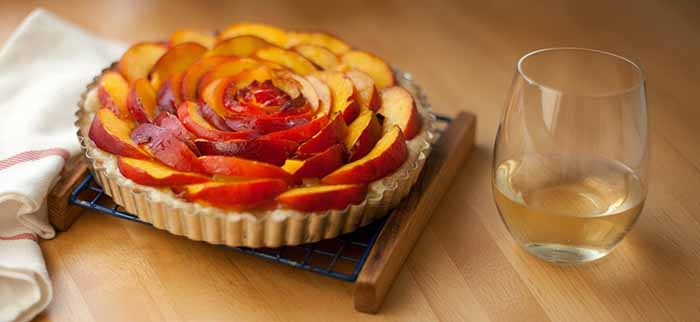
[56] Riesling and a nectarine tart—or any stone fruit (Abacus Photo).
CHECK OUT WHAT’S HAPPENING ON OUR HOME PAGE, THENIBBLE.COM.
|

