Key Lime Pie & Other Recipes For National Key Lime Pie Day
|
|
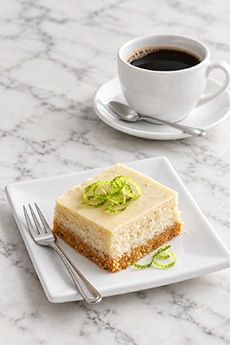
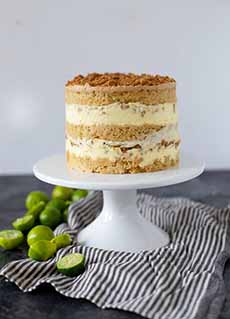
Updated September 2026 September 26th is National Key Lime Pie Day. It’s one of those out-of-sync holidays, since the domestic Key lime season generally runs from June through September, and can be scarce at the end of the month. Perhaps the people who campaigned for National Key Lime Pie Day in September sell the bottled juice! Imported Key limes from Mexico are available year-round, in theory; we never see them in our New York City markets. But please, please, don’t use bottled Key lime juice. It’s like using bottled lemon juice in a lemon meringue pie. Instead, keep your eye out for Key limes beginning in June, or make this recipe with regular Persian limes (your basic grocery store lime). Below: > Key lime pie: the easy recipe. > Substituting Persian lime juice: the hack. > Recipe: Key lime pound cake. > More Key lime recipes: bars, donuts, cake, Key limeade, and more. Elsewhere on The Nibble: The difference between Key/Mexican limes and Persian/Tahitian limes. > The history of Key Lime Pie. > The different types of limes: a photo glossary. > How to store lemons, limes and other citrus fruits. > The year’s 40+ citrus holidays. > The year’s dessert holidays: part 1 (more than 100). > The year’s dessert holidays: part 2 (more than 80).
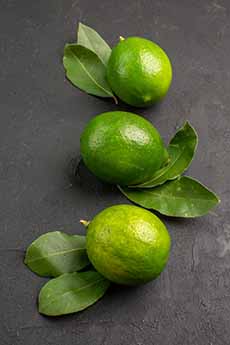
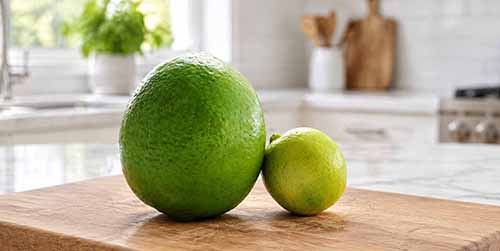
The Key lime is also known as the Mexican or West Indian lime—although it originated in the Indo-Malayan region of southern Asia. The original stock was brought here by Spanish and Portuguese explorers in the early part of the 16th century. It grows in the tropics and subtropics†, and is used in many tropical cuisines throughout the world. The word Key is capitalized because our domestic Key limes initially were grown in the Florida Keys, a string of tropical islands stretching some 120 miles off the southern tip of Florida, between the Atlantic Ocean and Gulf of Mexico. Today, California is also a major supplier. They are smaller and rounder than Persian limes, with thinner, smooth skins, more seeds, and a distinctive, strong aroma compared to their relative, the Persian/Tahitian lime (the grocery store lime). The domestic harvest (primarily from warm climates like Florida and parts of California) peaks during the summer months, specifically between June and September. Commercial domestic production is limited. Most U.S. groves were devastated by a major 1926 hurricane, after which Persian limes replaced much of the crop. Imports from Mexico and Central America now supply much of the U.S. market, making fresh Key limes available year-round. Ripe Key limes should be heavy, slightly soft, and pale yellowish-green rather than completely green and hard.
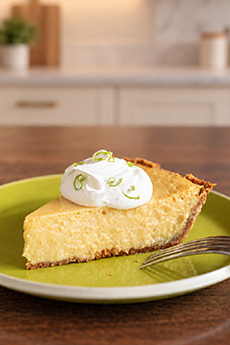
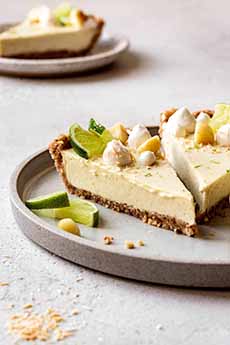
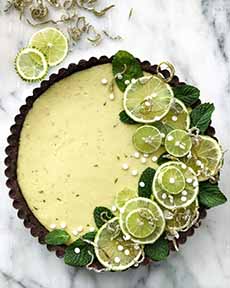
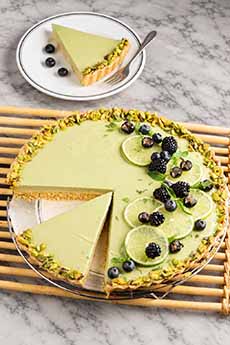
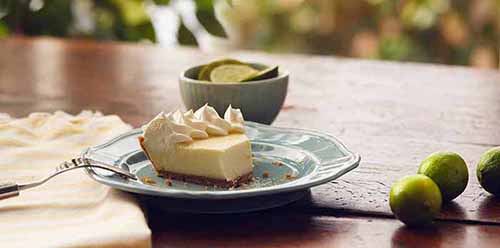
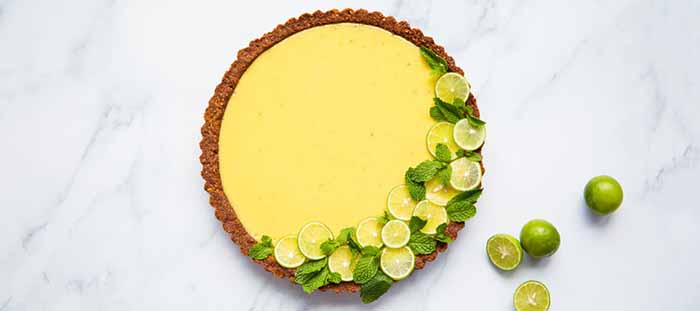
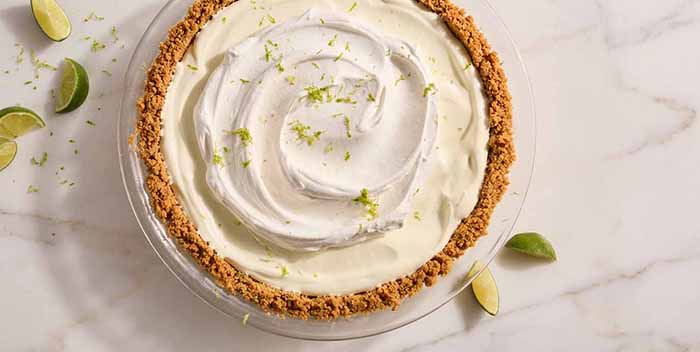
Key lime juice can be used in place of regular lime juice in anything, from cocktails to salad dressings (including fruit salad, where just a squeeze will suffice), on chicken and fish/seafood, in marinades, sauces and soups. Key lime pie is pretty simple to make. A graham cracker crust is filled with key lime juice and sweetened condensed milk. The garnish is up to the baker: anything from plain lime zest to whipped cream to meringue to candied lime peel. If you can get better graham crackers than the supermarket brands, which we find pretty tasteless, please do so. We rely on Trader Joe’s. Thanks to King Arthur Baking for the recipe. Ingredients For The Crust
1. PREHEAT the oven to 325°F. In a small bowl, mix the graham cracker crumbs, butter, sugar, salt, and optional coconut. Press into the bottom and up the sides of a 9-inch glass pie plate. Bake 15 minutes or until golden brown; cool on a rack. 2. MAKE the filling. In the bowl of a stand mixer fitted with the whisk attachment or in a large bowl with an electric hand mixer, whisk the lime zest and egg yolks at high speed for about 4 minutes. The mixture will lighten in color and thicken somewhat, looking a bit like Hollandaise sauce. 3. STIR in the sweetened condensed milk, mixing until smooth. Beat at high speed for 3 minutes; the filling will become slightly thicker and gain a bit of volume. 4. ADD the lime juice, stirring just to combine. The mixture will thicken. Add lime oil to taste. 5. POUR the mixture into the crust and return the pie to the oven. Bake for about 25 minutes, until the filling appears set around the edges, though still a bit wobbly in the center. The center should read about 160°F when tested with a digital thermometer. (King Arthur’s original recipe states 145°F, but we increased it for food safety. 6. REMOVE the pie from the oven, and cool to room temperature. Refrigerate for several hours before serving. Garnish and serve. Refrigerate any leftovers tightly covered for 3 to 5 days. Don’t freeze; freezing and thawing can significantly alter the texture of the filling, causing it to become watery and the crust soggy. TIP: Key limes are challenging to zest because of their size. If you want a lot of zest for garnish, consider using Persian limes. More than once we’ve been served a slice of “Key lime pie” that, to us, seemed to be made with regular lime juice. It was still a delicious piece of pie, but here are the differences. Substituting Persian limes (the standard, larger grocery store variety) for Key limes changes the flavor profile, aroma, and overall character of the pie. Key and Persian limes can both make a tart pie, but their aromas differ.
|
|
|
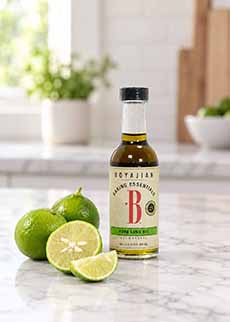
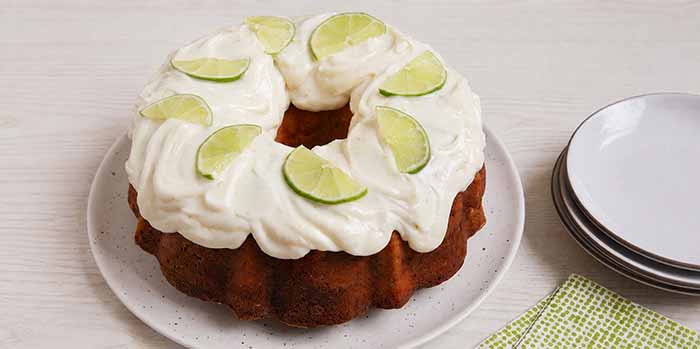
When bakers aim to replicate a true Key lime pie using Persian limes, what’s missing is that heavy, distinct aromatic floral oil and the subtle bitterness inherent to the skin and juice of ripe Key limes. If you want to approximate Key lime juice when using Persian limes, simply add 1 to 2 teaspoons of finely grated lime zest, or a drop of lime oil (photo #6) into the filling. This captures the intense aromatics that Persian lime juice lacks on its own. The signature tang of a Key lime pie comes from the chemical reaction between the citric acid and the sweetened condensed milk, which thickens and sets the custard naturally. Persian lime juice handles this part of the job just fine. Thanks to Taste of Home for this recipe, which was created by Pat Stewart of Canton, Georgia. Pat says, “It’s now the only cake requested at every gathering. The unfrosted cake freezes well.” Prep time is 40 minutes, bake time is 1 hour 15 minutes.
1. PREHEAT the oven to 350°F. Grease and flour a 10-inch fluted tube pan (Bundt pan). To remove cakes more easily, use solid shortening to grease the pan. 2. CREAM the butter and sugar in a large bowl until light and fluffy, 5 to 7 minutes. Add the lime juice and vanilla, and mix on high for 1 minute. Add the eggs one at a time, on low speed just until the yellow disappears. Scrape down the bowl as needed and between each addition. 3. SIFT the flour and salt together into clean bowl. Add 1/3 of the flour mixture alternately with 1/2 of the milk, on low speed until just mixed, beginning and ending with the flour. Transfer to the prepared pan. 4. BAKE until a toothpick inserted in center comes out clean or with a moist crumb, 1-1/4 to 1-1/2 hours. Cool in the pan for 10 minutes before removing to a wire rack to cool completely. 5. MAKE the frosting. In a large bowl, beat the cream cheese, butter, lime zest and lime juice until smooth. Gradually beat in the confectioners’ sugar. 6. SPREAD the frosting over the cake. If desired, garnish with lime slices and additional zest. Since it’s Key Lime Pie Day, we’ve only included sweet recipes here. But we also have savory Key lime recipes. If it’s out of season and the recipe requires Key lime zest, substitute regular lime zest. The bottled juice isn’t anywhere near as good as the fresh juice. But as you peruse these delicious recipes, mark your calendar for June!
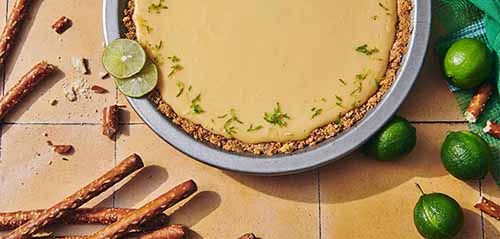
*Adding lime oil to a Key lime pie recipe is a baker’s secret for supercharging the flavor and visual appeal. It serves specific functional roles: intensifying the aroma and flavor and overcoming sweetness. A little goes a long way, from just a few drops to 1/4 teaspoon maximum. †The Tropics. The region of the world in which the sun is directly overhead for at least one day of the year is found between the Tropics of Cancer and Capricorn, from the latitudes of about 23.5°N (Northern Hemisphere) to 23.5°S (Southern Hemisphere). This portion of the world is known as the Tropics. The sunlight is stronger and climate is warmer than elsewhere on Earth. The Subtropics. The subtropical zones lie immediately north and south of the Tropics, usually between about 23.5° North and 40° South. Most of what is known as the “Mediterranean Climate” is found in the subtropics. ‡Key lime pie pretzel crust recipe from King Arthur Baking: Place 120 grams of pretzels in the work bowl of a food processor and grind until fine crumbs form. (By volume, this will be about 1 cup plus 2 tablespoons once finely ground into crumbs.) Add 3 tablespoons (35g) granulated sugar, 7 tablespoons (99g) melted unsalted butter, and 1/4 teaspoon table salt and pulse until combined. Press the mixture into the bottom and up the sides of a 9-inch greased pan. Bake at 350°F for 8 to 10 minutes; the crust won’t change color much but will firm up. CHECK OUT WHAT’S HAPPENING ON OUR HOME PAGE, THENIBBLE.COM. |
||