Food Fun, Food Beauty: Decorated Goat Cheese Logs - The Nibble Webzine Of Food Adventures Food Fun, Food Beauty: Decorated Goat Cheese Logs Recipe


THE NIBBLE BLOG: Products, Recipes & Trends In Specialty Foods


Also visit our main website, TheNibble.com.

Food Fun, Food Beauty: Decorated Goat Cheese Logs

Updated August 2026

August is National Goat Cheese Month.

All you need is a sharp knife and a peeler or mandoline to decorate goat cheese logs the way John Karangis does.

Karangis is the executive chef at Union Square Events, and his job is to present dazzling foods.

Yet, this particular dazzler does not require culinary school.

Below:

> Make this beautiful goat cheese log.

> Seasonal decorations.

> Garnishing with dill and other “feathery” herbs.

Elsewhere on The Nibble:

> The history of cheese.

> The different types of cheese: a photo glossary.

> 10 different ways to use goat cheese.

> A goat cheese crottin for dessert.

> Recipe: goat cheese ice cream. It’s delicious.

> The year’s 30 goat cheese holidays.

> The history of edible flowers and the different types you can eat.
 
 
RECIPE: DECORATED GOAT CHEESE LOGS

Ingredients

  • Goat cheese log(s)
  • Baby carrots (ideally the tricolor assortment)
  • Baby zucchini, summer squash or cucumber
  • Edible flowers (two different types, or a mixed selection)
  • Fresh dill or other feathery herb
  • Fresh cilantro, parsley or thyme
  • Gherkin-size cucumbers
  •  
    If your crowd likes hot and spicy, add narrow red chiles like birds-eye or cayenne; or sprinkle some red pepper flakes.

    For the holidays, you can create a seasonal look with strips of pimento or minced peppadew, rosemary leaves, golden raisins (sultanas) and pink and green peppercorns.

    See the seasonal variations below.
     
    Preparation

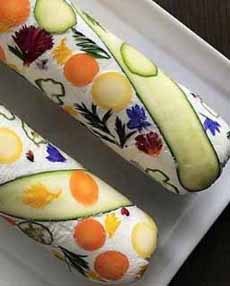
    1. SLICE the vegetables as thinly as possible, ideally using a mandoline. The zucchini or summer squash should be sliced into vertical ribbons; leave the peel on. Slice everything else in circles, horizontally.

    2. SNIP the herbs as shown in the photo. Pull the petals off the flowers.

    3. CREATE your own piece of edible art. To adhere the vegetables on top of the ribbons, use water to moisten.


    Decorated Goat Cheese Log
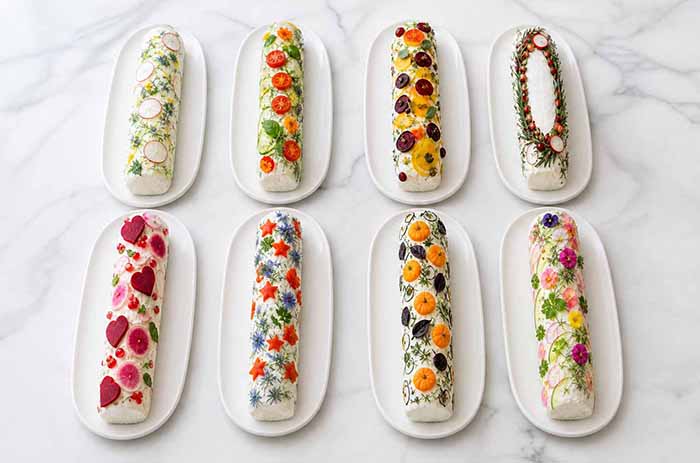
    [1] Decorated goat cheese logs (photos © Chef John Karangis).

    Goat Cheese With White Wine
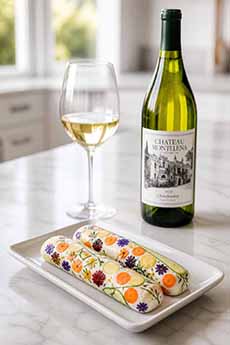
    [2] We like to serve them with a great California Chardonnay (photo © The Nibble).

    A Plate Of Edible Flowers
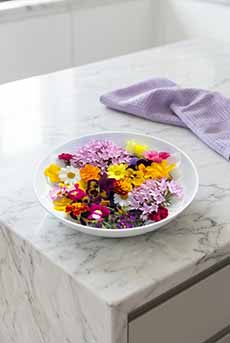
    [3] Edible flowers aren’t particularly flavorful, but they certainly add beauty to a plate (photo © The Nibble).

     
    Decorated Goat Cheese Logs
    [4] Decorations for every season (photo © The Nibble).
     
    SEASONAL DECORATIONS

    A goat cheese log is an especially good canvas for seasonal decoration. Use very thin slices of vegetables, tender herb leaves, edible flowers, and finely grated citrus zest; gently press them into the softened cheese before chilling. It’s that simple!

    Spring/Easter

  • Veggies and herbs: Use a pastel palette—pale green, yellow, lavender, and pink. Examples: asparagus tip slivers, carrot ribbons or multicolored carrot coins, chervil, dill, lemon zest, pea shoots, radish rounds or half-moons, small mint leaves.
  • Edible flowers: Calendula petals, tiny pansy blossoms, yellow violas.
  •  
    Summer

  • Veggies and herbs: Cucumber or zucchini ribbons; herbs—basil, dill, chervil, or fennel fronds; lemon and orange zest for bright citrus color; shaved raw summer squash; slices of yellow and red cherry tomato
  • Edible flowers: Borage, cornflowers, nasturtiums, or violas.
  •  
    Autumn/Thanksgiving

  • Veggies, herbs, and fruits: Use warm, earthy, harvest colors—dried cranberries, sliced in half; beets (very thin coins or half-moons of candy-stripe beet, golden beet, and red beet; orange zest; pomegranate arils; shaved carrot and delicata squash ribbons; tiny leaves of sage and thyme; toasted pumpkin seeds.
  • Edible flowers: Marigolds (deep copper, burnt orange, and golden-yellow hues) followed by chrysanthemum petals. For Halloween: nasturtiums in dark mahogany or deep orange with violas in deep purple/black.
  •  
    Christmas/Winter Holidays

    You could create a wreath effect by clustering rosemary, thyme, and sage along the edges, with pomegranate “berries” scattered throughout. Whatever you choose, make it a classic red, green, and white combination.

  • Veggies, herbs, and fruits: Herb leaves (flat-leaf parsley leaves, rosemary tips, thyme, sage leaves or chiffonade), pomegranate arils, radish slices; roasted red pepper, finely diced.
  • Edible flowers: A few small edible white flowers.
  •  
    Hannukkah

    For a palette of blue, white, gold, and green:

  • Veggies, herbs, and fruits: Blue/purple potato slices, very thinly shaved and blanched; dill and parsley; lemon zest; white radish, thinly sliced; yellow beet or carrot coins.
  • Edible flowers: Blue cornflowers or borage flowers.
  •  
    Fresh Dill & Other Feathery Herbs
    [5] Garnishes for every season! To make the pumpkins, see the †footnote (photo © The Nibble).
     
    GARNISHING WITH DILL

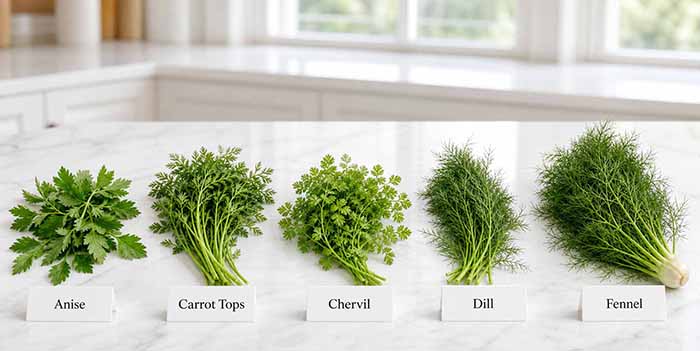
    “Feathery” dill is a popular herb for decorating. Here are some others:

    Fennel. The most feathery herb after dill is fennel. Fennel fronds look nearly identical to dill: fine, delicate, and bright green. They flavor is distinctly anise or licorice, rather than the tangy, grassy profile of dill. TIP: If you’re using the fennel bulb in a recipe, save the fronds to decorate anything else at the meal—or tomorrow’s meal.

    While fennel is the first-choice substitute, the second runner-up is something that most people throw away:

    Carrot tops: While technically a vegetable byproduct, the leafy tops of carrots are very feathery and edible. They have a flavor profile that sits somewhere between parsley and celery. Check out these 10 delicious uses for carrot tops.

    Other feathery or lacy herbs to consider:

    Anise: The leaves of the anise plant are quite feathery and pinnate, though the plant is more famous for its seeds.

    Chervil: Often described as a more delicate cousin of parsley, it has lacy, fern-like leaves. It’s a staple in French cuisine (one of the fines herbes*, along with chives, Italian [flat] parsley, and tarragon) and has a faint taste of anise and parsley.

    Yes, there’s always parsley, but as a garnish, it’s been done to death.

    ________________
     
    *Fines herbes are very delicate, unlike bouquet garni, which usually contains heartier, woody herbs like bay leaf, rosemary, meant for long simmering. Fines herbes are almost always chopped together very finely and added at the very end of cooking—or used as a fresh garnish—to prevent their volatile oils and bright colors from being lost to high heat. Their most famous use in the classic Omelette aux Fines Herbes, but they are also the standard seasoning for light butter sauces, poached fish, and spring vegetables.

    To create the tiny “pumpkins”: Round the edges of a 1″ or thinner carrot coin with a paring knife and hand-carve little notches into the top to give it a pumpkin silhouette. For the stem use a tiny snippet of a fresh parsley stem or a snippet of chive.
     

    CHECK OUT WHAT’S HAPPENING ON OUR HOME PAGE, THENIBBLE.COM.


    Comments are closed.

    The Nibble Webzine Of Food Adventures


    © Copyright 2005-2026 Lifestyle Direct, Inc. All rights reserved. All images are copyrighted to their respective owners.