Overnight Breakfast & Brunch Casseroles: Cinnamon Buns & Blueberry Muffins
|
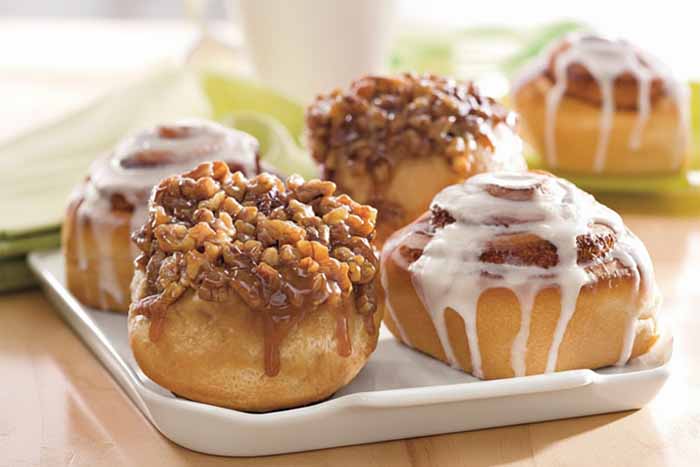
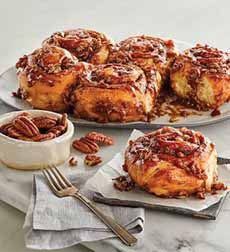
February 21st is National Sticky Bun Day. Sticky buns and cinnamon rolls were the biggest treat of our childhood breakfasts: Better than waffles or pancakes. The Horn & Hardart Automat, Americas’s first fast food chain, had such popular items that customers clamored to take them home. They set up a retail arm to package and sell some of them in retail stores. Our family devoured many boxes of the honey buns. Today, they’d be called pecan sticky buns. Below: > Cinnamon buns, honey buns, and sticky buns: the difference. > Recipe: The easiest way to make cinnamon buns is an overnight cinnamon bun casserole. > The difference between rolls and buns. > Recipe: overnight blueberry muffin casserole. Elsewhere on The Nibble: > The year’s 116 breakfast holidays. The terms are often used interchangeably, but there are two categories of sweet yeast buns: cinnamon buns and honey (now called sticky) buns. Other terms include cinnamon rolls, cinnamon swirls, honey buns, and sticky buns, among others (cinnamon pecan rolls, e.g.). All are made with a cinnamon swirl inside; they may have raisins as well. But a honey bun or sticky bun needs to have a sticky topping: caramel, honey, maple syrup, or sugar syrup. These typically have a garnish of nuts. Those topped with white icing fall into the cinnamon bun category. See a comparison of the two in photo #7, below. Only the sticky bun has its own holiday. Now: What if you could bake a pan of sticky buns or cinnamon buns with ease, and bring them to the table warm and fragrant? If this sounds like your kind of good time, McCormick has created the easiest recipe, an “overnight” casserole. But below we have recipes for: Mix five ingredients together the night before—bread, milk, cinnamon, and vanilla—just 10 minutes of prep time. The next morning, just bake the casserole for 25 minutes until golden brown. It then gets a drizzle of cream cheese frosting: 30 minutes total. We served it yesterday, and a very good time was had by all—with some leftover for today. While the recipe is a casserole, you slice it into square, bun-size pieces. The difference: Ingredients For 12 Servings |
|
|
|
1. WHISK the eggs, 1-1/2 cups of the milk, 1 tablespoon of the cinnamon, 3 teaspoons of the vanilla, and the baking powder in a large bowl until well blended. Add the bread cubes and toss to coat well. 2. GENTLY POUR into a 13″ x 9″ baking dish, sprayed with no-stick cooking spray. Cover and refrigerate for at least 4 hours or overnight. 3. PREHEAT the oven to 350°F. Remove casserole from the refrigerator. Mix the melted butter, brown sugar, and remaining 1 tablespoon of cinnamon in a small bowl until well blended. Drizzle the over casserole. Let stand 10 to 15 minutes. 4. BAKE for 20 to 25 minutes or until golden brown. Meanwhile… 5. MAKE the cream cheese topping. Mix the cream cheese, confectioners sugar, and remaining 2 teaspoons of vanilla in a small bowl until smooth. Slowly stir in the remaining 3 tablespoons of milk. 6. REMOVE the casserole from the oven and let stand for 5 minutes. Drizzle over the casserole before serving. There are many Standards Of Identity defined by the USDA and the FDA, but buns and rolls are not among them. Thus, there is no official answer. According to the American Institute of Baking: You may buy hot dog and hamburger rolls, for example; we buy buns. |
||



|
|
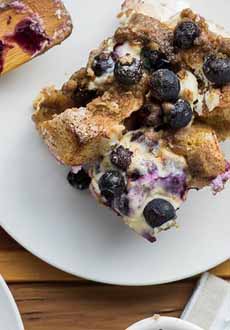
RECIPE #2: OVERNIGHT LEMON BLUEBERRY MUFFIN CASSEROLE If you prefer blueberry muffins to cinnamon buns, McCormick adapted the muffin concept as well. Prep time is 15 minutes the night before, and cook time is 30 minutes. Ingredients For 12 Servings For The Streusel Topping 1. MAKE the streusel: Mix the brown sugar, flour, and cinnamon in a medium bowl. Cover and set aside until ready to assemble in the morning. 2. MAKE the casserole: Whisk together the eggs, 1 cup of the milk, 1/4 cup of the granulated sugar and the cinnamon in a large bowl until well blended. Add bread cubes and toss gently to coat. |
|
|
3. POUR evenly into 13″ x 9″ baking dish sprayed with no-stick cooking spray. 4. MIX the cream cheese, the remaining 2 tablespoons each of milk and sugar, and the lemon extract in a medium bowl, until well blended. Gently stir in 1 cup of the blueberries. Spread evenly on top of bread cubes. Top with the remaining 1 cup of blueberries. Cover and refrigerate overnight. 5. PREHEAT the oven to 350°F. Remove the casserole from the refrigerator and let stand for 10 to 15 minutes. Meanwhile… 6. CUT the butter into the streusel mixture with a pastry blender or 2 knives, until the mixture resembles coarse crumbs. Sprinkle over the casserole. Bake for 30 minutes or until golden brown. Let stand 5 minutes before serving. Sticky buns have a Germanic origin, where they originated as yeast pastries called schnecken†. The breakfast pastry was brought to Philadelphia in the 18th century by German immigrants, who became known as Pennsylvania Dutch (a mishearing by English speakers of “Deutsch,” German). Schnecken were made from a rich yeast dough enriched with egg, sour cream, and butter. A pastry the size of a modern sticky bun or cinnamon roll (a normal one, not Cinnabon), they were filled with sugar, cinnamon, raisins, and ground pecans or walnuts or pecans. Many Germans arrived in the U.S., bringing their schnecken with them. Schnecken became popular among bakers in Germantown, a Philadelphia suburb, as early as the 1680s. They (and their subsequent name, sticky buns) are considered a Philadelphia specialty. There’s no record of exactly when English-speaking Philadelphians started calling them “sticky buns.” In some cities they were called honey buns, referencing the honey that created the stickiness. The sticky top is the result of an upside-down baking technique. Before the dough is placed in the baking pan, the pan is lined with the sticky ingredients—brown sugar, honey or both—as well as nuts and raisins. After the buns are baked, the pan is inverted so that the caramelized “bottom” becomes the top of the pastry. This is the original German schnecken technique. *You can substitute twice as much lemon zest (2 tablespoons) for the lemon extract. You can also make your own lemon extract by soaking lemon zest in vodka for two weeks, and then straining out the zest. †German schnecken are different from German-Jewish schnecken. The latter are rugelach (a cookie) rolled in a snail shape. Both yeast-pastry schnecken and Jewish cookie schnecken existed simultaneously in Germany. Immigrants to the U.S. from Eastern Europe (Poland, Russia and the Ukraine) called their version of schnecken—the same cookie dough, rolled in a different shape—rugelach. Jewish schnecken/rugelach are made with a cream cheese cookie dough, not a yeasted dough (although cream cheese, invented in the U.S., was not known in Europe). These rolled cookies can be filled with any types of jam or with chocolate; simply with cinnamon and raisins. CHECK OUT WHAT’S HAPPENING ON OUR HOME PAGE, THENIBBLE.COM. |
||