|
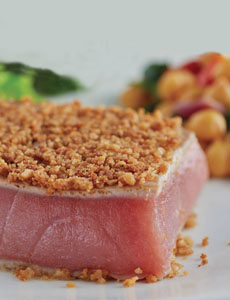
[1] A delicious way to prepare tuna steaks: with a pretzel crust (photo © Bonefish Grill.)

[2] Yummy tuna loin, about to be coated with crushed pretzels (photo © Sea Delight).
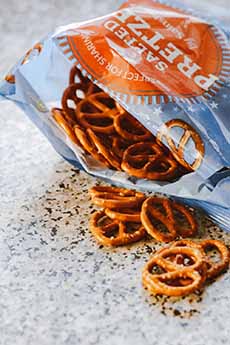
[3] Take a rolling pin to a bag of pretzels (photo © Lisa Fotios | Pexels).
[4] Dough for the original pretzels, called pretiola in Italian, were twisted to resemble a child’s arms folded in prayer (photo © Williams Sonoma). Here’s a recipe to bake your own soft pretzels.
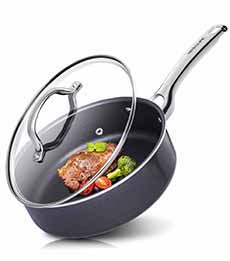
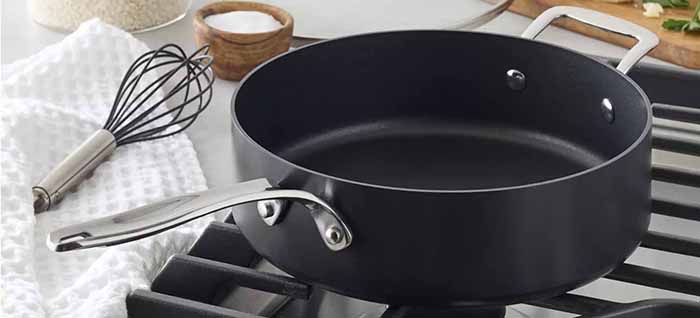
[5] Frying/sauté pans have straight sides that make liquids less likely to splash out. See more about the differene between frying pans and skillets below (photo © Hiteclife).
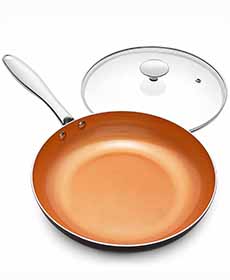
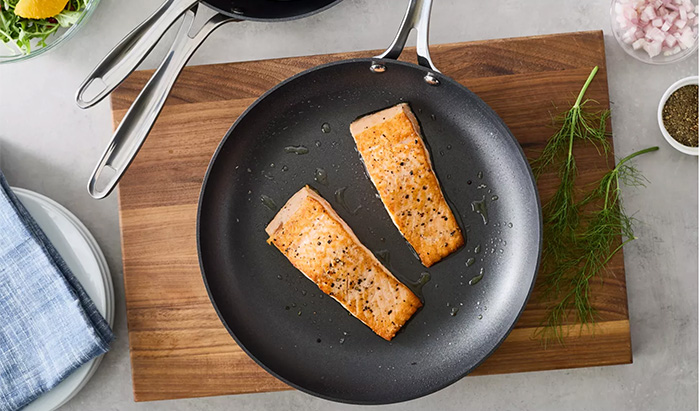
[6] A skillet has sloping sides that are good for quick cooking techniques like stir-frying, where the ingredients need to be moved around continuously (photo © Michelangelo). |
|
Beyond panko: If you’re looking for a tasty crust for fish fillets, turn to pretzels.
While we love panko as a crunchy coating for chicken, crushed pretzels give a boost to seared fish.
We adapted this recipe from a version we had at Bonefish Grill.
In addition to flavor and crunch, the pretzels are a fun alternative to the sesame crusted tuna recipe we typically used.
When we recreated the recipe at home, and discovered that:
The recipe can be used with any thick fish fillet or steak.
It’s easiest to crush pretzel sticks. Thin and uniform, they crush quickly and evenly.
But you can use any pretzel. We also tried the gluten-free Pretzel Crisps we had on hand, and whole wheat pretzels from Snyder’s Of Hanover (which also makes GF pretzel sticks).
Our favorite crust was made from Utz sesame pretzels. As a hack, add toasted sesame seeds to crushed whole wheat pretzels.
Don’t add much salt to the red wine sauce in the recipe, unless you’re using salt-free pretzels. Otherwise, there’s plenty of salt in the pretzel crust.
If you don’t want red wine sauce, we have plenty of options.M/li>
Check out the history of pretzels, below. Without prayers and kids, we wouldn’t have them.
April 26th is National Pretzel Day.
Below:
> A recipe for pretzel-crusted tuna with red wine sauce.
> Other sauce and fish options.
> A brief history of pretzels.
> The different pretzel shapes.
> The difference between a skillet and a frying pan.
Elsewhere on The Nibble:
> The different species of tuna.
> The year’s 60+ fish and seafood holidays.
RECIPE: PRETZEL-CRUSTED TUNA
You can substitute another fish.
Ingredients For 2 Servings
2 tuna steaks
1 cup crushed pretzels
1 teaspoon salt
1 tablespoon unsalted butter
For The Sauce
1 shallot
2 tablespoons Dijon mustard
3/4 cup red wine
1 tablespoon unsalted butter or canola oil
Pinch salt
Preparation
1. Pulse the pretzels in a food processor to the consistency of bread crumbs. Set aside.
2. MAKE the sauce: Mince the shallot and heat the butter in a skillet over medium heat. Add the shallots and sauté until soft. Then add the wine and deglaze the pan. Simmer the sauce for three minutes so the alcohol evaporates and the sauce thickens.
3. HEAT a cast iron skillet over high heat and add the butter or oil. Press the tops of the tuna steaks into the pretzel crumbs to coat. When the fat starts to smoke, place the fish face down in the pan.
4. COOK for 4-5 minutes top down, then flip over and cook for another 3 minutes to serve rare, as they do at Bonefish Grill.
5. SERVE with the sauce on the side, so the crumbs stay crisper.
Other Sauce Options
If you don’t want a red sauce, there are numerous alternatives, including:
Asian-inspired sauces: ginger-soy dipping sauce, sriracha or wasabi mayo, Thai peanut sauce.
Zesty sauces: chimichurri, lemon-caper sauce, mango or pineapple salsa.
Rich sauces: avocado cream (avocado, Greek yogurt, lime juice), wasabi-butter sauce (reduce white wine, vinegar, and shallots, whisk in butter and wasabi).
Other Fish Options
Firm white fish with their mild flavor allows the saltiness of the pretzel to shine through, their firm texture holds up well to the weight of the breading. Choices: catfish, cod, haddock, halibut, mahi-mahi, and tilapia.
Richer fish including salmon and rainbow trout stand up well to a pretzel crust. A honey-mustard glaze to adhere the pretzels is a popular preparation.
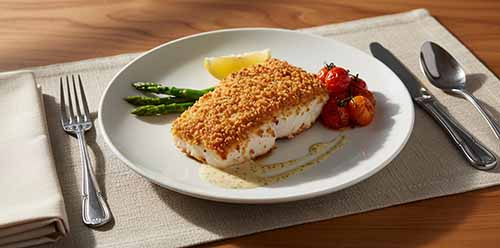
[7] Pretzel-crusted halibut. You can add a crust to your favorite fish (Abacus Photo).
|
THE HISTORY OF PRETZELS
It was all for the kids. In 610 C.E., monks in the what is today southern France northern Italy twisted and baked scraps of dough as a reward for children who had memorized their Bible verses and prayers.
The shape represented the monks’ concept of a child’s arms folded in prayer. The monks called this soft, baked dough a “pretiola,” Latin for “little reward.”
The word evolved into the Italian “brachiola,” which means “little arms.” Over the next few centuries, the pretiola journeyed through the French and Italian wine regions, crossed the Alps, traveled through Austria and arrived in Germany, where it became known as the Bretzel or Pretzel.
Pretzels In America
Much of the earliest commercial pretzel manufacturing in the U.S. happened in the southeastern Pennsylvania, the Pennsylvania Dutch country (a.k.a. the “pretzel belt”). They were made in small bakeries as well as the factories that grew from them.
Some early U.S. pretzel manufacturers are still with us; others were acquired or otherwise gone.
Julius Sturgis Pretzel Bakery (Lititz, PA), founded 1861, is often cited as the first commercial pretzel bakery in America. They’re still manufacturing, and open as a tourist site as well.
Bachman Pretzel Bakery (Reading, PA), founded 1884, has been produced by Utz since 2012.
Anderson Pretzel Factory (Lancaster, PA) — opened five years later (i.e., after 1884) .
Snyder’s of Hanover (Hanover, PA), founded 1909, is still going strong. It was acquired Campbell’s in 2017.
Federal Baking Company / Federal Pretzel Baking Company (South Philadelphia, PA), 1922, no longer operating.
Today’s Brand Leaders
Today, the top pretzel brands in the U.S. by approximate annual sales are:
Snyder’s of Hanover (The Campbell’s Company), $610M.
Dot’s Homestyle Pretzels (The Hershey Company), $553M.
Private label / store brands, $522M.
Utz, $197M.
Rold Gold (Frito-Lay / PepsiCo), $149M.
Other notable brands are Snack Factory Pretzel Crisps and 365 by Whole Foods.
> Here’s more pretzel history.
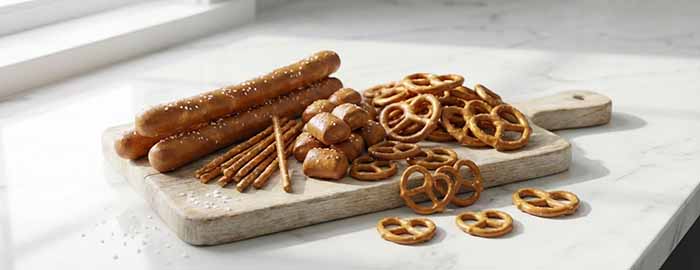
[8] Just a sample of more than a dozen pretzel shapes: rods, sticks, nuggets, and classic twists (Abacus Photo).
THE DIFFERENT PRETZEL SHAPES
The most recognizable pretzel shape is the symmetrical knot, a long strip of dough twisted back onto itself to resemble “arms in prayer.” These are called classic twists.
Given America’s love of the crunchy, salty snack, manufacturers have produced a breadth of different shapes:
Alphabet: Hard pretzels shaped into various letters of the alphabet.
Bavarian Twists: Often thicker and more robust than standard twists.
Bites / Nuggets: Small, thick chunks of pretzel dough.
Classic Twists: The standard three-loop knot found in both soft and hard varieties.
Holiday Shapes: Seasonal specials such as Christmas trees, bells, or hearts.
Mini Twists: Scaled-down versions of the classic knot, common in snack bags.
Olde Tyme: Larger,thick twists that provide a more substantial crunch.
Rings: Small, circular pretzel loops.
Rods: Large, thick, log-shaped pretzels that can be several inches long.
Splits: Pretzels that are split open during baking to create more surface area for salt and crunch.
Sticks and Dipping Sticks: Thin, straight strips of pretzel dough, the latter lightly thicker than standard sticks for dipping into cheese dip or mustard.
Thins: Flattened, cracker-like pretzels that offer a different texture.
Waffles / Snaps: Pretzels designed in a grid or lattice pattern that holds seasonings and dips well.
Wheels: Circular pretzels with “spokes” inside, resembling a wagon wheel.
That’s a lot of crunching!
THE DIFFERENCE BETWEEN A SKILLET & A FRYING PAN
It’s this easy: A skillet has slanted sides. A frying pan, also called a sauté pan, has straight sides that are higher than the skillet’s. (For this recipe, use whatever you have.)
Why the two different side shapes? And why are we including this information in a tuna recipe article?
Because the preparation calls for a skillet, and a survey of the folks present for the recipe tasting didn’t understand the difference between a skillet and a frying pan.
While the terms seem to be used interchangeably—even by the finest brands—there is a difference, which can be summarized as straight-side vs. sloping side.
Frying/Sauté Pan Benefits
If both pans are the same size, the frying/sauté pan (photo #5) will have a slightly larger surface area. In a 12-inch diameter pan, it can make the difference when fitting in pieces of chicken or other food, so you can cook everything in one batch.
The other benefits of a frying/sauté pan: Liquids are less likely to splash out of the higher, straight sides; and lids fit more tightly, limiting evaporation.
[9] A frying pan, a.k.a. a sauté pan, has straight sides so lids fit tightly (photo © Sur La Table).
Skillet Benefits
Chefs prefer the sloping sides of a skillet (photo #6) for quick cooking techniques like stir-frying, where the ingredients need to be moved around continuously. A skillet is also a better option for a frittata, served straight from the pan.
It is a fun fact in cooking that a skillet is better for sautéing than a sauté pan. The sloping sides make it easier to move pieces of food around while constantly stirring, and to more easily shake the pan to toss the food for even cooking. For the best sear, choose a cast iron skillet. It gets hotter than other metals.
You can, of course, sauté your food in the classic straight-sided sauté pan (frying pan), but it requires more work: constant stirring and turning.
[10] Contrary to its name, a skillet has sloped sides, making it easier to sauté (photo © Sur La Table).
Which Came First?
Guessing that the straight-sided frying pan may have come first, and the skillet adapted for greater flexibility, we tried to locate the facts. What we found was this, in Wikipedia:
Before the introduction of the kitchen stove in the mid-19th century, a commonly used cast iron cooking pan called a spider had a handle and three legs used to stand up in the coals and ashes of the fire. Cooking pots and pans with legless, flat bottoms were designed when cooking stoves became popular; this period of the late 19th century saw the introduction of the flat cast iron skillet.
Related Pans
Professionals use a sauteuse (saw-TOOZ), a pan that combines the best higher sides of the sauté pan and the sloping sides of the skillet. It is also called a fait-tout (fay-TOOT), which literally means that it “does everything”.”
Finally, mention must be made of the grill pan. It’s a frying pan with very low sides and series of parallel ridges on the cooking surface, which both enables cooking with radiant heat like a grill, and allows the fat to drain down.
________________
*Dot’s Homestyle Pretzels was a local brand popular in the Upper Midwest. Pretzel twists were created by Dorothy (“Dot”) Henke at her winter residence in Goodyear, Arizona, and production later shifted to her hometown of Velva, North Dakota. The distinctive “signature seasoning,” described as buttery/garlicky/spiced, was the “addictive” part of the brand’s appeal. When it experienced a significant growth, becoming the third-largest pretzel brand nationally in sales volume, The Hershey Company took note and acquired the brand in 2021.
CHECK OUT WHAT’S HAPPENING ON OUR HOME PAGE, THENIBBLE.COM.
|