Chestnuts Roasting On An Open Fire (How To Roast Chestnuts)
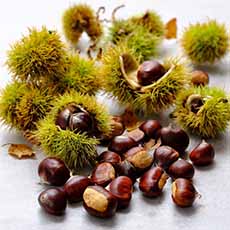
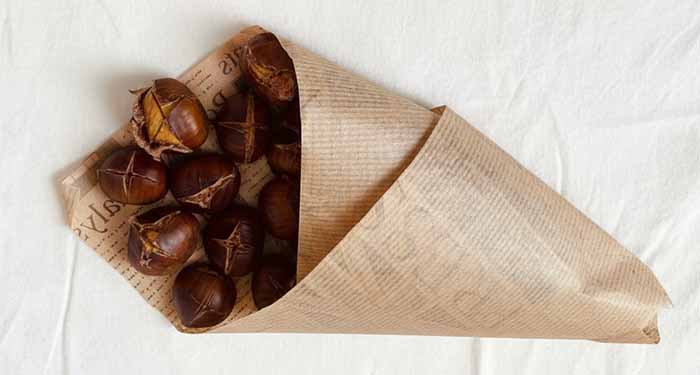
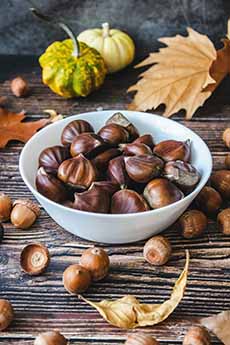 [1] Chestnuts drop from the trees in the fall. See photo #4 (photo © Tijana Drndarrski | Unsplash).
|
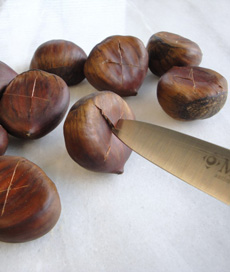
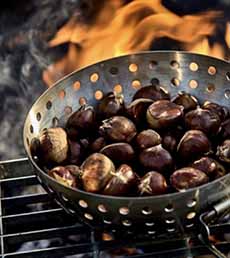
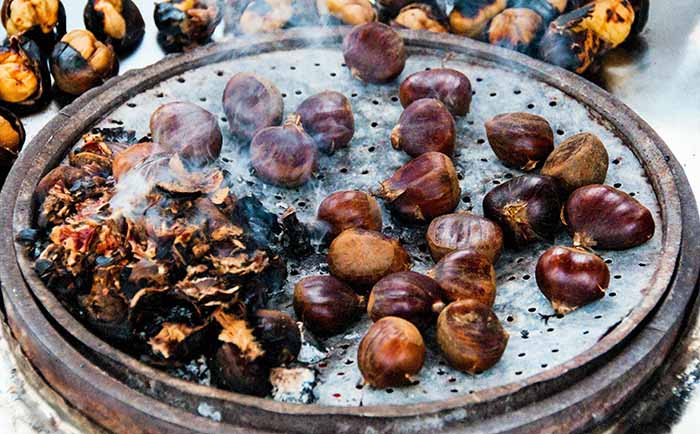
How would you like to roast your own chestnuts at home? Just the fragrant aroma of them is enough to make mouths water and fingers itch to peel them for snacking. You don’t need a working fireplace to roast the chestnuts. Back in the old days, the fireplace was the only source of heat in the kitchen. Today, we have other options. You can roast chestnuts in the oven in a pan, or on the stovetop with a special chestnut roasting pan. A chestnut roasting kit, complete with two pounds of chestnuts, is available at Melissas.com and elsewhere. It makes a nice family gift. Compared to other nuts, chestnuts are composed chiefly of starch; other nuts have a larger percentage of protein. The nutritional composition of chestnuts is similar to that of other starchy foods—corn, plantains, potatoes, etc. Yet, they are a better-for-you snack, a good source of minerals, vitamins, and some high-quality protein. December 14th is Roast Chestnuts Day. Below: > Sing “Chestnuts Roasting On An Open Fire.” 1. PREHEAT oven to 350°F. Cut an X on the flat side of each nut using a small, sharp knife. Be careful not to cut into the nutmeat. 2. OVEN ROASTING: Place the nuts in a single layer on an ungreased baking sheet and roast until the scored portions begin to curl up and the nuts release their fragrance, 15 to 20 minutes. CHESTNUT PAN ROASTING: Heat the pan over medium-low heat and add the chestnuts. Cook, tossing the chestnuts frequently until the shells crack and the chestnuts are cooked through. The timing is 30 to 35 minutes over a gas flame burner or 35 to 40 minutes over an electric or induction burner. 3. REMOVE the nuts to a plate and eat immediately. Peeling the nuts is part of the fun, and each person may want to peel his or her own (or, you can peel all of them in the kitchen before serving). However, they are hot. If the nuts are very hot, pick up individual nuts using a kitchen towel or other protection. Then with fingers or a knife, peel away the shell. Remove the inner skin, pop a nut into your mouth and enjoy. “Chestnuts Roasting on an Open Fire” is the informal name of “The Christmas Song”; it was originally subtitled “Merry Christmas to You.” This Christmas classic was composed by Mel Torme and Bob Wells in 1946. The most popular recording remains the first one, recorded by Nat King Cole. Here’s Nat King Cole on YouTube—the vocal track over a Christmas tree and fireplace visual. You can sing along: Chestnuts roasting on an open fire, Everybody knows a turkey and some mistletoe, They know that Santa’s on his way; And so I’m offering this simple phrase, |
|
|
THE HISTORY OF CHESTNUTS Chestnut trees first appear in the fossil record roughly 85 million years ago, long before the extinction of the dinosaurs (about 66 million years ago), and far before the appearance of mankind*. From the beginning of mankind’s migration to the Northern Hemisphere, chestnuts were a dietary staple throughout temperate regions. The European sweet chestnut (Castanea sativa), the Chinese chestnut (Castanea mollissima), the Japanese chestnut (Castanea crenata), and the American chestnut (Castanea dentata) had long been integral to local ecosystems and, eventually, to humans. Today, organizations like The American Chestnut Foundation work tirelessly to breed blight-resistant American chestnuts by crossing them with Chinese varieties, hoping to restore these giants to their native forests. Meanwhile, chestnut cultivation continues globally, with China now producing the vast majority of the world’s chestnuts, followed by South Korea, Turkey, and Italy. The majority of chestnuts sold in the U.S. come from Italy and Turkey. To a small extent, European sweet chestnuts, introduced by Thomas Jefferson in 1773, have become the primary source of commercial chestnuts grown domestically. The U.S. also grows Chinese chestnuts and American-Chinese hybrid varieties that are resistant to chestnut blight. Domestic production comes mainly from Michigan, Florida, California, Oregon, Virginia, and Washington state. †Tannins were used for tanning leather, dyeing fabrics, clarifying wine/beer, and making ink, among other things. CHECK OUT WHAT’S HAPPENING ON OUR HOME PAGE, THENIBBLE.COM. |
||