Mint Julep Cocktail Recipes & Mint Julep History
|
|
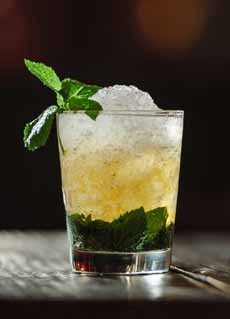
There’s no better way to watch the Kentucky Derby on Saturday than with a Mint Julep in your hand. A Mint Julep is made of spearmint, Bourbon, sugar, and water. It’s similar to a Mojito, but substitutes Bourbon for rum. The fresh mint leaves are used very lightly bruised to release more of the aroma and flavor. Traditionally, Mint Juleps are served in silver or pewter cups (shown in the photo). However, few of us have the space to keep a collection of julep cups, so any tall glass is fine. More opportunity to celebrate: May 30th is National Mint Julep Day. We start with two different recipes. The first uses brown sugar. While not the “original” julep sugar, it’s become a popular modern variation used by mixologists to add a deeper, molasses-like richness that complements the caramel notes of the Bourbon. We prefer it! May 30th is National Mint Julep Day, and June 14th is National Bourbon Day. Below: > Recipe #1: Brown sugar Mint Julep. > Recipe #2: Makers Mark Mint Julep recipe (different sugars). > The “nouvelle Julep”: fruit add-ons to the original. < The history of the Mint Julep. Elsewhere on The Nibble: > The different types of whiskey (plus, whiskey vs. whisky). > The top 4 Bourbon cocktails. > The year’s 25+ whiskey holidays. > The year’s 50+ cocktail and spirits holidays. Here’s an easy Mint Julep recipe; but recipe #2, below, But Recipe #2, below, is worth the extra effort: Ingredients Per Drink 1. MUDDLE two sprigs of mint with the brown sugar and one ounce of Bourbon in a julep cup or old-fashioned glass. 2. ADD the crushed ice, the remaining Bourbon and garnish with sprig of mint. |
|
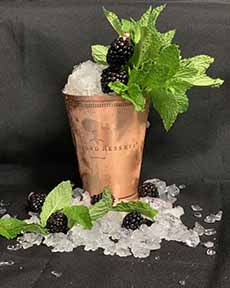
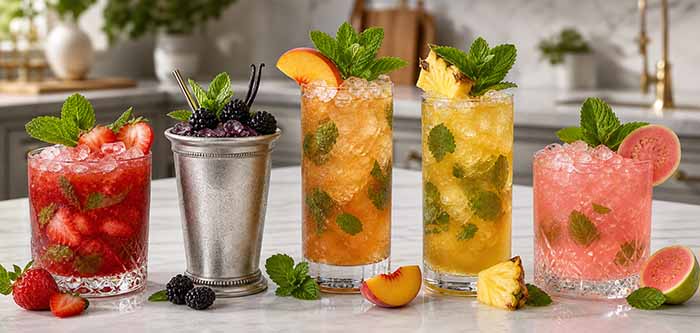
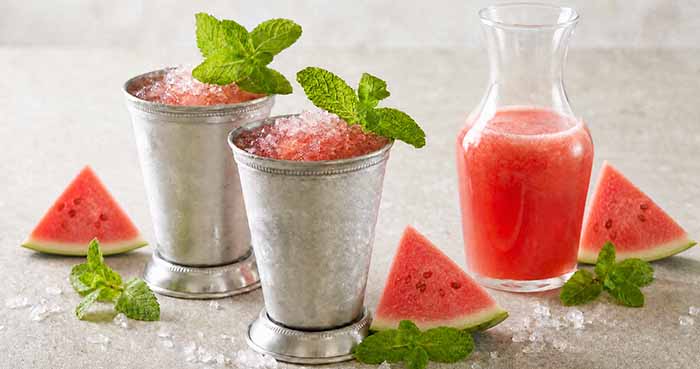
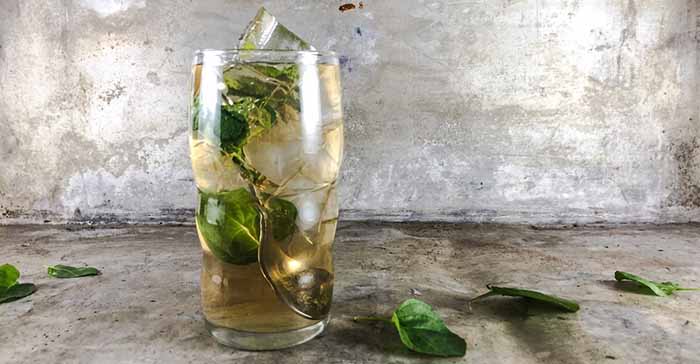 [4] You don’t need a pewter or silver julep cup. A highball glass is just fine (photo © Sid Wainer). RECIPE #2: MAKER’S MARK MINT JULEP Ingredients For About 10 Rocks Glass Drinks 1. Prepare the mint extract: Remove about 40 small mint leaves, wash and place in a small mixing bowl. Cover with 3 ounces of Bourbon. Allow the leaves to soak for 15 minutes. Then gather the leaves in a clean, soap-free piece of cotton cloth and vigorously wring the mint bundle over the bowl of whiskey. Dip the bundle again and repeat the process several times. Then set aside. 2. Prepare the simple syrup: Mix 1 cup of granulated sugar and one cup of water in a pot. Heat to dissolve the sugar. Stir constantly so the sugar does not burn. Set aside to cool. 3. Prepare the Mint Julep mixture: Pour 3 cups of Bourbon into a large glass bowl or glass pitcher. Add 1 cup of the simple syrup to the Bourbon. 4. Begin adding the mint extract a tablespoon at a time to the julep mixture. Each batch of mint extract is different, so you must taste and smell it after each tablespoon is added. You may have to leave the room a time or two to clear your nose. (Editor’s Note: Or use this trick: Put whole coffee beans in a cup and hold them to your nose. Coffee beans magically “clear the nose” so you can smell again.) The tendency is to use too much mint. You are looking for a soft mint aroma and taste—generally, about 3 tablespoons total. 5. Refrigerate. When you think the mixture is right, pour it into an empty bottle, cap tightly, and refrigerate it for at least 24 hours to marry the flavors. 6. Fill glass. To serve the Mint Julep, fill each glass half full with shaved ice. Insert a sprig of mint and then pack in more ice to about an inch over the top of the cup. Then, insert a straw that has been cut to one inch above the top of the cup so the nose is forced close to the mint when sipping the julep. 7. Garnish. When frost forms on the cup, pour the refrigerated julep mixture over the ice and add a sprinkle of powdered sugar to the top of the ice. Then serve. Beyond ginger, kiwi, and watermelon, mixologists are increasingly using a wide variety of seasonal fruits, liqueurs, and even vegetables to put a modern twist on the classic Mint Julep. Here are some of the the fruits and unconventional ingredients appearing on bar menus: In addition to the Watermelon Mint Julep above, consider: Unconventional Ingredients To make these at home: Considered the unofficial drink of the South, the Mint Julep began as a medicinal concoction to settle the stomach. As a cocktail, it blossomed in the American South in the late 1700s. Some historians say that the Mint Julep dates to the Colonies in the early 1700s. If so, it may have been mixed with rum instead of Bourbon, a more-available spirit from only as far away as the Caribbean. The Mint Julep was a drink for the well-to-do, who had access to the crushed ice and the silver or pewter cup in which the drink is served (the metal helps to keep the drink cold [source]). The Mint Julep cocktail first appeared in print in 1803, described as a “dram of spirituous liquor that has mint in it, taken by Virginians in the morning.” One visitor observed that the planters rose early and had their juleps, because a julep before breakfast was believed to give protection against malaria [source]. The oldest record at West Virginia’s Greenbrier Hotel (then the Old White Tavern) notes that in 1816, guests were ordering “julips” at a cost of twenty-five cents, or three (!) for fifty cents. Prior to the Civil War (1861-1865), brandy or whiskey from Europe was commonly used in a julep. During the war, if it could be had, the less expensive Bourbon from Kentucky was used. The word julep derives from the Persian for flower water (gol ab), referring to a rose water drink. When the concept migrated to the European Mediterranean, transliterated as julep, local mint replaced the rose petals. The clubhouse at Churchill Downs began mixing Bourbon-based mint juleps around 1875. This Mint Julep became the racetrack’s signature drink in 1938, when the venue started to serve the drink in Kentucky Derby souvenir glasses. Today, the Kentucky Derby serves more than 80,000 juleps over the two-day event. The capacity of the track is 50,000 (x 2 days = 100,000), so some revelers are not having their fair share! [6] How about a Watermelon Mint Julep? Here’s the recipe Here’s the recipe (photo © National Watermelon Promotion Board). CHECK OUT WHAT’S HAPPENING ON OUR HOME PAGE, THENIBBLE.COM. |
||