THE NIBBLE BLOG: Products, Recipes & Trends In Specialty Foods


Also visit our main website, TheNibble.com.

TIP OF THE DAY: Make Grilled Or Sautéed Fish Special

If you cook fish frequently, a quick broiling, grilling, sauté or poaching may be your technique of choice.

But before you put a piece of plain fish on a plate with vegetables on the side, consider serving it en brodo: in broth with vegetables.

In Italy, not just fish (pesce) but tortellini and other pasta types are served en brodo.

The vegetables get cooked in the broth, which adds more flavor. And if you poach the fish, that takes on more flavor, too.

The purpose of the broth is not to serve as a bowl of soup, per se, but to provide a flavorful base for the dish (and yes, the “soup” at the bottom is eaten, so include a soup spoon as well as a fork).

You can use any fish-friendly broth you like; for example:

  • Coconut milk broth
  • Fish broth
  • Mushroom broth
  • Tomato broth
  • Vegetable broth
  •  
    In the recipe below, we use vegetable or fish broth as the base. Both the vegetables and fish are cooked in the broth (i.e., poached fish).

    The broth recipe below has a Thai accent. We’re passionate about Thai flavors, but if you don’t like them, just leave out the asterisked* ingredients.

    Replace them with your choice of bok choy, celery, mushrooms, parsnips, zucchini and herbs of choice. Flavor the broth with salt and pepper instead of soy sauce and lime juice.

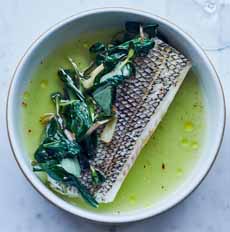
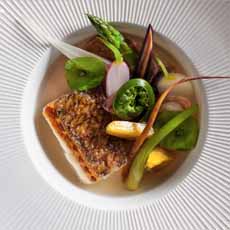
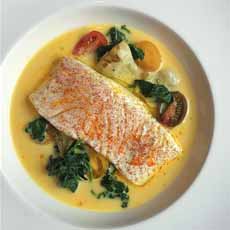
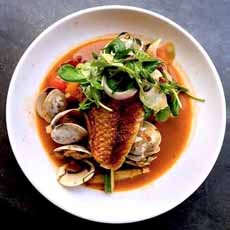
    And include something green for a color accent (photos 1-4). You may not want to cook them in the broth, but steam them separately in the microwave. Add to the dish when plating.
     
     
    RECIPE: FISH IN BROTH (PESCE EN BRODO)

    Ingredients For 2 Servings

  • 2 large fish fillets (6-8 ounces each)
  •  
    For The Broth

  • 24 ounces fish or vegetable stock
  • 1 clove garlic, finely sliced
  • ¾-inch slice fresh ginger*
  • 1 Thai chile, seeds removed and chopped* (substitute other chile)
  • 6 cilantro stems with leaves*
  • 2 carrots, julienned (matchsticks)
  • 1/2 cup snow peas
  • 4 scallions/green onions or spring onions (the difference), sliced
  • Dash of light soy sauce*
  • 1/2 lime, juiced*
  •  
    For The Garnish

  • Pea sprouts or other sprouts or microgreens
  • Cilantro sprigs
  • -or –

  • Top the fillet with an arugula or baby spinach salad, very lightly dressed in vinaigrette (photo #4)
  •  

    Black Bass En Brodo
    [1] Sautéed black bass in vegetable-herb broth with droplets of basil olive oil (photo courtesy Empire Diner | NYC).

    Cod En Brodo
    [2] Grilled cod in mushroom broth (photo courtesy Mihoko’s 21 Grams | NYC).

    Poached Halibut
    [3] Poached halibut in coconut broth (photo courtesy David Burke | Fishtail).

    Snapper En Brodo
    [4] Grilled snapper in tomato broth (photo courtesy Pakpao Thai | Dallas

  • Bonus garnish: 3-4 clams or mussels (photo #4)
  •  
    Preparation

    1. PLACE the stock, cilantro, chile, garlic and ginger in a large saucepan and bring to a boil. Reduce the heat and simmer gently for 20 minutes.

    2. STRAIN the stock, discarding the cilantro, chile, garlic and ginger. Return the broth to the heat and add the carrots, snow peas and scallions. Simmer for 5 minutes. Add the fish fillets and simmer for an additional 2-3 minutes. If using the clams/mussels garnish, add for a minute at the end,

    3. SEASON to taste with a dash of soy sauce and lime juice. Divide the sprouts between 2 large bowls and pour over the soup. Garnish with coriander leaves and accompany with lime wedges.
     
     
    WHAT’S THE DIFFERENCE BETWEEN A FILLET AND A FILET?

    Just the language, which impacts spelling and pronunciation. Fillet (FILL-it) is English and filet (fee-LAY) is French.


    Comments off

    FOOD FUN: Two-Pasta Mac & Cheese

    Fancy Mac & Cheese

    This mac and cheese recipe uses both wagon wheels and cavatappi instead of elbows (photo courtesy Barilla Foodservice).


    At Burtons Grill in Andover, Massachusetts, chef Scott Perry has fun with mac and cheese. It turns everyday mac and cheese into food art.

    It’s easy to replicate at home.

  • A mix of two pasta shapes. Chef Perry uses two different kinds of pasta. Forget the same old, same old elbows and try wagon wheels (ruote) and cavatappi, a fancy corkscrew. Or pick whatever shapes appeal to you. Check out the different shapes of pasta in our Pasta Glossary.
  • A topping of peas for color. You can substitute julienned sundried tomatoes in oil, diced red bell peppers (raw or blanched), or strips of pimento.
  • A rim of bread crumbs. Instead of sprinkling bread crumbs on top, Chef Perry puts them on the rim of the bowl, along with microgreens (substitute minced chives or parsley). We liked this idea so much, we actually purchased soup bowls with broad rims—which trendy chefs are using to serve just about anything.
  •  
     
    MORE MAC & CHEESE

  • Macaroni & Cheese History
  • Award-Winning Mac & Cheese Recipes 1
  • Award-Winning Mac & Cheese Recipes 2
  • Butternut Squash Mac & Cheese
  • Mac & Cheese Party Bar
  • Mac & Cheese With Caramelized Sweet Potato, Garlic & Rosemary
  • Ronald Reagan’s Mac & Cheese Recipe
  •  


    Comments off

    TIP OF THE DAY: Buying Vegetables (Who Knew?)

    We love little bits of food trivia that help us make better choices.

    Here are five tidbits from nutrition Madison Linek, RDN, LD, a clinical dietician with Kroger Health (Kroger is America’s largest supermarket chain).

  • Avocado. Some people go by a slight squeeze with the fingers, but you can find the perfectly ripe avocado by checking the color of the stem end. If it’s green, it is ready to eat. Any lighter, it’s not ripe enough and the more brown, it’s overripe. You probably know this trick about browning: To keep the cut surface of the avocado from browning quickly, leave the seed in, squeeze some lemon juice over the flesh and tightly wrap the surface in plastic wrap to prevent air from getting in.
  • Bell Peppers. In all the years of eating bell peppers, we never noticed that some have three sections on the bottom, and some have four. The peppers with three sections on the bottom are better for eating raw (e.g. crudités, salads) since they are sweeter. Those with four sections are better for cooking, where sweetness doesn’t matter as much. But of course, when selecting peppers, you can look for three sections for every use and bypass the four sections.
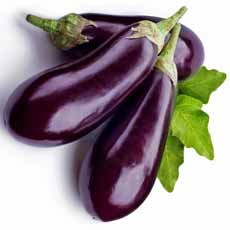
  • Eggplant. Do you want a less bitter eggplant? Look at the bottom for a more oval shape. These are the males, and they’re less bitter than the females, which have a more round bottom! Male and female eggplants? Who knew?
  • Pomegranates. If you need pomegranate arils but can’t find them prepackaged, here’s how to remove them from the fruit with less mess. Cut the pomegranate into quarters and place them in a bowl half full with water. Keeping the fruit in the water, peel the seeds out of the fruit. Strain them from the water and you’re ready to go.
  • Potatoes. To keep potatoes from sprouting, throw an apple or two in with them. The gasses the apples emit—ethylene, carbon dioxide and oxygen—will prevent potato sprouts.
  •  


    Purple Eggplant

    [1] The top and middle eggplants male and sweeter. The bottom eggplant is female and more bitter (photo courtesy ItDelice.com).

    Sprouted Potato
    [2] An apple will protect your potatoes from sprouting (photo courtesy Alberton Record).


    Comments off


    © Copyright 2005-2026 Lifestyle Direct, Inc. All rights reserved. All images are copyrighted to their respective owners.