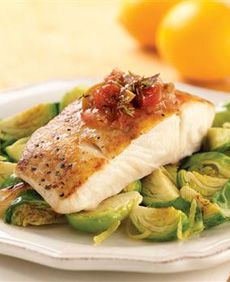
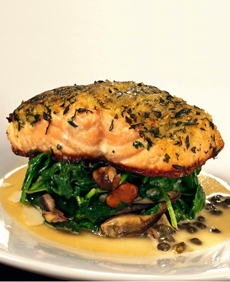
Roast salmon atop sauteed spinach and
mushrooms in a lemon butter caper sauce.
Photo courtesy Restaurant i at the Charles
Hotel, New York City. |
|
Too many people shy away from cooking fish because they feel it’s difficult. That’s a myth: It’s easy to cook healthy and delicious fish fillets, steaks and even whole fish.
(Whether you use the English term fillet, pronounced FILL-it, or the French word filet, pronounced fee-LAY, both refer to a boneless cut of fish or meat.)
Here’s a tip from Alissa Dicker Schrieber, The Kitchenista.
While there are endless ways to cook any given food, it’s important to have a go-to method you can turn to time and time again: something foolproof, that turns out great every time, and that you don’t have to give much thought to.
For fish, our go-to method is definitely roasting. It is an extremely simple undertaking: just three easy steps. |
| Roasting fish requires only three ingredients: extra virgin olive oil, sea salt and the fish. Herbs are invited, but optional (we use basil, dill, marjoram, oregano, rosemary or thyme).
Preparation
- Preheat the oven to 450°F. Line a baking sheet with parchment paper or aluminum foil, which prevents food from sticking and makes cleanup easier.
- Oil the baking sheet by pouring a drop of olive oil onto the parchment/foil. Spread it with a brush, a paper towel or your hand. Pat the fish dry with a paper towel and lay it on the parchment/foil. Sprinkle with optional herbs. Leave a bit of space between fillets; this helps them to cook evenly. If the fish has skin, place it skin-side-down. The skin will come off easily once the fish is cooked.
- Drizzle with olive oil to coat (1-2 teaspoons per small fillet, 2 teaspoons to 1 tablespoon per large fillet), sprinkle with salt and put the baking sheet in the oven. Very thin fish like sole can take as little as 6 to 8 minutes to cook. Medium-thick fillets like striped bass can take up to 12 minutes, while thicker filets (cod, halibut, salmon) may take 15 or 16 minutes. Cooking times are only guidelines; the actual time will vary with the size of the fillets and your particular oven.
You can serve roast fish simply, with lemon or lime wedges. The pan juices are very flavorful, so spoon them over the fish.
Or, you can make a sauce. The photo shows a lemon butter sauce with capers. For a healthier alternative, make a sauce of fat-free Greek yogurt with minced chives and mint. Season with garlic salt and fresh pepper and serve at room temperature (yogurt separates when heated, but you can warm it slightly in the microwave).
Whether or not you use a sauce, serve the fish atop the vegetables for a sophisticated presentation.
Pick a fish for tonight. Alaska cod (also called gray cod and true cod), Alaska halibut, artic char, farmed U.S. or South American tilapia, wild-caught Pacific flounder or sole, wild-caught or Canadian-farmed salmon or wild-caught or U.S.-farmed striped bass. If you’d like something else, check Seafood Watch and choose a sustainable fish.
|