|
National Strawberry Rhubarb Pie Day is June 9th. Rhubarb season is April through June, so you’ve got just a few more weeks to make this popular spring pie.
Rhubarb first grew wild in northwest China, and was cultivated as far back as 5,000 years ago, for medicinal purposes.
Technically, rhubarb is a vegetable, a member of the sorrel family (see the difference between fruits and vegetables). Even for a vegetable, it is very tart.
We have a delicious recipe for strawberry rhubarb pie with a lovely lattice top.
But given that the temperature here will be 97°F today, we’ll be celebrating with a strawberry rhubarb pie from Magnolia Bakery: sweet ripe strawberries, tart rhubarb and a dash of orange zest—we’ll probably go with the crumb top instead of the double crust.
There’s a rhubarb crumb muffin for those who don’t want pie. A dab of strawberry jam is in keeping with the holiday.
|
|
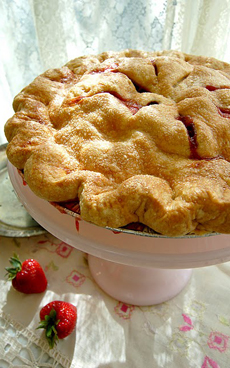
A fresh-baked strawberry rhubarb pie. Photo
courtesy Magnolia Bakery | NYC. |
RHUBARB TRIVIA
There are at least 60 species of rhubarb. Rheum rhabarbarum has been used for medicinal purposes in Asia and Europe for the last five thousand years. The roots were used as a purgative or laxative for digestive system problems. The stalk and leaves contained a large amount of oxalic acid, making them poisonous.
Rheum rhaponticum, the edible species of rhubarb, most likely originated in Mongolia or Siberia. It was introduced to Europe in 1608 by an Italian botanist, Prosper Alpinus, as a substitute for a Chinese species of medicinal rhubarb.
Rhubarb was first planted in England in 1777, by an apothecary. It was discovered by cooks, sweetened, and became popular for crumbles, jams, pies and sauces.
Before it was turned into sweet dishes, rhubarb was added to lentil soup and other soups, savory sauces, Moroccan tagines and Middle Eastern stews and to make homemade wine.
Be sure to cook only the stems; even in the edible variety, the leaves contain oxalic acid and are mildly toxic.
The word “rhubarb” comes from the botanical name Rheum rhabarbarum, which is a combination of the Roman name for the Volga River (Rha) and the Latin word “barbarum,” for foreign (since the plant came from territory across the Volga not controlled by Rome).
Benjamin Franklin, ambassador to London, introduced rhubarb seeds to America in 1772. Prior to then, only medicinal species were grown.
Rhubarb became a popular pie and pastry ingredient in the early 1800s. Rhubarb itself was nicknamed “pie plant.” It was also used in savory dishes .
While rhubarb is a botanical vegetable (and it looks like celery), in 1947 a New York court decided that it was a fruit. Likely owing to a petition by rhubarb growers, it was classified in the U.S. as a fruit: It would be counted as a fruit for the purposes of regulations and duties. The taxes on fruits were lower.
Strawberry rhubarb pie is one of the rare pies that combines fruits and vegetables. Can you name another? (Since tomatoes are a fruit, a mushroom and tomato pie counts.)
|
|