|
Updated August 2026
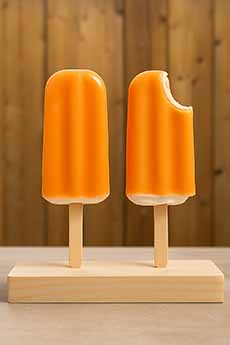
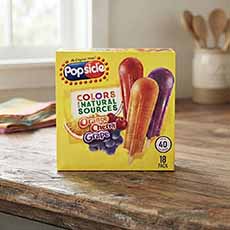
August 14th is National Creamsicle Day®. Why the trademark? While the word “Creamsicle” has become generic—like Band-Aid, Cellophane, Dumpster, Jacuzzi, Kleenex, and others—the trademark is the property of Unilever.
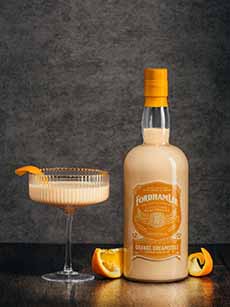
You don’t need to buy a Creamsicle to celebrate: Have a scoop of vanilla ice cream with one of orange sherbet. It’s one of our favorite easy desserts. Another is to pour orange liqueur over the ice cream.
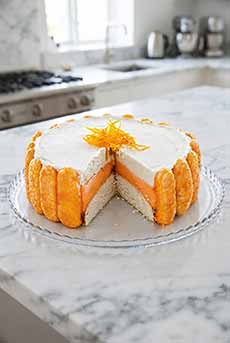
Each year we make the Creamsicle Ice Cream Cake recipe that follows. It couldn’t be easier: Just assemble four store-bought ingredients.
Below:
> The Creamsicle Ice Cream Cake recipe.
> The history of the Popsicle® and Creamsicle®.
Elsewhere on The Nibble:
> The history of cakes and the different types of cake: a photo glossary.
> The history of ice cream cake.
> The history of ice cream.
> The history of cake.
> Easy ice cream cake recipes.
> Beverage pairings for ice cream cakes.
> Recipes for Creamsicle ice cream and Creamsicle fudge.
> Recipes for Creamsicle milkshake, Creamsicle cheesecake, and Creamsicle a Creamsicle ice cream cocktail.
> The different types of ice cream and frozen desserts: a photo glossary.
> The year’s 50+ ice cream and frozen dessert holidays.
1. RECIPE: CREAMSICLE® ICE CREAM CAKE
Ingredients
1 loaf pound cake
1 pint vanilla ice cream
1 pint orange sherbet
Optional: orange marmalade
Grated orange zest (optional)
Preparation
1. SOFTEN the ice cream at room temperature until it is just spreadable.
2. SLICE the pound cake with a serrated bread knife, into three even layers. Press into a springform pan, trimming as necessary.
3. COVER the cake layer with orange marmalade. Place in the freezer until the marmalade hardens slightly. Then cover it with vanilla ice cream, using a spatula. If not using the marmalade, simply top the cake with the ice cream.
4. Place the middle layer atop the bottom layer, then top the middle layer with the top layer.
5. Cover in plastic wrap and freeze until ready to slice and serve. Garnish sliced pieces with a sprinkle of fresh orange zest.
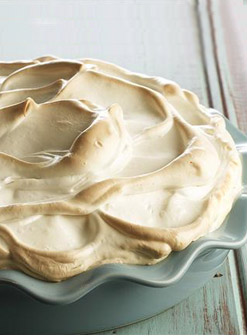
Variation: Use a graham cracker pie crust to make an a Creamsicle ice cream pie.
2. THE HISTORY OF THE POPSICLE & THE CREAMSICLE
Many foods—from yogurt thousands of years ago, to cream cheese, fudge, ganache, ice cream soda, and Toll House Cookies in the late 19th/early 20th century—were invented as the result of happy accidents.
The Popsicle®, the first of the “sicle” ice cream novelties, was no different, as you’ll see in the product history a bit down the page.
In 1905, 11-year-old Frank Epperson mixed together a fruit drink (believed to be orange-flavored) from powder and water and inadvertently left it on the porch.
It was an unseasonably cold night in the San Francisco suburbs, and when Frank found his drink the next morning, it was frozen. He eased it out of the glass and, holding it by the stirrer, ate it.
While Frank may have enjoyed his frozen fruit drink over the years, the public story doesn’t continue until 1923. A 29-year-old husband and father working in the real estate industry, Frank made what he called Epsicles for a fireman’s ball.
They were a sensation. His kids called the treat a “Popsicle” (photo #5), after their Pop.
In 1923, Epperson collaborated with employees of the Loew Movie Company to form the original Popsicle Company. It began selling the product through amusement-park and beach concessionaires.
Epperson filed for a patent, titled “Frozen Confectionery,” on June 11, 1924; it was granted that August. On September 8 of that year, he assigned all of his patent rights to a new entity that purchased the operating rights from the original Popsicle Company, the Popsicle Corporation of the United States.
According to The National Archives, he then “turned his attention to other matters.”
|