|
Updated September 2026
September 27th is National Chocolate Milk Day. Just in case you think it’s kid stuff, we present 13 different liqueurs and spirits you can mix into your chocolate milk.
Below:
> Liquors for adult chocolate milk.
> The history of chocolate milk.
> The history of chocolate syrup.
> The best chocolate syrup brands.
> The year’s 16+ milk and cream holidays.
Elsewhere on The Nibble:
> The history of chocolate.
> Make homemade chocolate syrup for your chocolate milk.
> The year’s 69 chocolate holidays.
1. LIQUORS FOR ADULT CHOCOLATE MILK
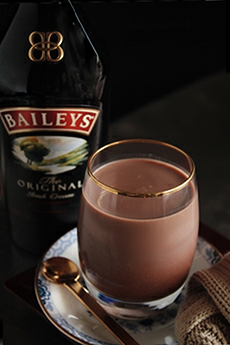
As you read this, sip a glass of chocolate milk—with a shot of chocolate liqueur (crème de cacao, Godiva). Our personal favorite, however, is good old Irish cream.
Liqueurs
We find that these flavors best complement a glass of chocolate milk.
- Amaretto
- Banana liqueur
- Chocolate liqueur (crème de cacao, white crème de cacao, and others)
- Coffee liqueur
- Irish cream liqueur
- Orange liqueur
- Peppermint schnapps
- Raspberry liqueur
Start with ¾ ounce of liqueur in 8 ounces of milk, since the chocolate syrup already contains considerable sugar, as does the liqueur. Add ice, and stir or shake.
Spirits
If you prefer something stronger:
- Bourbon: Works especially well with rich chocolate milk.
- Brandy or Cognac: A lighter approach to a Brandy Alexander.
- Irish whiskey: Smoother and lighter than Bourbon.
- Rum, dark or aged rum: Probably the best all-around pairing.
- Vodka: Neutral flavor, unless you use flavored vodka.
Start with 1 ounce of spirit in 8 ounces of chocolate milk. Add ice, and stir or shake.
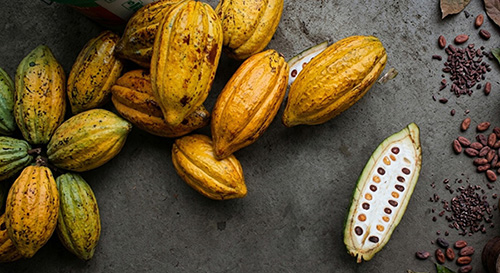
[7] Cacao pods, called cabosses (kuh-BAHSS), are the fruit of the cacao tree. The white flesh is the fruit, and the black seeds, or beans, get roasted and turned into chocolate (photo © Ritual Chocolate).
2. THE HISTORY OF CHOCOLATE MILK
Who Invented Chocolate Milk?
Sir Hans Sloane (1660-1753), for whom London’s Sloane Square is named (and whose collection of objets d’art and curiosities became the foundation of the British Museum), introduced chocolate milk to Europe. It wasn’t exactly the chocolate milk we know today—made with chocolate syrup to get kids to drink milk—but it was a start.
While Sloane was long credited by British tradition and Cadbury advertising with “inventing” chocolate milk, historical research (including by the British Museum and food historians like James Delbourgo, author of Collecting the World and the 2011 essay “Sir Hans Sloane’s Milk Chocolate and the Whole History of the Cacao” and Sophie & Michael Coe, authors of “The True History of Chocolate”) shows that indigenous Jamaicans had already been drinking cacao mixed with milk and spices long before Sloane arrived in 1687. Sloane merely documented and commercialized the recipe in Britain.
Cacao had been brought back to Spain by the conquistadors. When Cortés returned to Spain in 1528, cacao was part of the booty he presented to the Holy Roman Emperor Charles V.
A Kekchi Maya delegation from Alta Verapaz arrived in 1544, bringing cacao to Prince Philip (a son of Charles V, he became King Philip II of Spain in 1556).
For many years, cacao remained a Spanish secret, affordable only to the wealthy. (The story continues.)
Sloane encountered cacao in Jamaica in the late 1680s, where it was drunk mixed with water. He found it most unpleasant (as did Christopher Columbus and the Spanish conquistadors of Mexico—see details).
However, Sloane devised a means of mixing the ground cacao beans with milk, to make it more pleasant. He brought both cacao and his recipe (most likely unsweetened) back to England.
A physician, Sloane was initially interested in the medicinal properties of cacao†; he thought chocolate milk had soothing qualities. The recipe was initially sold by apothecaries. You can see ads for the original product on this Cadbury blog, which found them in the Cadbury archives. The earlier ad suggests chocolate milk for “lightness on the stomach” and “all consumptive cases.”
In addition, it was often prescribed for people suffering from “wasting disease”: The extra calories assisted in weight gain, and the caffeine-like compounds helped perk up the patients.
By the 19th century, chocolate milk had become an enjoyable food product. The Cadbury Brothers sold tins of Sir Hans Sloane’s Milk Chocolate (use the Cadbury link above to see that ad). One ounce (two squares) was dissolved into a pint of boiling milk, to which sugar was added creating hot chocolate milk, today known as hot chocolate.
3. THE HISTORY OF CHOCOLATE SYRUP
Chocolate syrup began less as an ice cream topping and milk enhancer than as a pharmaceutical ingredient.
To go back to the beginning: Cacao was consumed in Mesoamerica for thousands of years, as a bitter beverage for the privileged few. The beans of the cacao pod were highly valued, and even used as currency.
Ground, roasted cacao beans were blended with allspice, chiles, vanilla, and spicy petals from a local tree, Cymbopetalum penduliflorum, a member of the custard apple family known in English as sacred ear flower (its Nahuatl name is hueinacaztli).
|
|

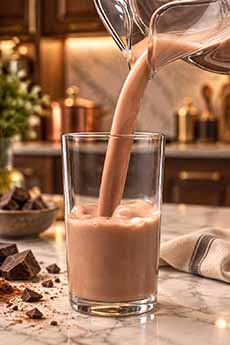
[1] Chocolate milk can be made with any milk or milk substitute (photo © The Nibble).
[2] Getting fancy with chocolate syrup design on the glass. Use a squeeze bottle to decorate the glass, then pour in the chocolate milk you’ve mixed separately. Add a topping of shaved chocolate (photo © Yi Mun | Unsplash).
[3] Add Baileys to your chocolate milk. Heavenly! (photo © The Nibble).
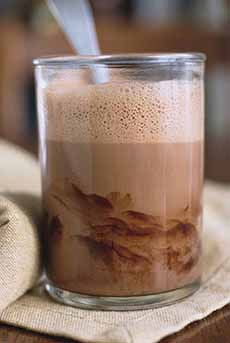
[4] A glass of chocolate milk with homemade chocolate syrup. Here’s the recipe (photo © Recchiuti Chocolate).
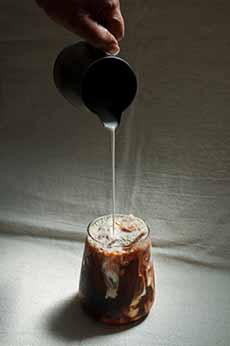
[5] Chocolate milk drama (photo © Pariwat Pannium | Unsplash).
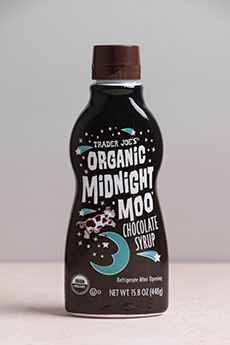
[6] Elevate your chocolate milk with better chocolate syrup, like Trader Joe’s Midnight Moo and Whole Foods’ 365 Brand, made with cane sugar instead of corn syrup. Ghirardelli is another brand to try (photo © Becoming Betty—read her review).
|
There were different recipes; some used local honey**, others had no sweetener. The local agave sap, which we use today, was not then used as a sweetener. Cane sugar from Europe arrived much later.
What Cortés had was a bitter drink, served tepid, but it suited the Aztec palate. However, when honored with a portion, Cortés spat it out.
But the cacao beans were brought back to Spain nevertheless, where cooks experimented with the ground, roasted beans and created a hot, sweetened beverage—in other words, hot chocolate.
- The 16th century: Cacao reached Europe in the 1500s, returning with Spanish explorers along with varieties of beans (lima, kidney, navy), chile peppers, corn (maize), squash (including pumpkins), tomatoes, turkey, and vanilla. This was known as the Columbian Exchange,* and also included precious metals and cultural artifacts from Mesoamerica.
- The 18th century: By the 1700s, chocolate was being promoted as having medicinal value.
- The 19th century: In 1828, Dutch chemist Coenraad J. van Houten developed a process for making cocoa powder easier to mix with water. The process also reduced the bitterness. Pharmacists combined cocoa, sugar, and water into sweet syrups that could mask the bitter taste of medicines. Still, the result wasn’t exactly the chocolate syrup we have today. To make it palatable, pharmacists would mix cocoa powder with at least eight times more sugar than chocolate [source].
- The popularity of chocolate syrup exploded in the second half of the 19th century, coinciding with the golden age of so-called patent medicines.
- During the late 19th century, drugstores increasingly operated soda fountains. Chocolate syrup was mixed with carbonated water, milk, or other drinks, gradually becoming a beverage flavor rather than merely a medicine base.
- The 20th century: Around the turn of the 20th century, stricter regulation of patent medicines, the growing popularity of ice cream, and cheaper mass-produced chocolate helped transform chocolate syrup into a confectionery product.
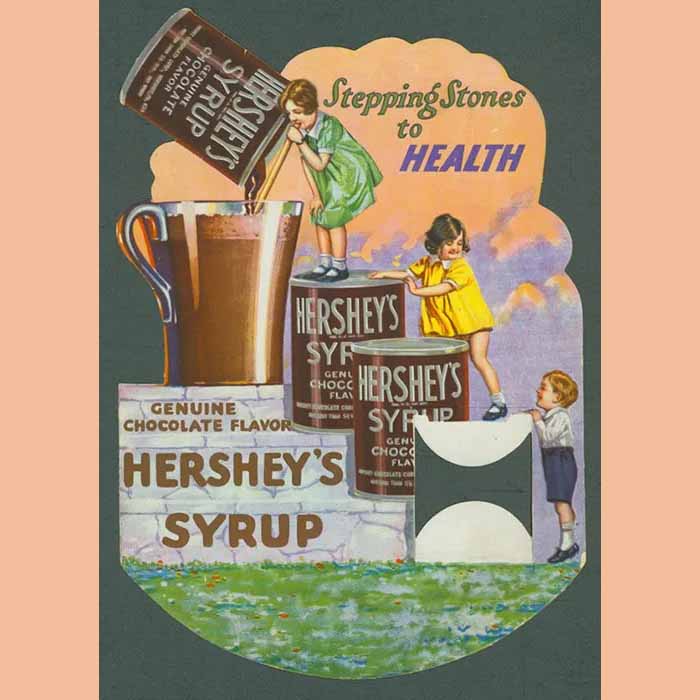
- Hershey began producing chocolate syrup commercially in 1926, initially selling canned single- and double-strength versions to soda fountains, restaurants, and bakeries. By the late 1920s, it was also being packaged for home use. Other brands, including Bosco, helped popularize chocolate syrup in the 1930s.
- By that time, chocolate syrup had become a standard topping for ice cream and an ingredient in chocolate milk, milkshakes, sundaes, cakes, and other desserts.
- If you are old enough to remember, those cans of chocolate syrup were opened with a can opener or by puncturing the lid with a church key (a.k.a. a can punch).
- Hershey switched from cans to 24-ounce plastic squeeze bottles in 1979, making it easier to use the syrup at home, including more precise drizzling for desserts as well as easier mixing into milk and other beverages.
- The category expanded beyond chocolate syrup to caramel, strawberry, and other flavors, including no-sugar-added, lower-calorie, and organic options.
- Alongside mass-market syrup, fine chocolate manufacturers and others have produced higher-quality products, made with better cocoa and a higher cocoa content.
[8] An old Hershey chocolate syrup ad (The Hershey Company image).
4. THE BEST CHOCOLATE SYRUP BRANDS
A syrup is mostly a mixture of sweetener and water, with cocoa/chocolate dispersed in it. Its quality is judged by the ingredient list, nutrition panel, serving size, and how much syrup you need to get real chocolate flavor.
Look for cocoa and/or chocolate before or directly after the sweetener. Similarly, look for real vanilla extract rather than “artificial flavor.”
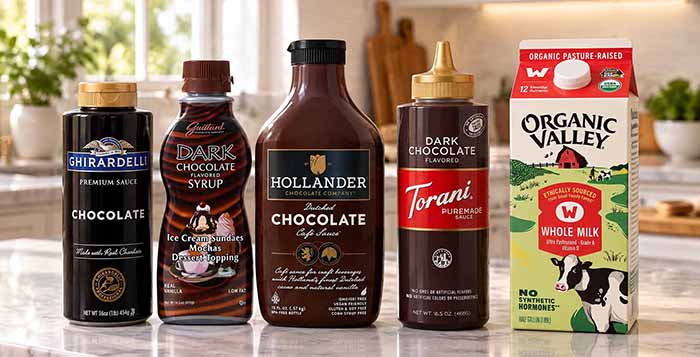
Some higher-quality brands are made for the professional market (Cacao Barry, Callebaut, Valrhona). The following brands, however, are readily available to consumers:
- Ghirardelli (they also make white chocolate syrup).
- Guittard (they also make white chocolate syrup).
- Hollander (they also make white chocolate syrup).
- Torani Puremade (they also make white chocolate syrup).
We found these additional brands on Amazon, which seem promising. We’ll have to have a taste test—perhaps for Valentine’s Day.
- 1883 Maison Routin Chocolate Syrup, sweetened with cane sugar (France—they also make white chocolate syrup).
- Alma White Chocolate Syrup (Italy), sweetened with cane sugar.
- Holy Kakow Organic Chocolate Sauce, sweetened with agave syrup.
- Joe’s Organic Syrup, dark chocolate/Dutch cocoa, made with cane sugar.
- Wildly Organic Chocolate Syrup, sweetened with agave.
[9] Have a taste test. You don’t even need milk: We taste them from a spoon (photo © The Nibble).
5. THE YEAR’S 16+ MILK & CREAM HOLIDAYS
- January 5: National Whipped Cream Day
- January 11: National Milk Day
- February 18: Cow Milked While Flying in an Airplane Day (a.k.a. Elm Farm Ollie Day)‡
- March 15: National Egg Cream Day
- May 21: National Strawberries and Cream Day
- June: National Dairy Month
- June 1: World Milk Day
- June 21: National Peaches and Cream Day
- June, Last Friday: National Cream Tea Day
- August 7: National Raspberries ‘N’ Cream Day
- August 12: Milkman Day
- August 22: World Plant Milk Day
- September, Last Wednesday: World School Milk Day
- September 24: National Horchata Day
- September 27: National Chocolate Milk Day
- The Year’s 6 Milkshake Holidays
Plus:
- February 11: National Don’t Cry Over Spilled Milk Day
- May 22: Harvey Milk Day
*The Columbian Exchange (named after Christopher Columbus) brought from Europe [although they may have originated elsewhere]: cereal grains (barley, rice, rye, wheat), fruits (bananas, citrus fruits like lemons and oranges, grapes, peaches), livestock (cattle, goats, pigs, sheep), horses, other foods and spices (garlic, onions, sugar cane). Unfortunately, European pathogens came along as well: the common cold, chickenpox, influenza, malaria, measles, smallpox, and yellow fever, which caused catastrophic mortality rates among indigenous populations.
**Stingless bees (Melipona beecheii) were cultivated by the Maya and other Mesoamerican peoples for their honey, beeswax, medicinal use, religious and ceremonial purposes, and trade and tribute.
†Hans Sloane was on to something. Modern research has shown that flavanol-rich cacao can impact cancer and cardiovascular disease over the long term. However, in the 1600s, health claims were speculative rather than scientifically proven. In 1631, the first recipe for a chocolate health drink was published in Spain by Antonio Colmenero de Ledesma, an Andalusian physician, in his book, Curioso tratado de la naturaleza y calidad del chocolate (A Curious Treatise of the Nature and Quality of Chocolate). A doctor who had lived in the West Indies, he claimed that chocolate was an aphrodisiac, caused fertility, and eased delivery in women. Here’s the true scoop on chocolate health claims, from the Cleveland Clinic. And, if it gets kids to drink their milk, one could interpret that chocolate milk is a health drink.
‡Cow Milked While Flying in an Airplane Day, one of the stranger holidays on the books, commemorates the day a Guernsey cow named Nellie Jay became the first cow to be flown and milked in an airplane. The famous flight was part of a scientific effort to study the effect of height on cows’ ability to produce milk. It occurred on February 18, 1930, during the International Aircraft Exposition in St. Louis, Missouri (flying from Bismarck, Missouri to St. Louis). Nellie’s milk was put in paper cartons and parachuted down to the spectators to generate publicity. During the publicity flight, she was billed as Elm Farm Ollie. Afterward, she was also called Sky Queen.
|
|