|
In the old days, bread was baked without preservatives and Grandma kept the leftover bread in a metal or wood “bread box” on the kitchen counter (our grandmother’s looked like this).
Did it help the bread stay fresh? Not really, although historically, it did help to keep mice away in homes that had critters (not Nana’s home, of course).
While there are some airtight plastic bread boxes today, the box is still full of air, a staunch enemy of baked goods.
Fresh-baked bread begins to lose moisture in a continuous process known as starch retrogradation, a hardening of the starch molecules as the water that was absorbed during baking begins to dry out. Without preservatives, a loaf of bakery bread will harden to the point of staleness in 24 to 48 hours.
Toasting, microwaving or otherwise reheating bread brings back some moisture—briefly—because the hot bread reabsorbs some moisture.
If you buy branded supermarket breads, they typically contain preservatives that retard starch retrogradation and mold growth for three weeks or more.
For all-natural bakery breads, made without preservatives, we rely on bread storage bags.
|
|
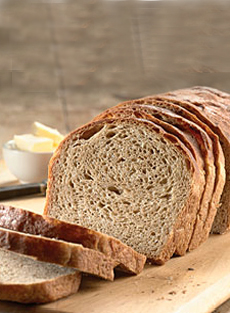
It’s moist and delicious today, but what about two days from now? Photo courtesy KingArthurFlour.com. |
|
We’ve had great success with Bread Armor Debbie Meyer bread bags.
MORE TIPS FOR KEEPING BREAD FRESH LONGER
Short-Term Solution: Airtight Plastic Bags
If you’ll eat the bread within two or three days, keep it in an airtight plastic bag on the counter. By day three it may need some freshening in the microwave (5-10 seconds), or you can toast it.
If you have an unsliced loaf, keep it that way and cut slices as needed.
Some breads, like baguettes, go stale very quickly and won’t last until the third day. If you have excess bread, secure it in plastic bags (cut into shorter lengths as necessary) and toss it in the freezer.
Or, you can let it go stale and use it to make bread crumbs. Pulverize chunks of bread in the food processor.
Or make bread pudding, bread salad, French toast or fondue—recipes that were invented to use up stale bread.
Breads that are enriched with dairy, eggs or sugar stay fresh longer, as those ingredients both trap moisture and interfere with starch retrogradation.
Longer-Term Solution: Freeze It (In Airtight Plastic Bags)
Freezing prevents the growth of mold and stops starch retrogradation. You can store bread, bagels, baguettes—almost any bread—in the freezer for a couple of months.
While bread will keep frozen longer than that, it’s one of the first foods to pick up unwanted flavors from a less-than-pristine environment.
Sliced frozen bread can be quickly restored to room temperature in the microwave—one of the advantages of freezing bread in slices.
Half or whole loaves can be thawed in the microwave to the point where you can slice off what you need. Then, reheat it, toast it or allow it to come to room temperature.
How Many Different Types Of Bread Have You Had?
Check out our photo-filled Bread Glossary.
|