THE NIBBLE BLOG: Products, Recipes & Trends In Specialty Foods


Also visit our main website, TheNibble.com.

TIP OF THE DAY: The Better “American Cheese” Alternative

There are many foods that send a shudder up the spine of a food writer and educator. They tend to be truly inferior products, both nutritionally and taste-wise; but the American palate has become so accustomed to them that people have no desire to experience something better. At the top of our shudder list: processed American cheese.

Children are taught to love it from their first gooey grilled cheese sandwich. But most “American cheese” so processed and packed with additives that it falls outside the legal definition of cheese. It may be comfort food, but it’s not good food.

Real cheese is made from milk coagulated into curds, which are then pressed into cheese. Processed American cheese, on the other hand, is a blend of milk, milk fats, milk solids, other fats and whey protein concentrates—and only 51% cheese. It must be labeled “cheese product” or “cheese food.”

Most people who buy it don’t note the difference. But there is a far better option: Cheddar cheese slices. Here’s an eye-opening infographic that compares Cheddar to processed American cheese. But in one sentence:

 
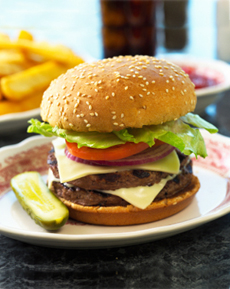
Trade in the inferior American cheese for real Cheddar slices. Photo courtesy Tillamook Cooperative.
 
Processed American cheese contains 51% real cheese or less; the ingredients are emulsified and held together with artificial ingredients and preservatives. It has twice the salt found in natural Cheddar.
A BRIEF HISTORY OF AMERICAN CHEESE

America colonists brought their cheese-making skills to the New World and could make numerous types of cheese. But a single type won out: Cheddar. It was uniquely sturdy under primitive conditions and withstood seasonal variations in temperature and humidity, while delivering excellent flavor.

The first cheese factory, enabling large-scale production, was built in 1851. When cheese is cut it in to blocks, there are leftover cheese trimmings.

By the mid-1800s, an Ohio cheese maker named Emil Frey figured out how to heat his cheese scraps and add a few other ingredients to create processed cheese. This new cheese was more bland than Cheddar, which appealed to the [de-evolving] American palate. It turned velvety-smooth when melted, and became known as Velveeta.


A double burger with American cheese. Photo
by Paul Johnson | IST.


While some sources give credit for processed American cheese to James L. Kraft, who shredded and re-pasteurized Cheddar trimmings with sodium phosphate and patented “American process cheese” in 1916, he was not the first to create processed cheese. Others did it decades earlier.

According to Chuck Blumer, who produces Spring Lake American Cheese another cheese maker other than Emil Frey decided to put the trimmings to good use by making a blended cheese.

He threw all of his trimmings into the cooker, added some barrel Cheddar for consistency and sliceability, added some moisture (water) for meltability, and invented American cheese. All cheese makers followed suit, thrilled to turn their trimmings into profits.


In 1885, Colby cheese was invented in Wisconsin by Joseph F. Steinwand, named for the township in which his father had built a cheese factory three years earlier. It is similar to Cheddar, but with some key differences in production. And like Cheddar, it was a hit.

American cheese became a mix of Colby and Cheddar cheese scraps. With the surge in popularity of convenience foods in the 1950s, processed American cheese took off. The Baby Boomer generation grew up eating American cheese sandwiches: with lettuce and tomato, cold cuts or grilled with or without a slice of tomato.

Says Blumer: American cheese became so popular that there were not enough trimmings to satisfy the demand. Cheese makers then shopped the world for any type of cheese they could buy at a cheap price. They would throw this cheap cheese in to the cooker with some cheddar and water to make their American Cheese. Most cheese makers still do this today.

So, American cheese evolved from being quality trimmings of Cheddar and Colby to any cheap cheese that can be processed into a uniform flavor.

THE REBORN AMERICAN CHEESE

There’s hope for everyone who adds a slice of American cheese to a burger, sandwich or omelet.

With Americans’ demands for more wholesome food, domestic Cheddar manufacturers have been making “American cheese” slices from 100% domestic barrel Cheddar.* And if you are making American cheese in Wisconsin, America’s largest cheese-producing state, you are required by law to use only 100% domestic barrel Cheddar in the production of American cheese.

Look for Cheddar slices from Organic Valley, Tillamook and other quality Cheddar producers.

Check out this infographic for the story of what you’re getting today when you buy Cheddar versus American Cheese.

Find more of our favorite cheeses and recipes.
 
*Barrel cheddar, or Cheddar barrel cheese, is a 500 pound barrels of cheese sold by cheese producers in to other manufacturers.


Comments off

PRODUCT: Wine Wipes For Red Wine Lovers

We have a friend who enjoys hearty red wines. After a few glasses, his teeth become so stained that monster movie makeup specialists should take note. It’s not a pretty sight.

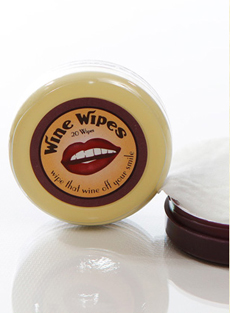
If only he would carry Wine Wipes. Unfortunately, the product packaging, with its image of female lips, is not exactly unisex. But either sex can use Wine Wipes discretely. The container can hide in the palm of your hand, and there’s a mirror on the inside of the lid.

Years ago, when we went through an intensive Port-drinking phase and ended up with embarrassing “tannin teeth,” we asked our dentist, who was near retirement, what we could do to eliminate the stains. “If I were in an earlier phase of my career,” he said, “I’d love to do the research. But I’m winding down.”

He did recommend drinking less tannic red wines. But when you’re in a Port mode, nothing else suffices. We ended up carrying a toothbrush and baking soda, and making trips to the restroom to clean our Bride of Frankenstein teeth.

 
If red wine stains your teeth, here’s the solution. Photo courtesy Wine Wipes.
 

Ten years later, we discovered Wine Wipes, a boon for people whose teeth stain more than they’d like. It’s easy to wipe away the unattractive dark red film on your teeth: Just run the cloth over your teeth, tongue and mouth, and they’ll be restored to normal.

The all-natural ingredients won’t otherwise interfere with the taste of the wine:

  • Baking soda, which gives off free radicals that penetrate the surface of the tooth’s enamel and turn the stain clear. It also neutralizes acids that can corrode the enamel.
  • Salt, used before toothpaste was invented, is a natural cleanser and antiseptic. It helps to remove stains, and its alkaline properties also fight germs. The slight taste of salt will not interfere with your palate.
  • Hydrogen peroxide is a mild bleaching agent and germ killer. It does not harm tooth enamel.
  • Calcium strengthens teeth by adhering to tooth enamel.
  • Glycerine coats the teeth to keep them from further staining.
  •  
    A small compact with 20 wipes has an SRP of $6.95.* You can get three for $14.99 on Amazon.

    Wine Wipes make great gifts for pals whose teeth tend to develop “wine tatoos,” and are fun stocking stuffers.

    Buy Wine Wipes on Amazon.com.
     
     
    *SRP = Suggested Retail Price, also called MSRP, Manufacturer’s Suggested Retail Price.


    Comments off

    TIP OF THE DAY: Mix Crudités With Green Salads


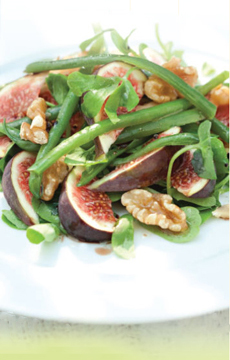
    Mix it up: a green salad with crudites, figs
    and nuts. Photo courtesy La Tourangelle.

      We were facing lot of leftover crudités—raw broccoli, cauliflower, green beans and sugar snap peas—among traditional salad ingredients like carrots, cherry tomatoes and radishes.

    Why is it that we normally toss the carrots, tomatoes and radishes into a green salad, but not the rest of the crudités?

    We amended that posthaste, and enjoyed a delicious “crudité salad”: a salad with more variety, more nutrition, more crunch. And we avoided a supply of withering raw vegetables. We also added nuts for protein, ripe figs and a walnut oil and white wine vinaigrette.

    For those who don’t have enough time in the day to eat their veggie quota, it’s also a two-fer (or perhaps, a three-fer).

    Find more of our favorite salad recipes.


    Comments off


    © Copyright 2005-2026 Lifestyle Direct, Inc. All rights reserved. All images are copyrighted to their respective owners.