|
If you still have Thanksgiving leftovers, this tip from Chef Johnny Gnall shows how to turn them into favorite comfort foods: dumplings or ravioli. If you have questions or suggestions for tips, email Chef Johnny.
At Thanksgiving, just about every content source offers you a new take on what to do with leftovers. Here’s my take: Use them to stuff dumplings! It gives you the chance to practice your dumpling- or ravioli-making skills and produces some delicious pasta.
Dumplings are a stuffed pasta similar to ravioli or tortellini, but with a thicker dough. If you have a pasta machine to press out thin dough, go for the ravioli!
All the Ziploc bags and Tupperware in my fridge, crammed full of leftover Thanksgiving goodness, were soon transformed into dumpling goodness (and you can freeze any extra dumplings).
So impress your family and friends with fresh, handmade pasta that lights up their taste buds and reminds them of that most special of eating holidays: Thanksgiving! I guarantee you they will GOBBLE it up, and may well demand that it become an annual event.
|
|

You can use up the remaining leftovers in a sandwich…or you can make “Thanksgiving Ravioli.” Photo courtesy McCormick.com.
|
|
HOW TO MAKE “THANKSGIVING DUMPLINGS” OR RAVIOLI
First, make a simple pasta dough by mixing 1 egg, 1 cup of sifted flour and 2 or 3 tablespoons of room temperature water. Professionals will do this on any clean, floured surface; but use a large bowl if you want to keep things contained and neat.
Combine the ingredients. Use your hands to gently bring the flour, egg and water together. If you find things getting dry and caking, add another tablespoon of water or two. If it’s too wet, add some flour.
Work the dough very gently. The more you handle it, the tougher any dough gets. So knead it softly and form it into a smooth ball. Don’t get frustrated if your first attempt doesn’t come together just as you’d expect. Feel free to scrap it and start over if you’d like—it’s only an egg and some flour. Don’t aim for perfect on your first few tries.
Roll out the dough. You can use a wine bottle if you don’t have a rolling pin. Try to get the thickness to about 1/8 of an inch, and keep your surfaces well floured, flipping the dough a few times to keep it from sticking as you roll it. Take a ring cutter with a width of 3-4 inches (the rim of a drinking glass or cup works in a pinch) and cut out as many circles as you can. Re-knead the scraps and roll out the dough to coax out a few more pasta circles.
Fill. Lightly brush the edges of one pasta circle with a diluted egg wash (1:1 ratio of egg to water) and spoon filling into the center, compacting it as much as you can without pressing on the dough.
Press on. Take another dough circle, brush one side with egg wash and place it, wet side down, onto the bottom circle. Gently press the edges of the two circles together (pressing too hard may cause it to stick to the surface). Once you’ve connected it all the way around, pick up your dumpling or raviolo (the singular form of ravioli) and now, more firmly, press its edges together.
Overstuffed? If you find you’ve overstuffed your little guy and filling comes out, wipe it off and use some flour on your fingers to absorb moisture. It’s important to create a dry, secure seal all the way around or the ravioli will open up in the water, spilling their contents like pasta piñatas.
Go for function over form. Do your best to center your filling and make your edges pretty, but put your focus on function over form. A well built, slightly less attractive dumpling or ravioli can be called “rustic” and still be successful, as long as it’s tasty. A poorly built pasta, on the other hand, can’t be called anything if it falls apart and doesn’t make it to the plate.
|
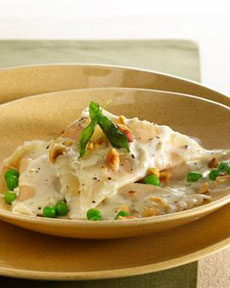
Ravioli stuffed with leftover turkey and
butternut squash. We even used up the last
of the peas and the sage. Photo courtesy
McCormick.com. |
|
Filling trick. If you find, after cutting your pasta circles, that your dough is on the thicker side, you can make tortolloni—large tortollini. Place your filling slightly off center and fold the circle over on itself, almost like a semi-circular taco. Lightly brush the edges with the 1:1 egg wash before you fold, and keep your fillings compact and your seal tight.
How to make tortelloni. Once you have taco-like half circles, pull the two corners slightly downward and in toward one another to form tortelloni. It takes a gentle hand a little practice to get them nice looking, so put on your favorite holiday tunes and take your time.
Don’t spare the flour and water. As always, if things get sticky, dust with a little flour; if the dough feels dry, put a few drops of water on your hands. Keep any dough that needs to sit for a while (as you work on other dough) under a slightly damp paper towel or two. With doughs, you have to roll with the punches to get things just right.
Ready to cook! Cook the pasta in gently boiling salted water for five to seven minutes or until tender and al dente (how to cook fresh pasta). Pull out a “tester” and taste to make sure they are just right.
|
|
RAVIOLI FILLING IDEAS
Here are five delicious fillings I made for my own pastas, all from fully cooked leftovers straight out of the fridge:
Brussels Sprouts, Glazed Ham, & Pomegranate: Thinly slice the ham and Brussels sprouts; toss in a few pomegranate seeds per piece.
Classic Turkey & Cranberry: Mix shredded dark meat with a dot of turkey drippings, stock or gravy and a bit of leftover cranberry sauce. Bonus: If you can get a bit of turkey fat or gelatin to mix in with the meat, your pasta may approach Asian soup dumpling moisture consistency as it cooks and the filling liquefies. This could be one of the tastiest and most satisfying items you have ever enjoyed. Just make sure your filling holds together well enough to allow for successful pasta construction.
Turkey & Mascarpone: Substitute the tart cranberry sauce in the previous bullet for a dash of creamy mascarpone cheese and a tiny pinch of nutmeg. If you don’t have mascarpone you can use sour cream, or simply whip a tablespoon of heavy cream to soft peaks. The nutmeg is a really nice offset to the rich cream.
Maple Squash: Take a few pieces of roasted squash, pumpkin or potato and mash with a fork along with a teaspoon or two of cream, or sour cream or mascarpone (or Brie, fromage blanc, crème fraîche or cream cheese—get creative). Get the mixture smooth and creamy, taste and adjust for seasoning, then go in for the kill: a generous drizzle of maple syrup stirred. The maple takes the whole recipe to holiday heaven. If you really have a sweet tooth (or a nostalgia tooth, for that matter), finish with a shake of pumpkin pie spice.
Stuffing: Toss in the stuffing with any leftover fresh herbs, carrots and peas, even cranberry sauce.
How to serve the dumplings? In broth, as a side or with a sauce of your choice. We like a white sauce, or try mixing tomato sauce or olive oil with some cranberry sauce.
Use these ideas as a jumping-off point, but remember that the point is to eat up the leftovers in a fun and delicious way, whether they’re from Thanksgiving, Christmas, Chanukah or last Thursday.
Review my tip on “Guerilla Cooking”, then head to your fridge, grab all leftovers you can carry and begin to perfect your handmade pasta technique!
|
|