THE NIBBLE BLOG: Products, Recipes & Trends In Specialty Foods
Also visit our main website, TheNibble.com.
|
March 25, 2013 at 6:46 am
· Filed under Fruits, Nuts & Seeds, Snacks
|
|
According to research conducted last month by Dole, more than half of American women have admitted to skipping a meal so they could enjoy a snack without feeling guilty.
With the introduction of Dole Banana Dippers, the company wants Americans to enjoy their meal and their sweet snack (not to mention the potassium and other nutrients in bananas).
For only 120 calories or less per serving, you can savor a packet of plain Dole Banana Dippers or Banana Dippers Dark Chocolate with Almonds, both covered in antioxidant-rich dark chocolate.
(Go for the almonds—see the nutritional information below.)
|
|
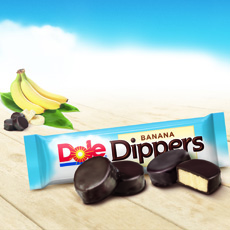
Frozen bananas substitute for ice cream. Photo courtesy Dole. |
The individual packets contain 4 slices of fresh-frozen, chocolate-dipped banana that provide an ice cream-like experience, without the cholesterol or 15 calories of sugar in a half-cup of ice cream (the 1.55-ounce packet has 4g dietary fiber and 7g sugar).
They have become a most popular snack at THE NIBBLE.
Bananas are a terrific, heart-healthy food when included in a diet low in saturated fat and cholesterol. Naturally fat-, cholesterol- and sodium-free, bananas are a good source of potassium, dietary fiber, manganese and vitamins B6 and C.
BANANA NUTRITION
With 110 nutrient-dense calories per serving (126 grams, or one medium-sized banana) bananas are delicious and nutritious. Here are the nutrients in a banana†:
|

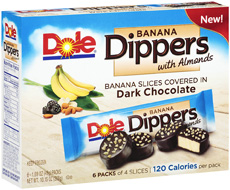
A box of Dole Banana Dippers with Almonds. Photo courtesy Dole. |
|
Vitamin B6 – .5 mg
Manganese – .3 mg
Vitamin C – 9 mg
Potassium – 450 mg
Dietary Fiber – 3g
Protein – 1 g
Magnesium – 34 mg
Folate – 25.0 mcg
Riboflavin – .1 mg
Niacin – .8 mg
Vitamin A – 81 IU
Iron – .3 mg
|
|
ALMOND NUTRITION
Nuts are a good protein food. Yes, they have fats, but those are largely unsaturated, heart-healthy fats which have been shown to lower LDL cholesterol and the risk of heart disease. Here’s the scoop on the health benefits of nuts. A one-ounce serving of almonds (23 almonds) delivers:
35% Daily Value of the antioxidant vitamin E
3.5 grams of dietary fiber
6 grams of protein
8% Daily Value of calcium
Only 1 gram of saturated fat and 13 grams of “good” mono and polyunsaturated fats
Other important nutrients including iron, magnesium, manganese, potassium, calcium, selenium and zinc
The small garnish of almonds on the Dole Banana Dippers has just a fraction of your daily almond allotment. So for your second snack, enjoy 22 of those 23 almonds!
*Methodological Notes: The DOLE Banana Dippers survey was conducted by Wakefield Research among 1,000 nationally representative U.S. women ages 18+, between February 4 and February 7, 2013, using an email invitation and online survey.
†Nutrient data provided by USDA’s National Nutrient Database. Almond information from Almond Board Of California.
|
|
|
Permalink
|
|
March 24, 2013 at 9:18 am
· Filed under Fruits, Nuts & Seeds
|
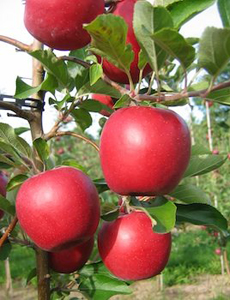
Do you think I’m sexy? Photo courtesy
Cornell University. |
|
It’s probably not a surprise, but a food with a sexy name is more appealing to consumers. The right name could command a much sweeter price for farmers, as research for a new apple name has shown.
Apple names generally fall into three categories:
“Sincere” names based on a breeder or location, such as Cortland, Granny Smith and McIntosh
“Sophisticated” names, which usually highlight the fruit’s appearance, such as Red or Golden Delicious and Golden Pippin
“Exciting” names that evoke the taste or texture of the apple, such as Honeycrisp, Jazz and Pink Lady
Using experimental auctions, researchers at Cornell University tested participants’ willingness to pay for five different varieties of apples, including a new, patented variety developed at Cornell. Auction participants didn’t know about the apples’ history or the Cornell connection, but they learned about each variety’s attributes, such as sweetness and crispness, and they tasted slices of each.
|
The researchers tested the new Cornell apple under three names: sincere “Williams,” sophisticated “Burgundy Beauty” and exciting “Flavor Haven.”
With the first two names, the average bid for the new apple was 12% higher than the average for four established apple varieties: Empire, Fuji, Honeycrisp and Piñata. With the “exciting” Flavor Haven name, the average bid for the apple jumped to 27% more than the other varieties.
As new, patented varieties of apples hit shelves, they will often sell for a premium—and not just because of the sexy name. They’re also more expensive to grow, as farmers have to buy licenses from the developers to grow them. There is a fairly substantial upfront fee—it could be $1,500 an acre to license—and then a royalty is paid on each box of fruit sold.
Historically, the agriculture schools of public universities developed new apple breeds and released them to the public. But in 1980, the Bayh-Dole Act gave universities the right to retain the intellectual property rights for their research.
So the next time you look at the variation in apple prices: There’s more than meets the eye.
|
|
|
Permalink
|
|
March 24, 2013 at 8:39 am
· Filed under Cocktails & Spirits
|
|
What can you say about an “unknown” vodka that ranks as high for quality as top brands, at one-third of the price?
You say: Forget the prestige labels and buy that vodka!
Wódka, the Polish word for vodka, is a well-priced vodka that tastes anything but generic (and we drink our vodka straight). Crisp and clean, with flavors of rye and hints of minerality, Wodka won a gold medal and 90 points from the industry authorities at the Beverage Tasting Institute.
Triple-distilled and on a par with most super-premium vodka brands, Wodka vodka is just $8.99 for a 750ml bottle. There’s no need to pay more for prestige brands: In these economic times, make price-value Wodka the new prestige.
BEVERAGE TASTING INSTITUTE RANKINGS
Belvedere: rank 92, $29.99
Stolichnaya: rank 92, $19.99
Absolut: rank 90, $20.99
Smirnoff, rank 90, $13.99
Wodka: rank 90, $8.99
Ciroc: Rank 88, $29.99
|
|
Pick your bottle! Photo courtesy Wodka vodka. |
The original distillery was a Polish state-owned monopoly founded in the late 1920s. American capitalists at Panache Beverages in New York City have revived the brand into what should be a worldwide hit.
Learn more about Wodka vodka at WeLoveWodka.com.
|
|
|
Permalink
|
© Copyright 2005-2026 Lifestyle Direct, Inc. All rights reserved. All images are copyrighted to their respective owners.