THE NIBBLE BLOG: Products, Recipes & Trends In Specialty Foods


Also visit our main website, TheNibble.com.

FOOD FUN: 5 More Food Idioms


“As easy as pie” refers to eating the pie, not
baking it. Photo courtesy Harry and David.
  As a follow up to last month’s list of 12 popular food phrases (idoms*), food phrases we have five more, courtesy of Dictionary.com.

1. Apples And Oranges

Apples and oranges refers to two incommensurable items, i.e. a comparison of things that cannot be compared. Though they are both fruits, apples and oranges are separated by color, taste, juiciness, uses and so forth.

The idiom first appeared as apples and oysters in John Ray’s 1670 “Handbook Of Proverbs.” Equivalent terms exist in many languages, from “grandmothers and toads” in Serbian to “love and the eye of an axe” in Argentine Spanish.
 

*An idiom is an expression whose meaning is not predictable from the usual meanings of its constituent elements, such as “kick the bucket” or “hang one’s head.’”

 
2. As Easy As Pie

It’s not so easy to make a pie, but anyone can eat one. “As easy as pie” is an idiom used to describe a task or experience as pleasurable and simple—like the act of consuming a pie, not the more difficult task of baking one.

According to Wikipedia, the phrase was used in 1910 by Zane Grey in “The Young Forester” and in 1913 “The Saturday Evening Post.” It is probably a development of the phrase “like eating pie,” first recorded in “Sporting Life” in 1886. The phrase is often interchanged with “piece of cake,” which shares the same connotation.
3. Cup Of Tea

Popularized in British Edwardian slang, “cup of tea” originally referred to something pleasant or agreeable. The negative usage, as in “not my cup of tea,” arose during World War II as a more polite way to say that you didn’t like something.

“You don’t say someone gives you a pain in the neck,” explained journalist Alister Cooke in his 1944 Letter from America. “You just remark, he’s not my cup of tea.’”


4. In A Nutshell

“In a nutshell” refers to a short description, or a story told in no more words than can physically fit in the shell of a nut.

The ancient Roman encyclopaedist Pliny the Elder claimed that a copy of Homer’s “The Iliad” existed that was small enough to fit inside a walnut shell. Almost 2,000 years later, in the early 1700s, the Bishop of Avranches in France tested Pliny’s theory by writing out the epic in tiny handwriting on a walnut-sized piece of paper.

Lo and behold, it fit!

5. Walking on Eggshells

This phrase means taking great care not to upset someone. It is thought to have originated in politics: Diplomats were described as having the remarkable ability to tread so lightly around difficult situations, as though they were walking on eggshells.

 
It’s true: “The Iliad” does fit in a nutshell! Photo by J. Eltovski | Morguefile.
 
In a nutshell, we hope you go bananas for food idioms. Whether or not they’re your cup of tea, these terms are easy as pie to use and they’ll make you the big cheese of any conversation!

So go ahead and spill the beans—it’s just like apples and oranges.
  

Comments off

TIP OF THE DAY: Healthier Shrimp Salad


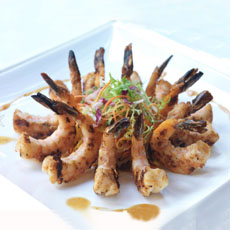
Grilled shrimp with a green salad. Photo
courtesy Haru Restaurant | New York City.


Shrimp salad loaded with mayonnaise: not good for you. Grilled shrimp with a vinaigrette-dressed salad or the grilled shrimp salad recipe below: A better idea. Other low-calorie shrimp dishes include ceviche; the classic shrimp cocktail or its update, the shrimp Martini (recipe below); or a lightly-dressed shrimp Caesar salad. Think Eat This, Not That.

Americans eat four pounds of shrimp a year—and it might be much higher if the tasty little swimmers were more affordable!

Shrimp may be small in size, but they’re huge in taste and health appeal. This little crustacean ranks as the #1 selling seafood in America. High in protein, low in carbohydrates and an abundant source of heart-healthy omega-3 fatty acids, shrimp are a good-for-you food. We obtained these shrimp health notes from SeaPak, a producer of frozen shrimp products.

 
According to the George Mateljan Foundation, a non-profit organization that utilizes unbiased scientific information to promote health, shrimp is one of the healthiest and most nutrient-rich foods in the world.

HEALTH BENEFITS OF SHRIMP

Nutrition.
A four-ounce serving of shrimp provides a whopping 23.7 grams of protein, which is 47% of the recommended daily allowance (RDA); nearly 40% of the RDA of vitamin D; and nearly 30% of the RDA of vitamin B12. Shrimp is also very high in tryptophan, an essential amino acid, and selenium, which induces the repair process in damaged cells and inhibits the proliferation of cancer cells.

Omega-3s. Studies show that shrimp and other seafoods that are rich in omega-3 fatty acids can improve cardio-vascular health and lower the incidence of heart disease and stroke. The American Heart Association recommends that people include these protective oils in their diets by eating at least two servings of seafood per week.

Cholesterol-Friendly.
Shrimp doesn’t deserve its old bad rap for high cholesterol. A study at Rockefeller University Hospital, co-sponsored by the Harvard School of Public Health, confirmed in 1996 that the cholesterol content of shrimp should not be a concern. The research results revealed that a shrimp diet raises levels of HDL, or “good” cholesterol, and decreases levels of LDL, or “bad” cholesterol (lowering LDL in the bloodstream significantly reduces susceptibility to heart disease).


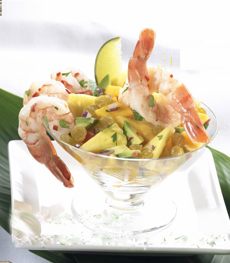
SHRIMP MARTINI RECIPE

Ingredients For 4 Servings

This recipe is served in oversized Martini glasses (about 10 ounces), but you can substitute another dish or goblet.

  • 16 jumbo shrimp, peeled and deveined
  •  
    For The Salsa

  • 1 ripe mango (small), diced
  • 1 ripe papaya (small), diced
  • 2 roma tomatoes (small), diced
  • ½ red onion (small), diced
  • 1 red bell pepper (small), diced
  • 1 green bell pepper (small), diced
  • 1 bunch cilantro chopped (2 tablespoons)
  • 1 lime, juiced
  • 1 teaspoon honey
  • 1½ -tablespoons vegetable oil
  • Salt and pepper to taste
  •  
    Garnishes

  • 4 pitted green olives
  • 4 slices lime
  •  
    A shrimp cocktail has a cocktail sauce garnish. But fill the same glass with anything else, and you’ve got a Shrimp Martini. This photo shows diced avocado substituting for the diced bell peppers in the recipe. Photo courtesy California Raisins.
     
    Preparation

    1. POACH shrimp in 2 quarts salted water until cooked through (3 minutes). Remove and chill in ice water.

    2. MIX all salsa ingredients; season with salt and pepper.

    3. DIVIDE salsa evenly among the glasses. Arrange 4 shrimp per glass. Garnish each with olive and lime slice. Place 1 glass on each plate and serve with a ramekin of cocktail sauce.
     
    Source: Ocean Garden Products, Inc. and Chef Lou Imbesi, Catelli Ristorante, Voorhees, NJ, via EatShrimp.com.

    GRILLED SHRIMP SALAD RECIPE

    Ingredients For 2 Servings

  • 6 jumbo shrimp
  • ½ red bell pepper
  • ½ green bell pepper
  • ½ yellow bell pepper
  • 2 slices red onion
  • ¼ cup olive oil
  • ½ lemon
  • ½ cup chickpeas
  • 10 fresh parsley leaves
  • Chili flakes
  •  
    Preparation

    1. CUT the peppers in thin slices, grill shrimp 4 to 5 minutes.

    2. MIX with remaining ingredients in a stainless bowl. Season with salt.

    3. DIVIDE into two portions; garnish with onion slice and serve.

    Source: Ocean Garden Products and Chef Marino Tavares, Ferreira Café Restaurant, Montreal, Quebec, via EatShrimp.com.


    Comments off

    RECIPE: Linguine Alla Vongole, With Clam Sauce & Asparagus


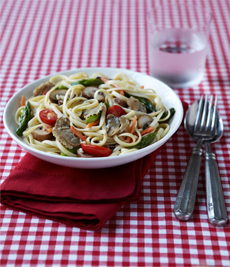
    [1] Linguine and clam sauce with asparagus. The recipe is below (photo © Dole).


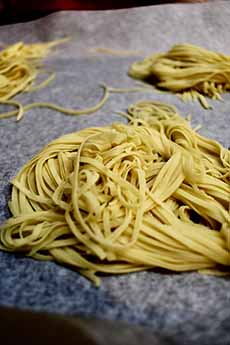
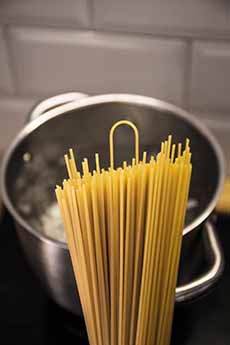
    [2] Fresh linguine pasta, the “flat” version of spaghetti (photo © Mindaugas Petrutis | Unsplash).


    [3] Dry fettuccine (photo © Isaac Quesada | Unsplash).

    Linguine With Pesto & Pine Nuts
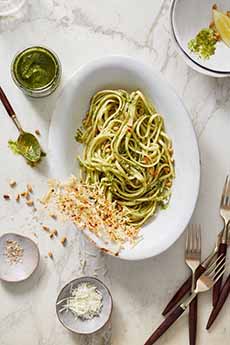
    [4] Linguine with pesto is a classic dish from Liguria, where both originated (photo © DeLallo).


    Before asparagus season ends, get your fill by adding it to your favorite dishes.

    Here’s an example of how easy it is, courtesy of Dole, which adds its fresh asparagus to the classic pasta dish, linguine with clam sauce.

    Consider using whole wheat linguine for fiber and flavor. If asparagus season has passed, add green beans or snow peas.

    This recipe makes 4 servings; prep time 10 minutes; cook time 25 minutes.

    Speaking of linguine (lin-GWEE-nay)…Americans often misspell it linguini.

    Show you’re a food connoisseur and use the original Italian!

    Originating in the Liguria, the costal region of northern Italy (capital Genoa), linguine is a narrow, flat version of round spaghetti (it is sometimes referred to as flat spaghetti).

    It’s a narrower version of another popular flat ribbon pasta, fettuccine.

    September 15th is National Linguine Day.

    > The history of linguine is below.

    > The history of pasta.

    > Check out the different types of pasta in our Pasta Glossary.
     
     
    RECIPE: LINGUINE & CLAM SAUCE (“ALLA VONGOLE”) WITH ASPARAGUS

    If asparagus is out of season, use broccoli florets.

    Ingredients

  • 8 ounces linguine
  • 1 tablespoon olive oil
  • 1 package (8 ounces) sliced mushrooms
  • 2 teaspoons minced garlic
  • ½ teaspoon salt
  • ½ teaspoon freshly ground black pepper
  • 1 pound asparagus, trimmed of woody ends and chopped into 2” pieces
  • 1 cup shredded carrots
  • 1 cup grape tomatoes, halved
  • 1 can (10 ounces) whole baby clams, drained (juice reserved)
  •  
    Preparation

    1. BRING a large pot of water to a boil. Cook linguine according to manufacturer’s instructions. Meanwhile…

    2. HEAT the oil in a large nonstick skillet over medium-high heat. Add the mushrooms, garlic, salt and pepper. Cook for 5 minutes until mushrooms begin to brown.

    3. ADD the asparagus, carrots and two tablespoons of water. Toss to combine and cover skillet. Cook 4 minutes longer.

    4. ADD the tomatoes and the clam juice. Cook uncovered 1 minute longer. If the pasta is not yet cooked, remove vegetables and clams from heat and cook pasta until it is al dente.

    5. DRAIN pasta and add to the vegetable mixture along with the reserved clams. Raise heat to high and cook 2-3 minutes longer until pasta is thoroughly coated and most of the liquid is absorbed.

    6. PLATE and serve.
     
     
    LINGUINE vs. SPAGHETTI vs. FETTUCCINE

    Do you know the difference between popular pasta cuts and shapes?

    Linguine is a flat ribbon, a narrower version of fettuccine (or, fettuccine is wider linguine.

    Spaghetti is a round ribbon pasta, thin like linguine. Bucatini is a thick round ribbon with a hole in the center (like a sipping straw).

    There are hundreds of pasta shapes in Italy—estimates range from 350 to as many as 600. Some are very similar, but with different names because they originated in different regions, in the days before mass communications could get the word out.


    THE HISTORY OF LINGUINE

    Linguini, a flat ribbon pasta that is wider than spaghetti but narrower than fettuccine, appears to have originated in 1700s in the region of Liguria, in northwestern Italy.

    Giulio Giacchero, author of a book on the economy of Genoa at that time, writes about trenette (another name for linguini) served with pesto, green beans and potatoes*. He notes that trenette al pesto was a typical festive dish of Ligurian families of the time [source].

    It was served for special occasions, and as a Sunday dish, until the mid-20th century, when it became part of the everyday repertoire [source].

    Both linguine and trenette are narrow, flat, and long, trenette just a smidge wider and elliptical in cross section rather than flat. Often, the terms are used interchangeably. Why does one region have two almost identical pastas with different names?

  • Linguine means “little tongues” in Italian, possibly referring to its flatness.
  • Trenette may derive from the Genoese dialect trenna, or strings.
  •  
    And in modern times, when pasta can be made by machine to within a millimeter, a thinner version of linguine is made called linguettine.

    As a coastal region, Ligurians had plenty of seafood to mix with their pasta. Hence, the popularity of linguine alla vongole (VAWN-go-lay), linguine in clam sauce and linguine misto mare, linguine with mixed seafood (mussels, scallops, shrimp, squid tentacles).

    Since basil pesto (pesto alla Genovese) also originated in Liguria (a major basil-growing region), pasta with pesto sauce was, and is, also very popular.

    By the last century, linguine had spread throughout Italy. And yes, red sauce lovers: Linguine is also popularly served with arrabbiata and marinara sauces.
     
     
    ________________

    *Pasta with potatoes? Strange? No. Remember that the days before refrigeration, meals had to be made from foods that were in season, or could be stored into the next season.


    CHECK OUT WHAT’S HAPPENING ON OUR HOME PAGE, THENIBBLE.COM.


    Comments off


    © Copyright 2005-2026 Lifestyle Direct, Inc. All rights reserved. All images are copyrighted to their respective owners.