THE NIBBLE BLOG: Products, Recipes & Trends In Specialty Foods


Also visit our main website, TheNibble.com.

TIP OF THE DAY: Smoked Salmon Rillettes & Champagne

Rillettes are a classic rustic French preparation of similar to pâté (or the cretons of Quebec), popularized in central France (think Anjou, Le Mans and Tours). Originally made with pork, the meat was cubed or chopped, salted and cooked slowly in the still-warm cooking fat until it is tender enough to be easily shredded.

The shredded meat—originally pork belly or pork shoulder—is mixed with enough of the fat to form a paste or pâté in French, which refers to any cooked ground meat and fat minced into a spreadable paste. The paste was placed in a crock.

The word first appears in writing in 1845. It derives from the Old French rille, meaning a slice of pork (rille dates all the way back to 1480).

Rillettes are typically served at room temperature with bread or toast points—and wine, of course. Long before the current, trendy bacon jam, there were rillettes.

Over time, the technique was applied to other meat and poultry: chicken, duck, game birds, fish (anchovies, salmon, tuna), goose and rabbit. Fish is not actually cooked in the fat, but it is blended with fat to create the paste.

In this recipe from Chef Aida Mollenkamp, was developed for Moët & Chandon to serve with Champagne. You can serve it with any sparkling wine.


smoked-salmon-rillettes-aidamollenkamp-230r

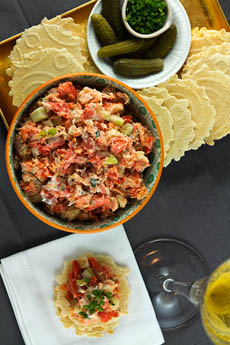
Smoked salmon rillettes. Photo courtesy Chef Aida Mollenkamp.


The recipe—Smoked Salmon, Crème Fraîche, and Fennel Rillettes—requires just 15 minutes or prep time, plus 2 hours of chilling time.

Chef Mollenkamp gave the classic recipe a modern, quicker, and slightly healthier twist, including a double dose of anise flavor from the fennel and the tarragon. The spread has a smoky, sweet anise flavor and is as delicious on a cracker as it on toast for a luxurious sandwich.

Let your imagination wander: We’ve enjoyed the leftovers on toast with scrambled or poached eggs!


brut-imperial-magnum_bienmanger-230
Great with smoked salmon rillettes: a magnum of Moët et Chandon Brut Impérial Champagne. Photo courtesy BienManger.com.
  RECIPE: SMOKED SALMON RILLETTES

Ingredients For 2 Cups (15 to 20 Hors d’Oeuvre Servings)

  • 2 tablespoons unsalted butter
  • 1/2 cup minced shallots
  • Salt and freshly ground black pepper
  • 2/3 cup small dice fennel
  • 2 tablespoons lemon juice
  • 2 tablespoons finely chopped fresh tarragon leaves or chives, plus more for serving
  • Optional: 1 tablespoon Pernod or other anise-flavored liqueur (see below)
  • 1/2 teaspoon loosely packed lemon zest
  • 1/3 cup crème fraîche*
  • 1 pound hot-smoked and/or cold-smoked salmon
  • Crackers or toasts, for serving
  • Optional: cornichons, pickled onions
  •  
    *If you can’t find crème fraîche, you can make it with this recipe, or substitute sour cream or plain Greek yogurt.
     
    Preparation

    1. MELT the butter in a medium frying pan over medium heat. When the foaming subsides, add the shallots and season with a pinch of salt and a few cranks of freshly ground black pepper. Cook until the shallots are translucent and soft. Set aside to cool slightly.
    2. COMBINE the shallots with the fennel, lemon juice, herbs, Pernod, lemon zest and crème fraîche. Season with a pinch of salt and some freshly ground black pepper.

    3. BREAK the salmon into bite-sized pieces and fold into the mixture until just combined. Taste and adjust the seasoning as desired. Transfer the rillettes to an airtight container, cover and refrigerate until chilled through, at least 2 hours.

    4. LET the rillettes sit at room temperature for a few minutes before serving so they’re spreadable. Sprinkle with herbs and serve with crackers or toast, along with the cornichons and/or pickled onions. For the best flavor, consume the rillettes within four days of preparation.
     
    SUBSTITUTES FOR PERNOD

    If you don’t have Pernod, you don’t need to spring for a bottle for the tablespoon required here. Instead, you can substitute absinthe, aguardiente, arak (a Middle Eastern liquor like ouzo), ouzo, pastis, raki (a Turkish liquor like ouzo) or Ricard.

    Sambucca, which is anise-flavored, is typically sweetened and thus not right for this recipe.
      

    Comments off

    RECIPE: Eggnog Crumble Bars

    If it’s a lazy day and you’ve got eggnog, bake these creamy Eggnog Crumble Bars for New Year’s Eve. “Crumble” refers to the streusel topping on the bars.

    The recipe is from Annie’s Eats for Go Bold With Butter. Check out both websites for more delicious recipes.

    Prep time: is 15 minutes, cook time is 35 minutes. While the bars are baking, check out the history of eggnog.

    “Grate whole nutmeg for these rather than using the pre-grated stuff,” Annie advises. “It definitely enhances the flavor.”

    RECIPE: EGGNOG CRUMBLE BARS

    Ingredients For 16 Bars
     
    For The Dough

  • 2 cups all-purpose flour
  • 2/3 cup sugar
  • 3/4 teaspoon baking powder
  • 1/2 teaspoon salt
  • 1/2 teaspoon grated nutmeg
  • 1/8 teaspoon cinnamon
  • 12 tablespoons cold unsalted butter, cut into small pieces
  • 6 tablespoons eggnog
  •    
    eggnog-crumble-bars-goboldwithbutter-230
    Another way to use eggnog in baking! Photo courtesy Go Bold With Butter.
     

    For The Filling

  • 8 ounces cream cheese, at room temperature
  • 1/4 cup granulated sugar
  • 1 large egg
  • 1/2 cup eggnog
  • 1 teaspoon vanilla extract
  •  

    organic-valley-eggnog-carton-230
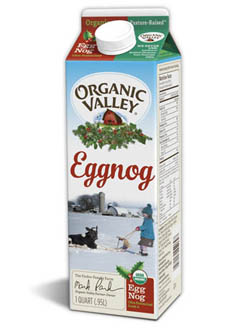
    For breakfast, make Eggnog French Toast. Substitute eggnog for the milk, but do add the egg! Photo courtesy Organic Valley.

      Preparation

    1. PREHEAT the oven to 350°F. Line 8 x 8-inch baking pan with foil or parchment paper.

    2. MAKE the dough: Combine the flour, sugar, baking powder, salt, nutmeg and cinnamon in medium bowl; stir to blend. Add the butter, cutting it into the dry ingredients with a pastry cutter or two knives, until mixture resembles coarse meal. Add the eggnog and stir with a fork or knead very briefly, just until crumbly dough comes together.

    3. TRANSFER two-thirds of the dough mixture to the prepared baking pan and press down into the bottom of the pan to form an even layer.

    4. MAKE the filling: Combine the cream cheese and sugar in bowl of electric mixer. Beat on medium-high speed until smooth, light and fluffy. Blend in the egg, then the eggnog and vanilla, until smooth. Pour the mixture over the layer of dough in the baking pan. Crumble the reserved dough over top of eggnog mixture.

    5. BAKE—rotating the pan halfway through baking—until just set, about 25 minutes. Let cool to room temperature on wire rack. Chill well before slicing and serving.


    MORE RECIPES WITH EGGNOG

  • Eggnog Mini Bundts Recipe
  • Eggnog Mini Cheesecakes Recipe
  • Eggnog Panna Cotta Recipe Recipe
  • Eggnog Truffles Recipe
  • Eggnog Wreath Cookies Recipe
  • White Chocolate Eggnog Fudge Recipe
  •   

    Comments off

    RECIPE: Snack On Sriracha Kettle Corn

    Americans consume approximately 17.3 billion quarts of popcorn each year. Sweet-and-salty kettle corn is the category’s fastest-growing flavor. Hot and spicy foods in general have been trending for some time.

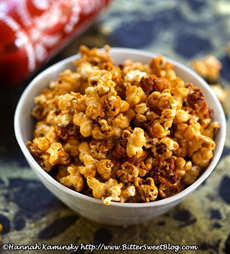
    So Hannah Kaminsky of Bittersweet Blog combined the two into a recipe for Sriracha Kettle Corn: sweet and salty plus a warm burn with each bite.

    This whole grain snack couldn’t be easier or faster to whip up, whether for better snacking while you’re hanging at home this week, or when guests drop by. Adjust the sriracha to taste, depending on how hot you like it.

    > The history of Sriracha sauce.

    > The history of popcorn.

    > The different types of chiles.

    > The Scoville Scale, which ranks the heat levels of different chiles.
     
     
    RECIPE: SRIRACHA KETTLE CORN

    Ingredients For 8-10 Cups Popcorn

  • 3 tablespoons coconut oil
  • 1/2 cup popcorn kernels
  • 1/3 cup granulated sugar
  • 3-5 teaspoons sriracha
  • 1/2-1 taspoon flaky sea salt (like Maldon)
  •  
    Preparation

    1. HEAT the coconut oil in a large stockpot over medium heat, along with two or three kernels. Keep covered, and when the test kernels pop, add the rest, along with the sugar and sriracha. Stir well to coat before quickly covering with the lid once more.

    2. SHAKE the pot constantly and vigorously to prevent the corn from burning. This is critical, both for even cooking and for fewer unpopped kernels. Once the popping has slowed to one every two to three seconds…

    3. REMOVE the pot from the heat and uncover, continuing to shake for a few minutes until the popping has stopped. Pour the popcorn onto a sheet pan and sprinkle evenly with salt, to taste. Let cool and break up the large clumps, picking through to remove any unpopped popcorn kernels that might remain.

       
    sriracha-kettle-corn-kaminsky-230
    [1] Sriracha kettle corn adds heat to the traditional sweet and salty seasonings (photo © Hannah Kaminsky | Bittersweet Blog).

    Rooster Brand Sriracha Sauce
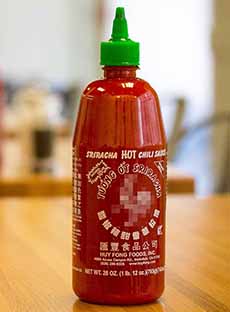
    [2] Rooster brand Sriracha sauce from Huy Fong, the first Sriracha in the U.S. (photo © Steven DePolo | Wikipedia).


    WHAT IS KETTLE CORN?

    Kettle corn is sweet-and-salty popcorn. A Colonial invention, the corn was popped in iron kettles and then sweetened with sugar, honey, and sometimes molasses before adding the salt. It is less sweet than caramel corn and appeals to those who like a sweet-and-salty flavor profile.

    Check out the history of popcorn.
     
     
    WHAT IS SRIRACHA?

    Sriracha, pronounced see-RAH-jah, is a Thai hot chili sauce. It is made from red chiles, distilled vinegar, garlic, sugar, and salt; and is aged for three months or longer.

    Unlike American hot sauces such as Tabasco, which are vinegar sauces that are infused with hot chiles, sriracha is primarily puréed chiles, making it a much thicker sauce.

    The sauce is named after the coastal city of Si Racha in eastern Thailand, where it was first made and marketed. Different brands can be found in the Asian aisle of many supermarkets and in Asian groceries.

    According to multiple sources, including an article in Bon Appétit, the sauce was made more than 80 years ago in by a local woman, Thanom Chakkapak. She initially made the condiment for her family, and then for friends, to enjoy with the local seafood (think of it as a much hotter counterpart to American cocktail sauce).

    As is a common story in the specialty food business, they encouraged her to sell it commercially—and it became the best-selling chile sauce in Thailand. In 1984, Ms. Chakkapak sold her business to a major food company, Thai Theparos Food Products.

    What’s the correct spelling: sriraja, si-racha, sriracha or siracha?

    According to Andrea Nguyen, who wrote the article for Bon Appétit: Since Thailand does not adhere to one romanization system for Thai words, many variants have emerged, chosen by manufacturers who have created their own version of the original sauce.

    However, the most commonly accepted spelling is sriracha.


    CHECK OUT WHAT’S HAPPENING ON OUR HOME PAGE, THENIBBLE.COM.


    Comments off


    © Copyright 2005-2026 Lifestyle Direct, Inc. All rights reserved. All images are copyrighted to their respective owners.