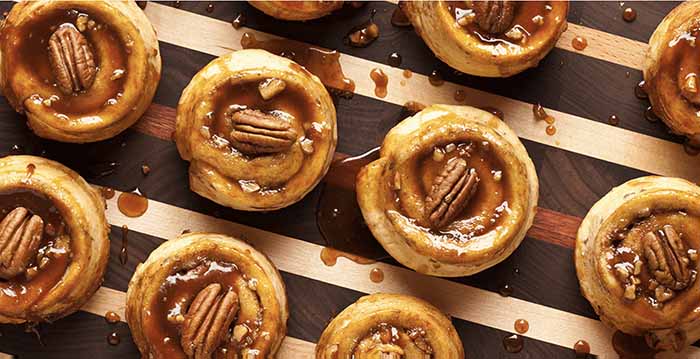
Recipe For Brown Butter Cinnamon Rolls, A Favorite Weekend Treat
|
On Mother’s Day we called our aunt to send our best wishes, and ended up chatting about our family’s favorite topic: food. We ended up reminiscing about the Pecan Logs from Fanny Farmer and the Pecan Honey Buns from Horn & Hardart, both chains long gone. After the call ended, we couldn’t wait to make these delicious, 90-minute Brown Butter Cinnamon Rolls from one of our favorite bakers, Audra, The Baker Chick. If you’d like to bake something this weekend, we recommend these yummy breakfast and tea-time pastries. They’re at best warm from the oven (or warmed up in the microwave), but “best” is relative: They’re always delicious! Any extras can be frozen. October 4th is National Cinnamon Roll Day, and February 21st is National Sticky Bun Day. > The year’s 15+ pastry holidays. Below: > The year’s 5 cinnamon holidays are below. > The history of cinnamon rolls. > Different types of cinnamon rolls around the world. The recipe follows, but first, some definitions: Ingredients For 12 Rolls 1. HEAT the milk in a small saucepan until it bubbles, then remove from the heat. Whisk in the butter and stir until melted. Let the mixture cool until lukewarm. 2. COMBINE in a large mixing bowl 2¼ cups of the flour, the yeast, sugar and salt; whisk together. Add the water, the egg and the milk mixture; beat well with an electric mixer. Add the remaining flour, ½ cup at a time, using a wooden spoon to stir well after each addition (the dough will be too thick and sticky at this point to use the a mixer.) When the dough has just pulled together… |
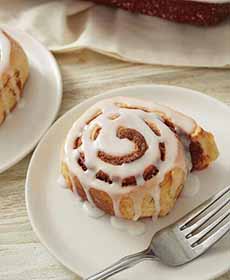
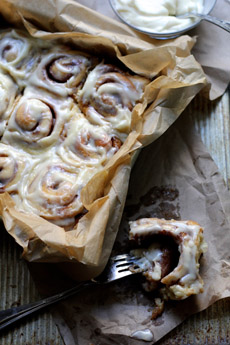 [1] The Baker Chick’s Brown Butter Cinnamon Buns. The recipe is at the left (photo © The Baker Chick).
|
|
|
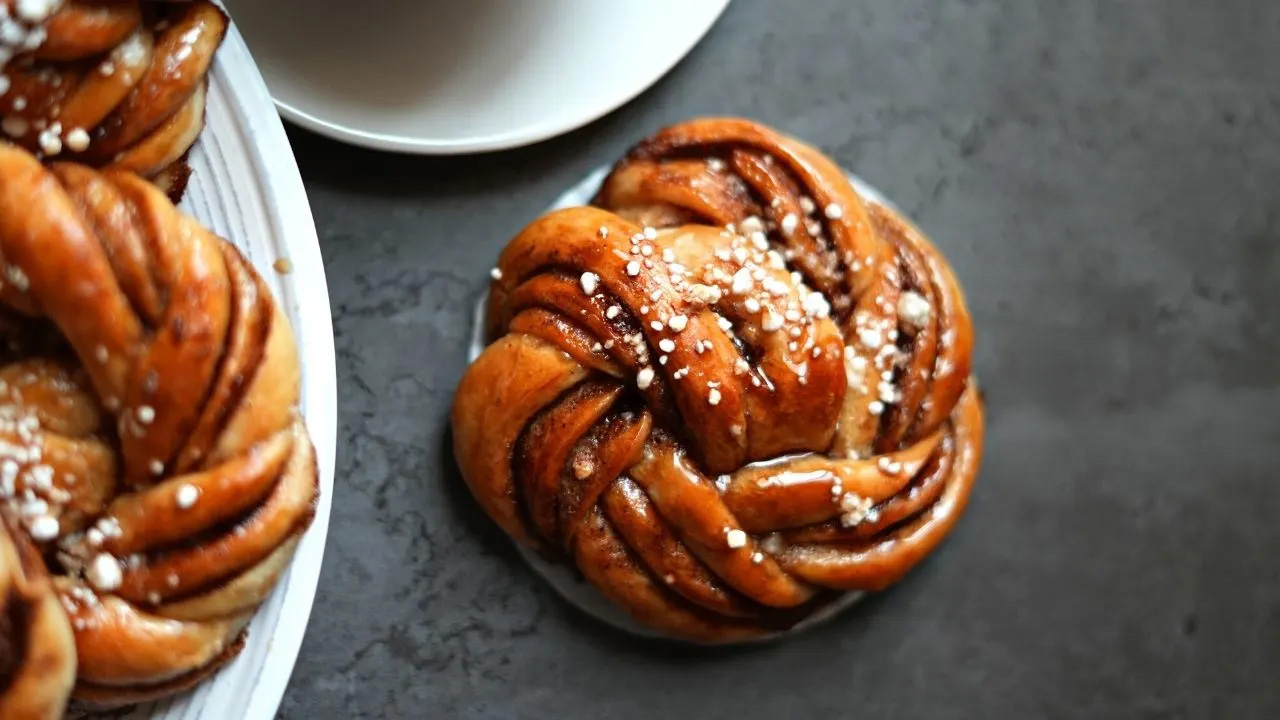
3. TURN it out onto a lightly floured surface and knead until smooth, about 5 minutes. Alternatively, use the dough hook in a stand mixer. When ready, the dough will spring back when lightly pressed. Cover the dough with a damp cloth and let it rest on the counter for 10 minutes. Meanwhile… 4. BROWN the butter by placing it in a small microwave-safe container. Cover it with a microwavable saucer or other tight lid (including microwavable plastic wrap with a vent cut in) and microwave for 3-5 minutes. The butter will melt, pop and then turn brown. If you don’t have a microwave, you can do this on the stove top. While the butter cools slightly, mix together the filling—butter, brown sugar and cinnamon—in a small bowl. 5. ROLL out the dough into a 9×12 inch rectangle on a lightly floured surface (use a 9×13 baking dish as a guide.) Using a pastry brush, slather the dough with the brown butter. Sprinkle the dough with the cinnamon-sugar mixture and the optional raisins/nuts, and press in lightly so they does’t fall out when you roll the pastry. The brown sugar mix should cover the dough all the way to the edges. 6. ROLL up the dough and pinch the seam to seal. Using a serrated knife, cut into 12 equal size rolls and place in a 9×13 baking dish. Cover and let the rolls rise in a warm place* until doubled, about 30 minutes. 7. PREHEAT the oven to 375°F. Bake for 17-20 minutes, or until golden. While the rolls bake… 8. MAKE the frosting: Whip together the softened butter and cream cheese with an electric mixer until smooth and creamy. Add the vanilla and the powdered sugar, ½ cup at a time. Beat until creamy and spreadable. Let the rolls cool for 10 minutes and then spread the rolls with frosting. Serve warm. There are many foods that have cinnamon as a key ingredient, from chai to gingersnaps to rice pudding. Here, we confine ourselves to those with “cinnamon” in their name. Originating in Sri Lanka, cinnamon has been prized since ancient times, used throughout Asia, ancient Egypt, and ancient Rome. However, it was extremely expensive and rare in Europe until trade routes expanded. By the 18th century, when Sweden was a major European power with global trade connections, kanelbullar, Sweden’s version of cinnamon buns, were first created (photo #5, above)—often flavored with cardamom, another favorite spice in Swedish baking. The dough was twisted to expose the filling. And it was Sweden that created Cinnamon Bun Day (Kanelbullens dag) on October 4th. Germans created their own version of cinnamon-flavored rolled pastries called schnecken (meaning “snails” for their spiral shape). It spread to other parts of Europe and eventually came to the U.S. with German immigration in the late 19th and early 20th centuries. The cinnamon roll evolved significantly on American shores. In the 1950s, when they hit mass market production and could be found neatly boxed in supermarkets, the American cinnamon roll was heavily frosted, fluffier, and sweeter than European versions. Not surprisingly, Americans loved this sweeter version, and the rolls became so popular that they led to cinnamon roll bakeries, like T.J. Cinnamons in Kansas City, Missouri†. This led to the launch (in December 1985) of the Cinnabon chain, which turned the cinnamon roll into supersized, cream-cheese-frosted indulgence tempting visitors to food courts, malls, and airports. Regional differences abound. *Proofing is the final rise of shaped dough before baking—a specific rest period during the fermentation process. Cold air will retard the rise, so if it’s cold in your kitchen, preheat the oven to 200°F and proof the dough in the oven. †After serveral acquisitions, the T.J. Cinnamons brand is now owned by GoTo Foods (formerly Focus Brands) that also currently owns Auntie Anne’s, Carvel, Cinnabon, Jamba, McAlister’s Deli, Moe’s Southwest Grill, and Schlotzsky’s brands.
CHECK OUT WHAT’S HAPPENING ON OUR HOME PAGE, THENIBBLE.COM.
|
||