Tillen Farms Natural Maraschino Cherries (Or Make Your Own)
|
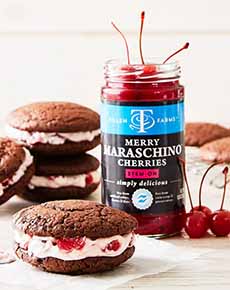
The maraschino cherry is no longer a bad-tasting joke. Tillen Farms has created a delicious, all natural maraschino cherry—no artificial colors or flavors, no sulfites or preservatives, no high fructose corn syrup but real cane sugar.
And to think: America has been feeding these “standard” maraschino cherries to kids, who gobble up all that bad stuff! The FDA’s Standard of Identity defines maraschino cherries as “cherries which have been dyed red, impregnated with sugar and packed in a sugar sirup‡ flavored with oil of bitter almonds or a similar flavor.” Sounds harmless enough, until you examine the details. Now you can bring peace of mind to parents and happiness of palate to hot fudge sundaes and Shirley Temples, not to mention adult fare like a Tom Collins or a Manhattan. Tillen Farms all-natural Merry Maraschino Cherries are the way to go with maraschino, made only with cherries, water, sugar, vegetable and fruit concentrate (for color) and natural flavor. The product is free of artificial ingredients and preservatives, non-GMO, and gluten free. It is certified kosher by Star-K. We like to give bottles as party favors and stocking stuffers. If you can’t find them locally, they’re readily available online. Below: > The history of maraschino cherries. > How to make brandy-infused maraschino cherries. Elsewhere on The Nibble: > The two species of cherries: sweet cherries and sour (tart) cherries. > The year’s 15+ cherry holidays. > Recipe for Black Forest Cake (chocolate and maraschino cherries). |
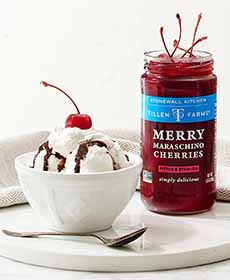 [1] Life can be a bowl of maraschino cherries (photos © Stonewall Kitchen).
|
|
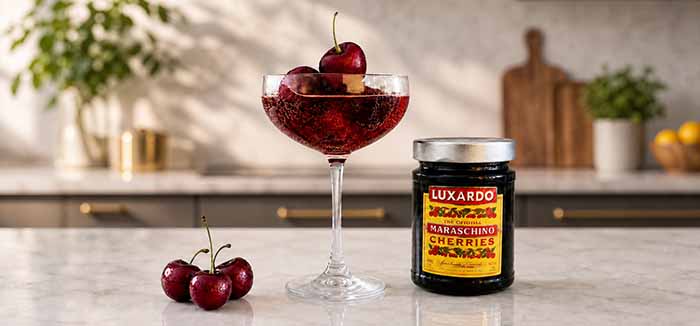 [3] If you love to eat maraschino cherries, make the brandy-infused recipe below and eat them from a glass of Prosecco. It’s our personal version of a “maraschino cocktail” (photo: The Nibble). THE HISTORY OF MARASCHINO CHERRIES The Marasca cherry (Prunus cerasus var. marasca) is a type of sour Morello cherry that grows largely in Bosnia, Croatia, Herzegovina, northern Italy and Slovenia. With a bitter taste and a drier pulp than other cherry varieties, they are ideal to make cherry (maraschino) liqueur. The ubiquitous maraschino cherries were once quite elite, originally preserved in the liqueur as a delicacy for royalty and the wealthy. In the 19th century, the preserved cherries became popular in the rest of Europe, but the Balkans supply was too small for the whole. Hence they became a pricey delicacy, largely confined to royalty and the wealthy. Because of the relative scarcity of the Marasca tree, other cherries came to be preserved in various ways and sold as “maraschino,” leading to the red-dyed version we have come to know, with no liqueur but plenty of corn syrup. You can purchase maraschino cherries from brands like Amarena or Luxardo, but we prefer the flavor of homemade. This recipe creates a cherry that is sophisticated, firm, and deeply aromatic. If cherries are in season, use fresh Bing or Rainier cherries. Pit them, but leave the stems on if you want a “cocktail cherry” look. High-quality frozen dark sweet cherries work surprisingly well. Use the infused cherries to garnish both sweet and savory foods: over desserts, as a garnish for grilled or roasted meat and poultry, even dropped into a Manhattan or other cocktail, or threaded on a cocktail pick. Recipe tips: For The Syrup 1. MAKE the infusion liquid (syrup). In a small saucepan over medium heat, combine the syrup ingredients. Bring to a simmer just until the sugar is dissolved (you don’t want to boil off the alcohol). Remove from the heat and let cool for 5 minutes. 2. STIR IN the cherry liqueur and vanilla extract. 3. PLACE the cherries in a clean glass jar. If you plan to keep them for more than 2-3 months, sterilize a Mason jar. See the *footnote. 4. POUR the warm liquid over the cherries until they are completely submerged. Seal the jar and let it sit on the counter until it reaches room temperature, then move them to the refrigerator. While you can eat them in 24 hours, they are best after 2 weeks. They will keep in the fridge for several months. TIP: If you aren’t using Maraschino liqueur, add a drop of Almond Extract. True maraschino cherries get their flavor from the crushed pits, which taste like almonds. Both the high sugar content and the alcohol inhibit bacterial growth. The biggest risk isn’t the jar, it’s cross-contamination. Never “double-dip”; always use a clean spoon or cocktail pick to get a cherry out of the jar. Never use your fingers: natural oils and bacteria from skin can cause the syrup to cloud or spoil faster. †How to adjust the sugar: Since each variety of cherry spirit has a different level of sweetness, adjust the added sugar depending on which spirit you use. A quick rule of thumb: with Cherry Heering use 3/4 cup sugar, with maraschino liqueur use 1 cup sugar, and with Kirsch use 1-1/4 cups sugar. Here’s why: > Cherry Heering, sweet and jammy, provides the deepest red color and a thick, syrupy result. You might want to reduce the sugar in your syrup by 1 or 2 tablespoons, otherwise the final cherries might be cloying. > Maraschino liqueur like Luxardo (photo #3), clear and nutty, will deliver a more “botanical” and complex cherry flavor with high herbal notes and a strong almond finish from the pits. The syrup will be lighter in color than the naturally red maraschino liqueur. If you want that deep red “maraschino” color, you can add a few drops of beet juice or use the juice from the cherries if you’re using frozen ones. > Kirsch is strong, dry, and high proof, resulting in a much punchier, boozy cherry flavor. Since Kirsch has zero sugar, you should increase the sugar in the syrup by about 2 tablespoons to ensure the cherries still feel like a dessert garnish and not just fruit soaked in alcohol. ‡Sirip vs. Syrup: While “sirup” is the historical spelling, and can even be found in some older official government and university agriculture manuals still in use. However, modern dictionaries list it as an obsolete. CHECK OUT WHAT’S HAPPENING ON OUR HOME PAGE, THENIBBLE.COM.
|
||