Gooey Butter Cake Recipe For National Gooey Butter Cake Day
|
|
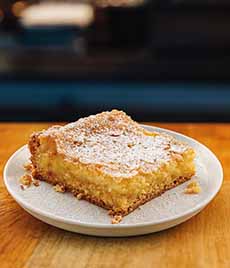
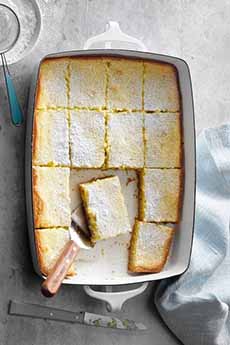
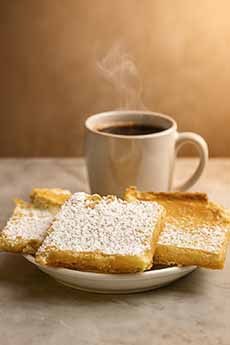
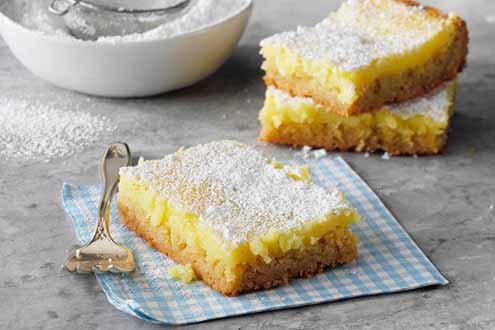
We had never heard of Gooey Butter Cake until we came across its holiday, August 12th, National Gooey Butter Cake Day! It turns out that it’s a signature dish of St. Louis, Missouri, a local go-to treat. But wherever you call home, this rich, delicious, and super-easy dessert hits the spot. The bottom layer of yellow cake of topped with a gooey top layer made from butter, cream cheese, eggs, and vanilla, garnished with confectioners’ sugar. Gooey Butter “Cake” isn’t actually a cake. It’s a bar cookie, like lemon bars. Bars are one of the 10 different types of cookies. The recipe follows, courtesy of Taste Of Home. But if you don’t want to bake, you can order some directly from St. Louis (see below). > The history of Gooey Butter Cake is below. > Buy Gooey Butter Cake online, below. > The history of confectioners’ sugar is below. > Why is confectioners’ sugar used as a [messy] garnish? > The different types of cake: a photo glossary. > The year’s 55 cake holidays. Prep time is 20 minutes and bake time is 40 minutes, plus 1 hour cool time. This cake is particularly sweet, in keeping with many American palates. We cut the sugar by 1/3 in both the cake and the topping. The recipe was provided by Cheri Foster of Vail, Arizona and tested by Lisa A. Kaminski and Val Goodrich of the Taste Of Home Test Kitchen. 1. PREHEAT the oven to 325°F. In a large bowl, combine the flour, sugar, baking powder, and salt. In another bowl… 2. WHISK together the melted butter, egg, and vanilla. Add to the flour mixture and stir to combine. Press onto bottom of a greased 13 x 9-inch baking dish. 3. MAKE the topping. In a large bowl, beat the cream cheese and eggs until smooth. Add the confectioners’ sugar and stir to combine. Pour over the crust. 4. BAKE until the center is almost set and edges start to brown, 40-45 minutes. Cool for 1 hour on a wire rack. Sprinkle with additional confectioners’ sugar if desired. Gooey butter cake was invented by accident in the 1930s by a German-American baker in St. Louis, Missouri. There are different origin stories, but the most common told story attributes it to a baker at Park Avenue Coffee Shop who mistakenly reversed the proportions of butter and flour while making regular cake batter. Instead of throwing out the mistake, he baked it anyway and discovered the deliciously rich, gooey texture What is known for sure is that gooey butter cake emerged from the German-American baking community in St. Louis during the Great Depression. It has remained a beloved local and regional dessert ever since. In fact, it’s considered the signature dessert of St. Louis. The original Park Avenue Coffee Shop in St. Louis that opened in the 1930s is no longer in operation. However, there is a locally owned St. Louis business called Park Avenue Coffee that opened in Historical Lafayette Square in 2006, and now has several locations. It not only makes the original Gooey Butter Cake; it makes a number of different flavors that you can buy online. |
|
|
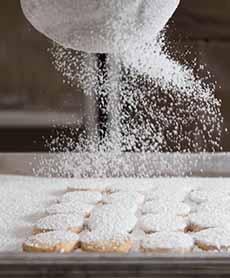
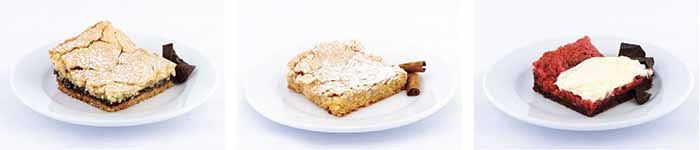
Flavors rotate, but be on the lookout for, among others: Gooey Butter Cake is one of many baked dessert and sweet bread recipes that has confectioners’ sugar sprinkled on top. It may look elegant at first, but it always makes a mess, flaking off on one’s clothing and adhering to fingers and everything else it touches. It just doesn’t adhere well to most baked goods. So why is it used as a garnish? Confectioners’ sugar (also called powdered sugar and 10x sugar, because it is milled/sifted 10 times) has a long tradition in European baking. In addition to visual appeal as a garnish—a 19th-century discovery—confectioners’ sugar evolved from practical baking needs. Starting with granulated sugar for a moment: Sugarcane originated in Southeast Asia and India, with India discovering how to refining the cane juice into crystalline form by 4th–5th centuries C.E. The technique moved westward to the Middle East, but did not reach Europe until the 13th century. The form of granulated sugar sold in Europe from the late Middle Ages through the 19th century were molded at the refinery into a cone shape called a sugar loaf. It was easy to chip off pieces with a sugar nipper. Plus, a finer texture allowed for smoother mixing and better incorporation into batters and creams. (Remember: These were the days of hand-mixing, long before the first electric mixer appeared in 1885, a pricey appliance for commercial use*.) Powdered sugar was often sold in compressed tablets or disks which were grated. The commercial production of confectioners’ sugar became more standardized in the 19th century, when factory-made powdered sugar became available. This marked the transition from home sifting to commercial production. Modern confectioners’ sugar includes small amounts of anti-caking agents—typically cornstarch or calcium phosphate—to prevent clumping. > The different types of sugar: a photo glossary. CHECK OUT WHAT’S HAPPENING ON OUR HOME PAGE, THENIBBLE.COM. |
||