Caramel Custard Recipes For National Caramel Custard Day
|
|
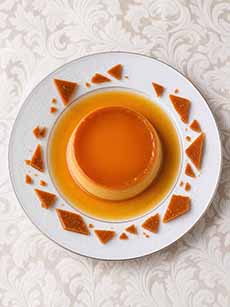
Updated June 2026 October 3rd is National Caramel Custard Day (National Chocolate Custard Day is May 5th). Also called crème caramel in France, and flan in Spain, caramel custard is a custard dessert with a layer of clear caramel sauce (photos #3 and #4). Note that in France, flan Parisien refers to a classic custard pie or tart. Buttery shortcrust pastry is filled with pastry cream and baked until the top blisters. Here’s a recipe. A layer of caramel is added to the bottom of the mold, creating a dark caramel top and sauce when the custard is unmolded. Caramel custard can be made in individual ramekins, in a cake pan, loaf pan, in a fluted flan pan or tall fluted mold, or other shape. In the U.S., caramel custard isn’t the same as creme caramel. Instead of the caramel topping, caramelized sugar is mixed into the custard prior to baking. It gets confusing. Below: > Julia Child’s crème caramel (caramel custard) recipe. > Garnishes for crème caramel. Elsewhere on The Nibble: > The different types of custard, a photo glossary. > The difference between pudding and custard. > The year’s 24 pudding and custard holidays. Custard is one of our favorite dishes: a symphony of cream, eggs and flavorings, baked to a velvety texture. Most people consider custard to be sweet—a dessert that ranges from crème caramel, crème brûlée, flan and others. But there’s more: You’ve got a delicious savory custard that can be eaten at breakfast, lunch and dinner. In brief, custard has eggs, pudding doesn’t. Similarly, panna cotta isn’t a custard; it doesn’t contain eggs. It is an American-style pudding*, thickened with gelatin. What about custard-style yogurt? It’s a marketing name for yogurt in which the fruit is already mixed in and distributed evenly throughout. A successor style to fruit-on-the-bottom yogurt, it was created as a convenience for people who didn’t like to stir up the fruit. It has nothing to do with custard—but it does give the yogurt a creamy, pudding-like consistency. (Editor’s note: We guess that “custard” yogurt sounded more elgant than “pudding” yogurt.) This recipe uses a four-cup mold to make a family-size caramel custard, which can be cut into 6 servings. If you want to use individual ramekins, bake for half the time—20 minutes at 350°F. Ingredients 1. PREHEAT the oven to 350°F. In a small saucepan, combine ½ cup sugar with ¼ cup water. Bring to a boil over low heat, stirring to dissolve the sugar. Increase the heat to high and cook, without stirring, until the syrup turns a light caramel color. 2. REMOVE the saucepan from the heat and dip the bottom into cold water to stop the cooking. Pour the caramel into a 4-cup charlotte mold, and tilt so that it covers the bottoms and sides. Let cool. 3. BRING the milk and vanilla to a boil in a small saucepan. In a heatproof bowl, beat the eggs, egg yolks and ⅔ cup sugar until blended. Whisking constantly, pour the hot milk into the egg mixture; if you don’t whisk constantly, the eggs will curdle. Let rest for a few minutes, then strain. |
|
|
4. PLACE the mold in a small but deep baking or roasting pan, and add hot water to come about two-thirds up the sides of the mold. Place the pan on the stove over medium heat, and bring the water to a simmer. The water should stay at a low simmer at all times; do not let it boil or the custard will overcook. 5. TRANSFER the pan to the oven. Bake until a knife inserted into the center of the custard comes out clean, 40 to 50 minutes. Keep the custard in the baking pan until the water cools. Remove from the pan to finish cooling. 6. SERVE: Run the tip of a knife around the top of the custard to loosen it. Invert a serving platter over the mold and quickly turn it over again. Carefully remove the mold. *In Britain, puddings began as boiled or steamed, savory foods of minced meat. The earliest puddings were sausages, such as black pudding, a type of sausage made with pig’s blood. Sweet versions evolved, which were steamed cake-like desserts. Now, pudding refers to any sweet, final course of a meal, which Americans call dessert. Berries: raspberries in particular, whose tartness cuts the richness perfectly and bright color is appealing scattered around the base. Citrus: finely grated orange or lemon zest over the top adds brightness and aroma. Or, candied citrus peel alongside. Caramel: a few shards of hard caramel or toffee or a delicate spun sugar nest on top add drama and reinforce the flavor. Cream: a dollop crème fraîche adds a bit of tang, or a quenelle of whipped cream. The latter should be unsweetened or barely sweetened. Fleur de sel: lightly sprinkle a few coarse flakes over the caramel sauce as it pools. It’s a sophisticated touch: the salt amplifies the flavor. Herbs and flowers: a single small sprig of fresh mint is classic; edible flowers are another option, but most people don’t eat them. Nuts: a few toasted slivered almonds or a small cluster of caramelized pecans or hazelnuts. CHECK OUT WHAT’S HAPPENING ON OUR HOME PAGE, THENIBBLE.COM. |
||