Chambord Cocktail Recipes & The History Of Chambord
|
Chambord, a black raspberry liqueur from the Loire Valley of France, is a super-premium black raspberry liqueur known for its unique flavor and versatility in cocktails. Make one or more of them to celebrate Bastille Day. > Also below, the history of Chambord liqueur. July 14th (“le quatorze juillet”) is Bastille Day in France, officially called the Fête Nationale (“National Celebration”). If you missed that lesson in European History class, it commemorates the storming of the Bastille prison in Paris on July 14, 1789. It was a rallying point and symbolic act of rebellion in the French Revolution, which toppled the French monarchy (then ruled by Louis XVI, married to Marie Antoinette) and established the French Republic. The Bastille was a fortress used as a prison for political prisoners who had challenged the King Louis XVI and Queen Marie Antoinette over taxation, food shortages, and other socioeconomic issues. The royals had overtaxed the people to pay for their lavish lifestyles, and turned a deaf ear to their problems. You may recall that in answer to a warning that the starving people had no bread, Marie-Antoinette is alleged to have said, “Then let them eat cake.” With cries of “Liberté, égalité, fraternité,” the citizens faced down the Gardes Françaises at the prison. The rebellion resulted in two immediate legislative changes: the medieval system of feudalism was abolished, and the Declaration of the Rights of Man and of the Citizen was passed. The festivities are the equivalent of America’s July 4th/Independence Day celebration. Several cities in the U.S. celebrate Bastille Day, too. (Is it the fraternité another reason to party?) However: Don’t wish any French person “Happy Bastille Day.” That’s an Anglo-American term only used in the U.S. and the U.K., and not universally familiar in France. Instead, say “Bonne Fête Nationale!” (bun fet nah see oh NALL). There are many ways to celebrate Bastille Day on July 14th. In our bailiwick, that means foods, wines and cocktails. In the beverages department, Champagne is the de facto choice*, although many popular cocktails were invented in France, including the French 75, the Kir and the Kir Royale, the Mimosa and the Sidecar. This year, we’re toasting with three different Chambord cocktails. Chambord is a raspberry liqueur brand, fashioned after a late-17th-century recipe from France’s Loire Valley. The black raspberry flavor is rich and alluring, with layers of red raspberry fruit and a subtle note of vanilla. You can: RECIPE #1: CHAMBORD ROYALE |
|
|
|
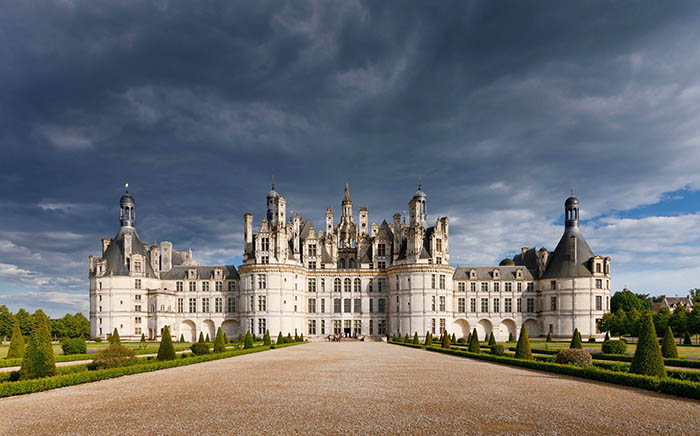
Preparation POUR the Chambord into a flute glass. Top with Champagne. Garnish with a raspberry. Ingredients Per Drink FILL a large wine glass with ice. Add the Chambord, white wine and soda. Stir lightly and serve. Ingredients Per Drink FILL a tall glass with ice. Add the Chambord, vodka and lemonade. Garnish with the lime wedge. Chambord, created in the 1980s, was inspired by the story of a luxurious raspberry liqueur produced at Château de Chambord in the Loire Valley of France. The occasion was a visit by King Louis XIV (1638-1715) in the late 17th century. The liqueur was sweetened with sugar‡ and honey and flavored with exotic spices—a luxury only the nobility could afford. Fruit liqueurs trace back to 13th-century where they were often made by monks, who earned income through brewing and distilling, among other agricultural pursuits†. Liqueurs were commonly made by macerating soft fruits such as cherries, gooseberries, strawberries, and raspberries in alcohol, to which distillates of spices or herbs and sugar were added. Raspberry liqueurs increased in popularity during the latter half of the 17th century (the time of King Louis XIV), when it was common for the nobility to enjoy liqueurs and Cognac at the end of their fine meals. Beyond France, historical records indicate that raspberries were used in alcoholic beverages in Scotland as early as the 18th century, often in homemade cordials and infusions. In fact, given that cordial-making was widespread in homes, by the 17th century raspberries had a fairly broad spread across Europe, and sugar was more affordable, we can imagine many people enjoying a glass. Chambord was launched in 1982, created by Norton “Sky” Cooper at his family’s cordial distillery, Charles Jacquin et Cie. Established in 1884, it’s America’s oldest cordial producer. The multinational spirits firm, Brown-Forman Corporation, acquired the Chambord brand in 2006. While there are many other raspberry liqueurs on the market (including fine Scottish brands), marketing has made Chambord the best-known. Thus, Chambord is a modern revival and commercialization of a much older European tradition of raspberry-based cordials and liqueurs (the difference). And it’s delicious! You can enjoy a small snifter instead of (or with) dessert. *There are less expensive French sparkling wines called crémant (cray MONT). Ask your salesperson for recommendations. †In monasteries of the Middle Ages, monks were devoted to the study of botany and alchemy, and diffused many distilled spirits with medicinal herbs. They established extensive gardens, including herb gardens, kitchen gardens, and orchards, to cultivate plants for various purposes. You may remember from high school biology that an Augustinian monk, Gregor Mendel, is the father of modern genetics. His groundbreaking work with pea plants laid the foundation for understanding how traits are inherited. ‡Sugar was introduced to Europe by Arab expansion from the Middle East into the Mediterranean, reaching Sicily around the 9th century and Spain by the 10th century. The Crusaders further facilitated the introduction of sugar to Northern Europe in the 11th century. It was very costly.
|
||