Breakfast Taco Recipe, Taco History & National Taco Day
|
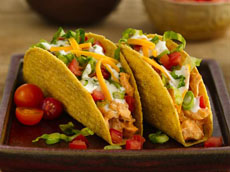
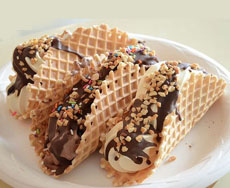
The first Tuesday in October is National Taco Day, and this year it coincides with Taco Tuesday. What does that mean? Tacos for breakfast? Definitely. We have a breakfast taco recipe for you (below). If you’re a taco lover, you’ve already had tacos for lunch and dinner. How about tacos for dessert? To put them all in one list, the year’s four taco holidays are: > The recipe for breakfast tacos. > More taco recipes: beyond the tried-and-true. > The history of the breakfast taco. > The history of Taco Tuesday. Elsewhere on The Nibble: > Bake hard taco shells from corn tortillas (so easy!). > The year’s 25+ Mexican and Tex-Mex food holidays. Elsewhere on The Nibble: > Bake hard taco shells from corn tortillas (so easy!). > The year’s 25+ Mexican and Tex-Mex food holidays. Surprisingly, the Aztecs did not invent the taco; nor did anyone else, until the 18th century. According to Professor Jeffrey M. Pilcher, author of Planet Taco: A Global History of Mexican Food, tacos are not an ancient food. Rather, as he discusses in an article in Smithsonian Magazine, Mexican silver miners in the 18th century likely invented the taco as a hand-held convenience food. Deriving its name from the “tacos” of gunpowder used to blast through rock, the humble miner’s fare was followed by taco carts and taquerías in the working-class neighborhoods of Mexico. As the taco spread throughout Mexico, each region added its own touches: meats, spices, salsas, and garnishes. Mexican Americans in the Southwest reinvented it. As late as the 1960s, tacos were virtually unknown outside Mexico and the American Southwest. In 1962, businessman Glen Bell founded Taco Bell as a drive-up with a few outdoor tables. It grew into a mass-marketing powerhouse, serving an Anglo version with a hard shell at quick-service restaurants nationwide. This hard pre-fried corn tortilla shell (photo #2) is not authentic. Like the burrito, a larger wheat flour tortilla, it was born in the U.S.A. Yet within 50 years the United States had shipped its hard taco shells worldwide, from Australia to Mongolia—redefining the taco in the eyes of millions, if not billions. Today the taco is an internationally beloved snack and meal, with an abundance of styles and varieties. You can invent your own “signature” taco. Ours is Japanese-style spicy tuna in a hard corn tortilla shell with a drizzle of wasabi mayonnaise. Along with diced onions, instead of diced tomatoes, we add diced mango. We make the mayo ourselves, to make it have more wasabi and less mayo. The process is the same: Just blend wasabi into mayonnaise until you reach your preferred degree of wasabi heat. See more creative spins below. This American event was begun in 1982 as a successful promotion by Taco John’s. It encouraged people to go out for tacos on Tuesday nights and offered specials like $1 fish tacos. Since tacos are easy to make at home and popular with the whole family, Taco Tuesdays are also a frequent event in home kitchens. While Taco John’s trademarked the name, other venues use the trademark but can receive “cease and desist” letters. Taco Tuesday has become such a part of American culture that we think Papa John’s should allow Taco Tuesdays for everyone! The history of the breakfast taco follows. |
|
|
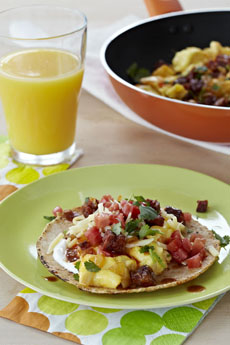
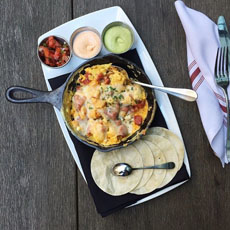
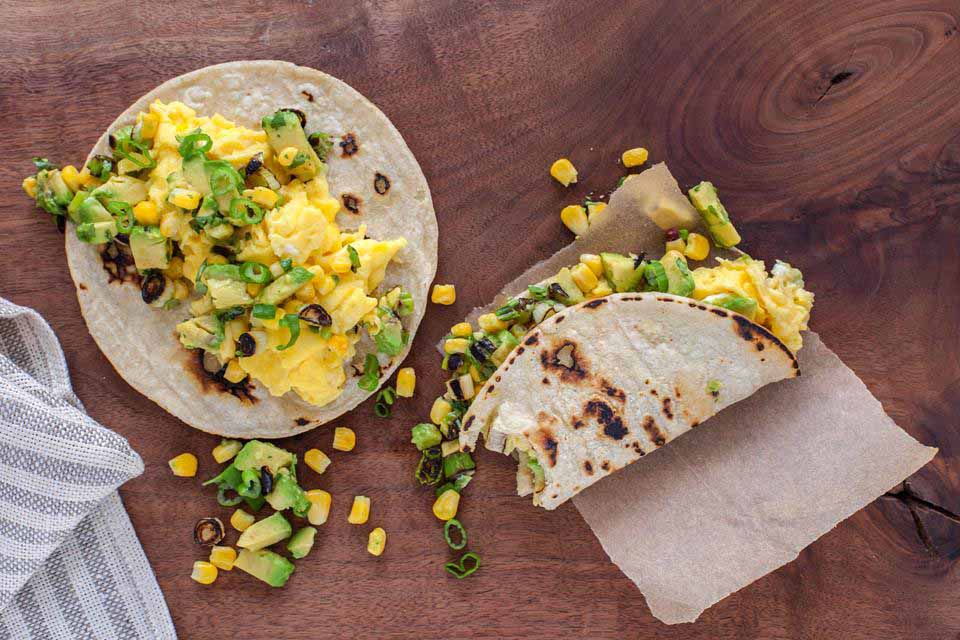
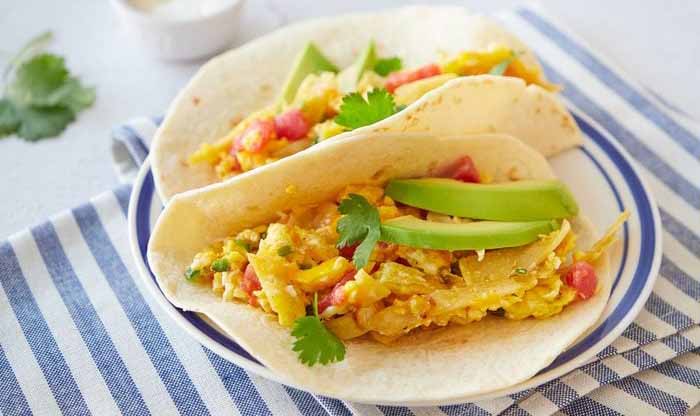
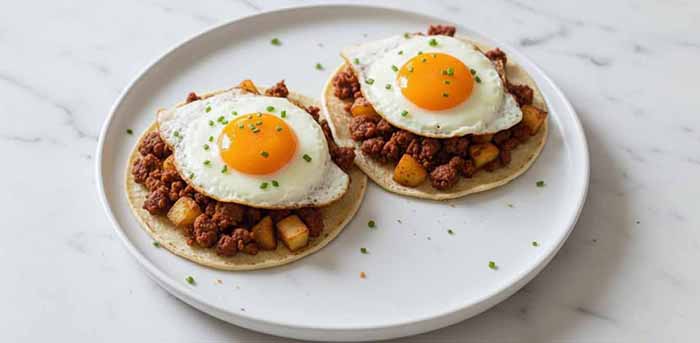 [7] Fried egg and chorizo breakfast taco. Here’s the recipe (Abacus Photo). THE HISTORY OF THE BREAKFAST TACO While the term “breakfast taco” is relatively modern, its roots go back 2,500 to 3,000 years when the indigenous people of Mesoamerica—Aztecs, Mayans, and others—wrapped food in thin, flat corn cakes called tlaxcalli. (The cultivation of the corn itself goes back much further*.) When the Spanish arrived in the 1500s, they renamed them tortillas (“little cakes”). Eventually, wheat was introduced to Northern Mexico and Texas. According to legend (and some historical records), Juan Garrido, an African conquistador and former slave of Hernán Cortés, found three grains of wheat in a bag of rice. Because wheat grew better in those arid climates than corn, the flour tortilla became the standard vessel for food in the borderlands. The “Pre-” Breakfast Taco Evolves In Northern Mexico & South Texas For centuries, families in Northern Mexico and South Texas ate eggs, beans, and leftover meats wrapped in tortillas for breakfast. It was portable, cheap, and filling. In the early 20th century, these “breakfasts” were mostly sold by “Chili Queens,” who made them at home. They weren’t called “breakfast tacos”; they were just breakfast. You’d simply ask for a “taco de huevo con chorizo” (egg and chorizo taco). The Breakfast Taco Arrives The modern breakfast taco exploded in the 1970s and 1980s when it transitioned from a home-cooked staple to a restaurant phenomenon. This led to a famous contention over bragging rights: Unlike the American-invented breakfast burrito, essentially an egg-and-sausage wrap sandwich, this recipe is truer to Mexican preparations. There’s a fight between Austin and San Antonio over the origin of the breakfast taco. At first, it was a breakfast made at home: eggs, sausage, or other pork and cheese, rolled in a warm tortilla. In Mexican kitchens, tortillas are a staple, like a loaf of bread. The concept then migrated to breakfast stands and restaurants, as far back as the 1950s. Thanks to IMUSA USA, a maker of kitchenware for global recipes—for this breakfast taco recipe. You can find more recipes on their website. 1. MIX the sour cream, lime juice, and salt in a bowl; put aside. 2. CHAR the tortillas over a gas flame or directly on an electric burner until blackened in spots, turning with tongs. Place in a tortilla warmer or aluminum foil and set aside. 3. ADD the olive oil to a nonstick sauté pan and bring to medium-high heat. Sweat the onions for about one minute and add the diced chorizo. Cook for 5-6 minutes until chorizo is browned. 5. ADD half of the cilantro and all of the cooked chorizo to the beaten eggs. Blend and pour into the pan. Cook on low heat, stirring from time to time. 6. PLACE the cooked eggs, cheddar, tomatoes, and remaining cilantro in separate bowls and lay them out throughout the table with the warm tortillas. Let everyone build their own. You may think that National Taco Day is a day to celebrate the classics; but as you do, put on your thinking cap and invasion the next great taco combination you can make. ________________ Around 500 B.C.E., archaeological evidence) shows that comales (flat clay griddles) were being used in regions like Oaxaca and Central Mexico, proving that people were flattening dough into thin discs and searing them over a fire. The oldest “tortilla” fossil dates to roughly 500 B.C.E. in the Valley of Tehuacán, but most anthropologists believe the practice was widespread long before it was captured in the fossil record. By the 14th-16th centuries C.E., the height of the Aztec (Mexica) Empire, the tlaxcalli (pronounced tlahsh-KAHL-lee), or corn tortilla, was an essential component of the Mesoamerican diet. It wasn’t just a side dish; it was a vessel and a utensil. In a society without metal forks or spoons, the tortilla was the “edible spoon.” Women spent hours every morning grinding nixtamalized corn on a stone tool called a metate. Bernal Díaz del Castillo, one of Hernan Cortez’ soldiers in the context of Mexico, wrote in his journals about the massive markets at Tlatelolco, describing dozens of varieties of tlaxcalli—some white, some yellow, some folded, and some filled with everything from beans and chili to turkey and small dogs! CHECK OUT WHAT’S HAPPENING ON OUR HOME PAGE, THENIBBLE.COM.
|
||