Cherry Almond Rugelach Recipe, History, & Much More
|
Cherry-themed recipes work both for Valentine’s Day (February 14th) and Washington’s Birthday (February 22nd, celebrated nationally on President’s Day, which falls this year on February 16th). National Rugelach Day is April 29th. There’s nothing better with a cup of tea or coffee than homemade rugelach. Try this recipe from QVC’s David Venable. Below: > David Venable’s cherry-almond rugelach recipe. > Is rugelach a pastry or a cookie? > Rugelach’s relatives: similar cookies/pastries. Elsewhere on The Nibble: > The 10 different styles of cookies. > The different types of cookies: a photo glossary. > The year’s 44 cookie holidays. Ingredients For 64 Cookies 1. MAKE the dough: Cut the cream cheese, butter, and almond paste into bits. Pulse the cream cheese, butter, almond paste, and flour in a food processor until crumbly. Place the mixture onto a working surface and knead the dough together. Shape it into 4 equal disks, wrap each in plastic wrap, and chill for 2 hours or up to 2 days. |
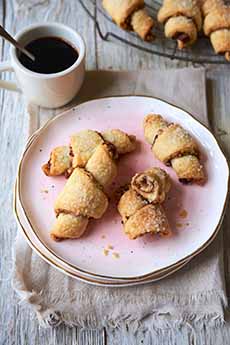
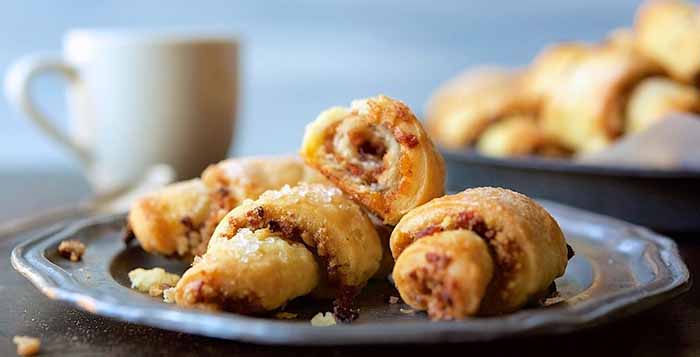
 [1] Cherry almond rugelach (photo © QVC).
|
|
|
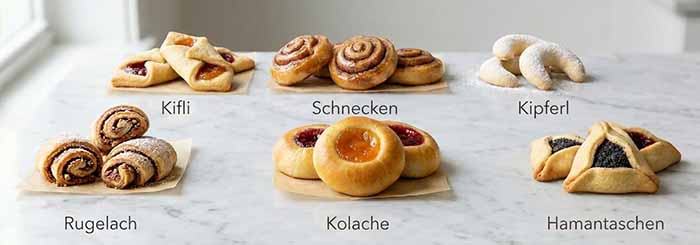
2. PREPARE the filling: Place the cherries, brandy, and water in a small saucepan and simmer over medium-low heat until all the liquid has been absorbed. Remove the pan from the heat. When the mixture has cooled to room temperature, place the cherries, sugar, and cinnamon in the bowl of a food processor and purée until smooth. Transfer the mixture to a small mixing bowl and fold in the almonds. Set aside. 3. MAKE the cookies: Preheat the oven to 350°F. On a well-floured work surface, roll 1 disk into a 12″ round (be sure to keep the other disks chilled until ready to roll). Spread a quarter of the cherry mixture over the dough, leaving a 1/2″ border. With a chef’s knife or pizza cutter, cut each round into 12 wedges. Roll the wedges from wide to narrow, so you end up with a point on the outside of the cookie. Repeat with remaining discs of dough. 4. PLACE the cookies on ungreased baking sheets and chill the rugelach for 20 minutes. Brush each cookie with egg and sprinkle with sanding sugar. Bake for 30 minutes, or until golden brown. 5. COOL and store in an airtight container. Rugelach (pronounced RUH-guh-lach, with that throat-clearing “ch” in the back of the upper palate), a traditional European (Ashkenazi) Jewish pastry, is a small crescent-shaped or square-cut cookie (or pastry—see the discussion below) made of cream cheese dough with a filling—originally nuts, raisins, and cinnamon. Its name comes from the Yiddish “rugel,” or royal, and it goes by other names such as kipfel (in Hungary and the Czech Republic) and horns of plenty (in non-Jewish areas of the U.S., where people “rugelach” may not sound as appetizing). The traditional shape is the crescent, but the square cut is equally popular. Since rugelach was made in perhaps a dozen European countries by bakers who spoke a dozen different languages, it has been variously spelled rugelah, rugalah, rugelach, rugalach, rugulah, ruggelach, and ruggalach (in other words, you can ask people to spell it, and they have an excellent chance of getting it right). We have even seen “rugala,” from a New York City baker. In Europe the dough was made with butter, sometimes with sour cream added. A circle of dough was covered with a mixture of nuts, raisins, sugar, and cinnamon; then cut into wedges, and the wedges were rolled up into crescents. Rugelach evolved when it immigrated to America. Cream cheese was added to the dough. The Food Timeline, a historical reference source, says the cream cheese rugelach recipe may have been developed by the Philadelphia Cream Cheese Company, which sounds like a good bet. In the land of infinite possibilities, countless flavor variations were developed by creative bakers. Today, in addition to the original raisin and nut filling, apricot, cherry, and raspberry preserves are the most popular, plus chocolate (the latter creating, in effect, the Jewish version of pain au chocolate). The cream cheese dough is, to our palate, the foundation of great rugelach. It imparts a special flavor that, along with the burst of fruit, nut, or chocolate filling, makes rugelach such a unique pastry (plus its beautiful balance—a rich and satisfying pastry that is not particularly sweet). While the ingredients are simple (flour, sugar, butter, cream cheese, an egg, spices, and filling), so many rugelach are disappointing: inferior ingredients*, margarine instead of butter, dough with not enough cream cheese, or no cream cheese at all. More often than not we encounter the seven deadly sins of rugelach: bland, dry, doughy, oily, too sweet, not sweet enough, and…dearth of cream cheese. If you haven’t had rugelach before, when should you serve them? While they are cookie-size, they are more related to Danish pastry (think Danish at the Ritz, not the deli variety); so you can serve them whenever you would serve either cookies or breakfast pastry. This gives you carte blanche from breakfast through dinner, and all snacks in-between. Although not well-known, savory rugelach is a recent offshoot—a late-20th-century innovation—by a creative American baker (we can’t find out exactly who). A 1997 print attribution reveals a user-submitted recipe on Food.com and says it was “Found…in a 1997 Southern Living ‘Home for the Holidays’ publication.” The recipe has a pesto filling with basil, Parmesan, garlic, olive oil, pine nuts. It’s the earliest citation we could find to show that savory rugelach existed in mainstream American by the late 1990s. Here’s the recipe. More recently, one baker wrote: “I refuse to let my rugelach filling be constrained by sweet flavors alone. Go savory with green olive tapenade, harissa, or any other jammy pastes (hello,‘nduja!), then add nuts and bread crumbs for texture” [source]. And King Arthur Baking, one of our favorite reference sources, has this article on baking savory rugelach. Some of its suggestions: This is an ongoing culinary debate! The answer is: rugelach can honestly fall into both categories, although since it’s a finger food (no fork required), we at The Nibble call it a cookie. The classification varies depending on who you ask. In American Jewish bakery tradition, rugelach has long been sold and categorized alongside cookies: in the bakery showcase, on cookie trays, in cookie tins, and at holiday cookie exchanges. Technically, rugelach has a lot more in common with pastry than a typical cookie: Whether you’re Team Cookie or Team Pastry, at the end of the day you’re on Team Rugelach, and in for some delicious nibbling. Rolled, filled pastries and cookies belong to a family found across many cultures. If we had to pick the most similar, kipferl/kifli† and schnecken are the nearest cousins, sharing the same Eastern/Central European heritage, cream cheese-based dough, and nut or fruit fillings that almost certainly influenced rugelach as Ashkenazi Jews adapted local baking traditions to their own cuisine.Here are some delicious relatives: *Quality counts: One can buy flour, sugar, butter, preserves, etc., of average quality, or one can buy the best. It costs more to bake with top flours like King Arthur, organic eggs, and Cabot butter, e.g., or to use Valrhona chocolate instead of supermarket-brand chocolate morsels. †Kipferl is confusing. The confusion is completely understandable because the terms for these pastries overlap across different Eastern European cultures, and the names often describe either the shape or the dough depending on whom you ask. Both are correct, but they represent different traditions of the same culinary family: > The Crescent Shape (Vanillekipferl) in the photo, covered with powdered sugar, is called kipferl, specifically Vanillekipferl (vanilla crescent), in Austria and Germany. The dough usually contains ground nuts almonds or hazelnuts and is heavily dusted in vanilla sugar. > The Folded Shape (Kifli/Kolaczki). The folded pastry in the top left of the photo is popular in Hungary, Poland, and the Czech Republic. However, it’s often called kipferl or kolache in the U.S.—just type the word “kipferl” into Google Images and see what comes up. This gets confusing. They are often called kifli (or kiffles in the U.S.), which is the Hungarian word for crescent. More confusion: In Hungary, many bakers roll that same dough into crescents. What it is: A square piece of dough (often a cream cheese or sour cream dough) with jam in the middle, where two opposite corners are folded over each other to form a “bow tie” or “envelope” shape. In Poland, these are almost always called kolaczki (or kolacky). They are practically identical to the Hungarian kiffle in ingredients but are more strictly associated with the folded square shape. Back to photo #7, the white shape at the top right is the Austrian crescent cookie. The folded “bow tie” filled with jam on the left side of the top row is the Polish/Hungarian style. CHECK OUT WHAT’S HAPPENING ON OUR HOME PAGE, THENIBBLE.COM. |
||