What Is Quark Cheese? A Creamy, Slightly Tart Fresh Cheese
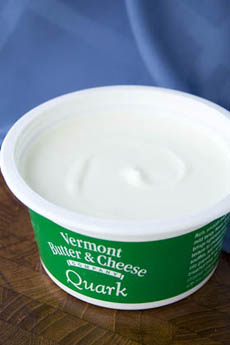
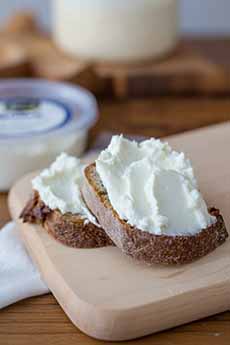
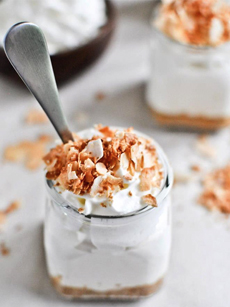 [1] Quark can be eaten like yogurt or used as a bread spread and in recipes (photo © Vermont Creamery).
|
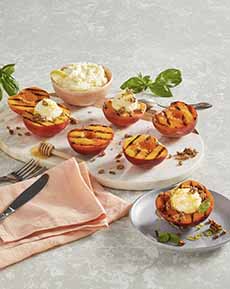
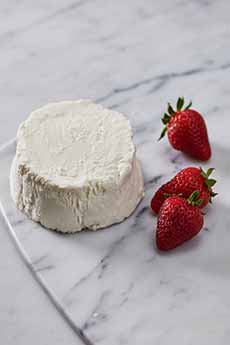
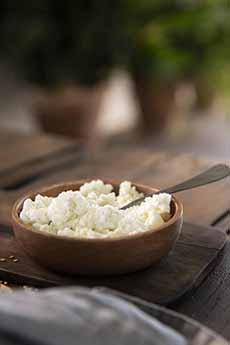
If you like yogurt—or even if you don’t—try Quark cheese. Depending on who makes it, it’s smooth and creamy like Greek yogurt or sour cream, or more firm like cream cheese. All textures are delish! In fact, Quark has approximately the same amount of calories, but a richer flavor, than low-fat sour cream. So it’s a real find for your baked potato and chili. Everything you need to know about Quark follows including Elsewhere on The Nibble, you’ll find: > The different types of cheese: a glossary. January 19th is World Quark Cheese Day. > The year’s 30 cheese holidays. > Other fresh cheeses including crème fraîche, fromage blanc, labné, mascarpone, and queso fresco. Quark is a soft, unripened (fresh) cow’s milk cheese. It’s traditionally used in both savory and sweet dishes: spread on bread, used in cheesecakes, mixed into dips, or eaten with fruit and honey. In North America, the recipe is almost identical to fromage blanc, except that fromage blanc is totally fat-free. Some American producers compare it to soft cream cheese. Others call is a cross between sour cream and ricotta. And others describe it as similar to farmer’s cheese or cottage cheese. Whatever the descriptor, Quark has a creamy texture and a slightly tart taste, similar to a mild sour cream. While it has yet to take off in the U.S., Quark is so popular in Germany that it accounts for almost half of that country’s total cheese production: The average German eats about 10 pounds of Quark a year. In German, it’s pronounced “kvarg.” You can find Quark in every German market. But it’s a different style than American Quark (details below). In other parts of Europe, Quark is also known as koarg, kwark, qwark, quarg, twarog, saurmilchquark, speisequark and fromage frais. In the U.S. and Canada, Quark has yet to catch on. It’s only made by artisan dairies, and some dairies make 2% and fat-free versions in addition to full-fat Quark. The next time you see it, take it home and see how it enriches your daily dining. If you can’t find it locally, you can buy it online. At Vermont Creamery, Quark is made from cow’s milk that is coagulated overnight into fresh curd, using lactic acid or rennet to curdle the milk. The next day, the curds are drained in cheesecloth and whipped with a trace of crème fraîche. Other producers add a small amount of cream. The cheese is high in protein and often salt-free; while it’s naturally lowfat, there are nonfat versions as well. Cheesemakers start by curdling milkThe curds are heated and stirred continuously to prevent hardening as it thickens. The final product is a white, soft cheese that is sold and served without aging. It’s important to note that in the U.S., which does not have a tradition of making Quark, the artisans who have been making it for the last 20 years or so have developed their own recipes. As a result, Quark can have the soft consistency of yogurt through the semi-firm consistency of cream cheese. Quark has been made in German-speaking regions for centuries, although its exact origins are difficult to pinpoint. The tradition of making fresh cheeses from soured milk goes back to ancient times across Europe, but quark as we know it became particularly associated with German, Austrian, and Eastern European cuisine. Historical records suggest it’s been a staple food in these regions since at least the Middle Ages, valued for being an accessible source of protein that didn’t require the aging process of harder cheeses. The word quark comes from the German (and related Slavic languages), where it refers to this type of fresh curd cheese. The term is believed to derive from the Slavic word tvarog (which refers to the same food). The dairy product name likely came through West Slavic languages into German. In German, “Quark” can also colloquially mean “nonsense” or “rubbish,” although this meaning is unrelated to the cheese. Although it’s been a kitchen staple in Germany, Poland, Russia, and neighboring countries for generations, quark remained relatively unknown in English-speaking countries until recent decades. In 1963, physicist Murray Gell-Mann took the word from James Joyce’s novel “Finnegans Wake,” a reference to the sentence, “Three quarks for Muster Mark,” since the hypothetical particles came in threes. He later connected it to the sound of the German word for cheese curd, quark—a happy coincidence, as the particles’ role as fundamental building blocks of matter mirror the “curd” idea. Here’s a full discussion. Quark is the German word for curds; curds are coagulated milk. Some definitions translate it as “cottage cheese.” However, neither American nor European quark resembles what Americans know as cottage cheese, with recognizable curds. With quark, the curd consistency is smooth, like curdled milk (see photo below). In Europe, some or most of the whey is removed by hanging the quark in cheesecloth and letting the whey drip off, to achieve the desired thickness. This gives artisan (handmade) European quark its distinctive shape of a wedge with rounded edges (photo #5). In commercial production it is formed into blocks with the consistency of ricotta or pot cheese. In the United States and Canada, quark can be a somewhat different product, most often sold in plastic tubs with most or all of the whey. This creates a style that has the texture of yogurt or sour cream: a denser, more spreadable consistency (photo #3). And then, there’s the texture that looks like cream cheese (photo #6) and the one that resembles cottage cheese (photo #7). The texture of domestic quarks varies by the preference of the producer. Your task: Try as many different brands as you can, to see which you like the best. Both European and American styles are eaten the same way. Quark can be eaten directly like yogurt or sour cream, or substituted in recipes that use them. Quark is so versatile, it can do almost anything and adds creamy flavor anywhere. You can use it as is: |
|
|
Wine Pairings: *In German, Quark and Topfen, the names of cheeses, are also used to mean “nonsense.” This latter usage is believed to be an inspiration for the passage written by James Joyce in his fanciful novel, Finnegan’s Wake: “Three quarks for Muster Mark!/Sure he hasn’t got much of a bark/And sure any he has it’s all beside the mark.” This excerpt is from a 13-line poem directed against King Mark, the cuckolded husband in the Tristan and Isolde (Iseult) legend. The use of the word “quark” to describe elementary particles of matter was taken from this poem by Murray Gell-Mann, the physicist who received the 1969 Nobel Prize for his work in classifying quarks. The allusion to three quarks seemed perfect to him, since originally there were only three subatomic quarks. CHECK OUT WHAT’S HAPPENING ON OUR HOME PAGE, THENIBBLE.COM. |
||